

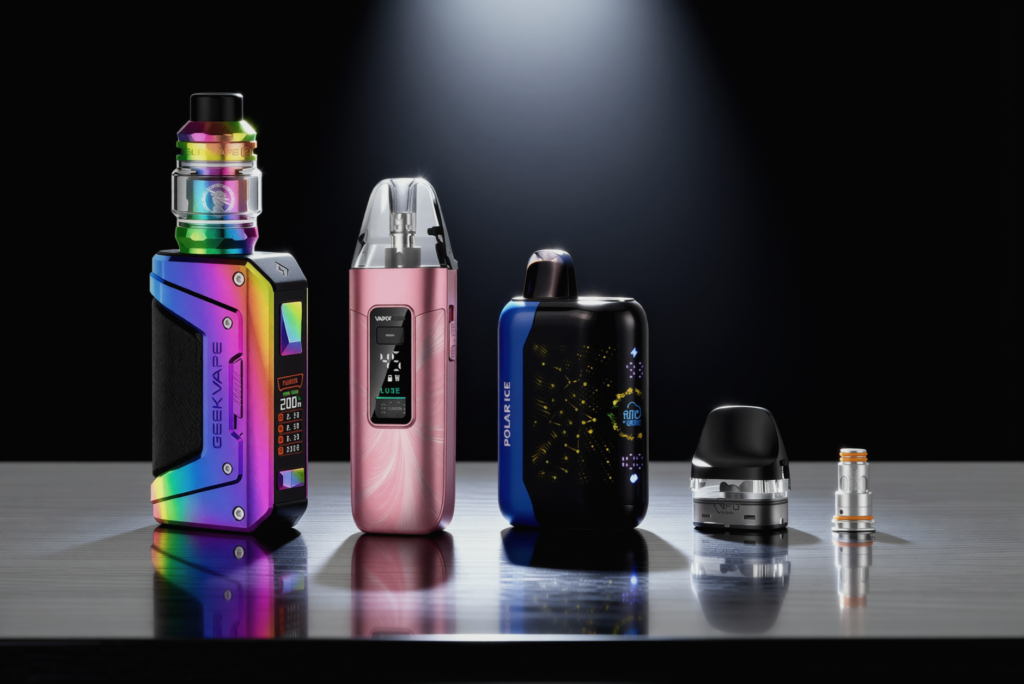
If you are new to vaping (whether you are a smoker looking to switch, or just curious about how vaping works), this guide covers what you need to know. No fluff, no sales pitch. We walk through how vapes actually work, the four main device types, how to choose nicotine strength, what flavors to start with, how to maintain your device, and the safety basics every new vaper needs. Each section links to our detailed standalone guides if you want to go deeper.
Key Takeaways
- Vaping works by heating e-liquid into an inhalable aerosol using a battery-powered coil : no combustion, no smoke, no tar
- Four device types dominate the market: disposables, pod systems, vape pens, and box mods. Beginners should start with disposables or pod systems
- Nicotine strength matters. Smokers switching from cigarettes should match their nicotine intake; non-smokers should avoid nicotine entirely
- 6.5% of U.S. adults used e-cigarettes in 2023, up from 3.7% in 2022, with the highest usage among adults aged 18–25
- Safety is non-negotiable. Buy from authorized retailers, avoid counterfeit products, and understand battery basics if you use a rechargeable device
- PG vs VG ratios
- nic salt vs freebase
What Is Vaping and How Does It Work?
Vaping is the act of inhaling and exhaling the aerosol (commonly called vapor) produced by an electronic cigarette or similar device. Unlike traditional cigarettes, vapes do not burn tobacco. Instead, a battery-powered heating element (the coil) heats a liquid, called e-liquid or vape juice, until it turns into an aerosol that you inhale.
Every vape device has three core components:
| Component | What It Does |
| Battery | Powers the device; either built-in (disposables, pod systems) or removable (box mods) |
|---|---|
| Coil/Atomizer | Heating element that vaporizes the e-liquid; wears out over time and needs replacement |
| E-liquid reservoir | Holds the vape juice; can be a pre-filled pod, a built-in tank (disposables), or a refillable tank |
When you activate a vape (either by pressing a button or simply inhaling, depending on the device), the battery sends power to the coil, which heats up and turns the e-liquid into vapor. That is the entire mechanism.
For a deeper look at the science behind what you are inhaling, see our guide on what chemicals are in vapes.
The Four Types of Vape Devices
Not all vapes are the same. The device you choose shapes your entire experience : flavor quality, nicotine delivery, maintenance level, and cost. Here is how the four main categories compare:
1. Disposable Vapes
Disposable vapes are single-use devices that come pre-filled with e-liquid and pre-charged. You use them until the e-liquid or battery runs out, then throw the entire device away.
Best for: Complete beginners who want the simplest possible entry point.
| Pros | Cons |
| Zero setup. Open the box and vape | Most expensive per-puff over time |
| No maintenance, charging, or refilling | Limited flavor options per device |
| Wide availability at convenience stores | Environmental waste concern |
| Low upfront cost ($5–$25) | Cannot adjust nicotine or airflow |
For our top picks, see the best disposable vapes and our guide on why disposables are the best starting point for beginners.
2. Pod Systems
Pod systems are compact, rechargeable devices that use replaceable pods instead of tanks. Pods come either pre-filled (closed system) or empty for you to fill yourself (open system).
Best for: Beginners who want a reusable device with better long-term value.
| Pros | Cons |
| Reusable device, replaceable pods | Need to charge and replace pods |
| Better flavor and vapor than disposables | Slightly more complex than disposables |
| Lower cost per puff vs. disposables | Fewer flavor options than refillable tanks |
| Compact and pocket-friendly | Limited power and customization |
3. Vape Pens
Vape pens are pen-shaped devices with a refillable tank and a replaceable coil. They offer more power and vapor production than pod systems, with the ability to choose any e-liquid.
Best for: Beginners who want more control over their vaping experience and do not mind a bit of maintenance.
| Pros | Cons |
| Refillable with any e-liquid | Need to refill and change coils |
| Better vapor production | Larger than pod systems |
| More affordable long-term | Requires some basic maintenance |
| Adjustable airflow on many models | Learning curve for new users |
4. Box Mods
Box mods are the most powerful and customizable vape devices. They feature removable batteries, adjustable wattage/temperature, and large refillable tanks. Some use sub-ohm tanks for massive cloud production.
Best for: Experienced vapers. Not recommended for beginners.
| Pros | Cons |
| Maximum power and vapor production | Bulky and heavy |
| Full customization (wattage, temp, airflow) | Steep learning curve |
| Removable batteries for all-day use | Requires battery safety knowledge |
| Best flavor from high-end tanks | Most expensive upfront |
How to Choose Your First Vape
For most beginners, the decision comes down to disposable vs. pod system. Here is a simple framework:
| Your Situation | Recommended Device | Why |
| Just want to try vaping | Disposable | Lowest commitment, zero setup |
| Switching from smoking | Pod system (closed) | Consistent nicotine delivery, cigarette-like draw |
| Want to save money long-term | Pod system (open) or vape pen | Refillable = much lower cost per puff |
| Interested in flavors and clouds | Vape pen | Refillable tank = unlimited e-liquid choices |
Budget reality check: A $15 disposable that lasts 2–3 days costs roughly $150–$225/month. A $30 pod system with $15 worth of pods per week costs roughly $90/month. The savings compound fast.
Understanding E-Liquid (Vape Juice)
E-liquid is what gets vaporized. Every e-liquid contains some combination of these ingredients:
| Ingredient | Purpose | Safety Note |
| Propylene Glycol (PG) | Carries flavor; provides throat hit | Generally recognized as safe for ingestion; long-term inhalation effects still being studied |
|---|---|---|
| Vegetable Glycerin (VG) | Produces vapor clouds; adds sweetness | Same safety profile as PG |
| Nicotine | Satisfies cravings; addictive | Highly addictive; not recommended for non-smokers |
| Flavorings | Provides taste | Food-grade flavorings, but inhalation safety differs from ingestion safety |
PG/VG Ratio
The ratio of PG to VG affects your vaping experience:
- High PG (50/50 or 60/40): Stronger throat hit, thinner vapor, better flavor clarity. Preferred by smokers transitioning from cigarettes
- High VG (70/30 or 80/20): Smoother throat hit, thicker vapor clouds, slightly muted flavor. Preferred by cloud chasers and sub-ohm vapers
- 50/50: The most common middle ground. Works well in pod systems and vape pens
Nicotine Strength Guide
Choosing the right nicotine strength is one of the most important decisions for a new vaper. Too little and you will not be satisfied; too much and you may feel nauseous or dizzy.
| Nicotine Strength | Who It Is For | Equivalent (Approximate) |
| 0 mg/mL | Non-smokers; vapers who have quit nicotine | N/A |
|---|---|---|
| 3 mg/mL | Light smokers (< 10 cigarettes/day) | Very low |
| 6 mg/mL | Moderate smokers (10–15 cigarettes/day) | Low |
| 12 mg/mL | Heavier smokers (15–20 cigarettes/day) | Medium |
| 20 mg/mL (max in UK/EU) | Heavy smokers (20+ cigarettes/day) using MTL devices | High |
| 50 mg/mL (salt nicotine) | Heavy smokers using pod systems | Very high (but smoother due to salt formulation) |
Nicotine salts are a specific type of nicotine that is smoother at high concentrations, making 25–50 mg/mL tolerable in pod systems. Freebase nicotine at those levels would be extremely harsh. For more details, see our complete guide on how much nicotine is in a vape.
Choosing Your First Flavor
Flavor is the most personal part of vaping. Here are the main categories:
| Category | Examples | Best For |
| Tobacco | Classic tobacco, Virginia, Cuban blend | Smokers who want a familiar taste |
|---|---|---|
| Menthol/Mint | Peppermint, spearmint, ice blends | Smokers who preferred menthol cigarettes |
| Fruit | Mango, strawberry, blueberry, watermelon | Most popular category; wide appeal |
| Dessert | Vanilla custard, cheesecake, cookie | Sweet-tooth vapers |
| Beverage | Coffee, cola, lemonade | Variety seekers |
| Nicotine-free | Same flavors, 0 mg/mL nicotine | Non-smokers or former vapers stepping down |
For our top picks for new vapers, see the top 5 vaping flavors for beginners.
How to Vape: Your First Puff
If You Are Using a Disposable
- Remove the device from its packaging
- Remove any rubber stoppers from the mouthpiece or airflow holes
- Put the mouthpiece to your lips
- Take a slow, steady draw for 2–3 seconds
- Inhale into your lungs (or hold in your mouth first if you prefer)
- Exhale
That is it. No buttons. No settings. For more details, see our how to vape guide.
If You Are Using a Pod System
- Charge the device fully before first use
- Insert a pod into the device
- Wait 5 minutes after filling a new pod (if refillable) to let the coil saturate
- Activate by inhaling (draw-activated) or pressing the fire button
- Take slow, gentle draws. Do not pull hard like a cigarette
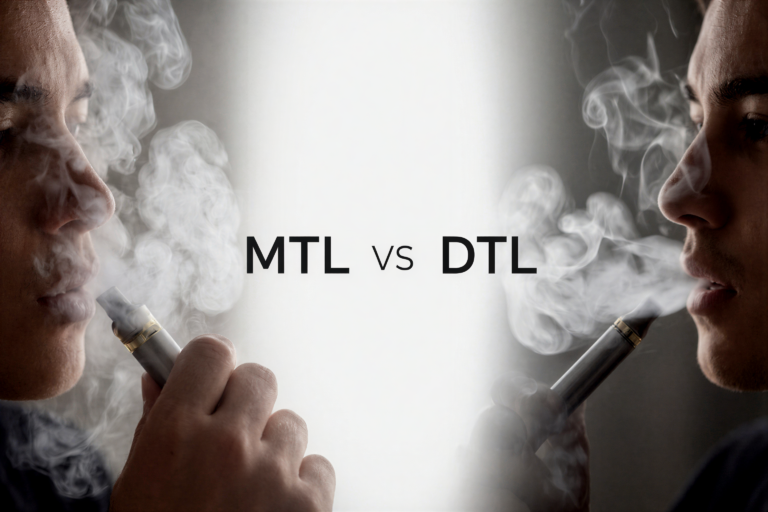
MTL vs. DTL: Two Vaping Styles
| Style | How It Works | Best Device | Similar To |
| MTL (Mouth-to-Lung) | Draw vapor into your mouth first, then inhale to lungs | Pod systems, disposables, vape pens | Smoking a cigarette |
|---|---|---|---|
| DTL (Direct-to-Lung) | Inhale vapor directly into your lungs in one smooth draw | Sub-ohm tanks, box mods | Taking a deep breath |
Most beginners should start with MTL. It feels more natural if you are coming from smoking and works best with the nicotine strengths recommended above.
Vaping vs. Smoking: What the Evidence Says
This is the question most beginners ask first. Here is what the current evidence says:
- Public Health England (now the Office for Health Improvement and Disparities) has consistently stated that vaping is “a fraction of the risk of smoking”. Their 2015 landmark report estimated vaping is around 95% less harmful than smoking
- The Royal College of Physicians (2016) concluded that the hazard to health arising from long-term vapor inhalation from e-cigarettes is unlikely to exceed 5% of the harm from smoking tobacco
- The Cochrane Review (2024 update) found high-certainty evidence that nicotine e-cigarettes help people stop smoking more than nicotine replacement therapy or nicotine-free e-cigarettes
- However: Vaping is not harmless. The long-term health effects of inhaling vaporized PG, VG, and flavorings over decades are not yet known, because the products have not existed long enough for long-term studies
For a deeper look at the evidence, see our analysis of whether vaping can help you quit smoking and whether it is better to smoke or vape.
Vaping Safety Basics
Buy Authentic Products
Counterfeit vapes are a real and growing problem. In 2025, U.S. federal agencies seized 4.7 million illegal e-cigarettes worth $86.5 million. That represents only a fraction of the counterfeit market. Fake vapes can contain unknown chemicals, inconsistent nicotine levels, and unsafe batteries.
Always verify your products. See our complete guide to spotting fake vapes.
Battery Safety (For Rechargeable Devices)
If you use a device with a removable battery (box mods, some vape pens):
- Never carry loose batteries in your pocket. Use a battery case
- Do not charge batteries unattended or overnight
- Replace batteries that show visible damage, dents, or torn wrapping
- Use the charger that came with your device, not a phone charger
- Buy batteries from reputable brands (Sony/Murata, Samsung, LG)
Nicotine Safety
- Non-smokers should not start vaping with nicotine. Nicotine is highly addictive, and there is no health benefit to starting
- Keep all vaping products away from children and pets. Nicotine is toxic in high doses
- If you feel dizzy, nauseous, or get a headache while vaping, stop immediately. These are signs of nicotine overconsumption
- See our guide on how nicotine in e-cigarettes affects the body
Zero-Nicotine Options
If you want the experience of vaping without the addiction risk, zero-nicotine vapes exist. They contain the same PG/VG/flavoring but no nicotine. Learn more about whether nicotine-free vapes are safe and the benefits of zero-nicotine disposables.
Vaping Laws and Regulations (U.S. Focus)
| Regulation | What It Means |
| Federal minimum age: 21 | You must be 21 or older to purchase any vaping product in the U.S. |
|---|---|
| FDA PMTA requirement | All vaping products must have a Premarket Tobacco Application on file with the FDA to be legally sold |
| Flavor restrictions | Some states and cities have banned flavored vape products; federal rules are evolving |
| Online sales restrictions | Online retailers must verify age before shipping |
| Travel restrictions | Vape devices cannot be placed in checked luggage on flights. Carry them in your cabin bag only |
For the latest on how regulations are changing, see our coverage of FDA authorization of flavored vapes and vape bans around the world.
Common Beginner Mistakes (and How to Avoid Them)
| Mistake | Why It Is a Problem | What to Do Instead |
| Choosing nicotine that is too high | Nausea, dizziness, headaches | Start at 3–6 mg/mL (freebase) or 20 mg/mL (salt); adjust from there |
|---|---|---|
| Chain-vaping | Nicotine overload; coil burns out faster | Take breaks between puffs; 5–10 puffs per session is plenty |
| Not priming a new coil | Dry hits (burnt taste that ruins the coil) | Wait 5 minutes after installing a new coil before vaping |
| Buying from sketchy sources | Counterfeit products with unknown ingredients | Buy from authorized retailers; verify authenticity codes |
| Ignoring battery safety | Risk of battery failure or explosion | Use the correct charger; do not carry loose batteries |
| Expecting vaping to taste like a cigarette | Disappointment and relapse to smoking | Vaping tastes different; give it a week to adjust |
Your First Week: A Practical Timeline
| Day | What to Do |
| Day 1 | Buy a disposable or basic pod system. Try a tobacco or menthol flavor if switching from smoking. Take 5–10 puffs when you would normally have a cigarette. |
|---|---|
| Day 2–3 | Notice when you crave a cigarette vs. when you crave a vape. Use the vape to bridge the gap. Do not stress if you still smoke some cigarettes. |
| Day 4–5 | Try a fruit or dessert flavor if you are finding tobacco/menthol boring. Experiment with your draw technique. Slow and steady works best. |
| Day 6–7 | Evaluate: Are you reaching for the vape more than cigarettes? If yes, you are on track. Consider upgrading to a pod system for cost savings if you plan to continue. |
Where to Go From Here
This guide covers the fundamentals. When you are ready to go deeper, these resources will help:
Device Guides:
- What Is a Disposable Vape?. Types, lifespan, and how they work
- Pod System Vapes: Authoritative Guide. Everything about pod devices
- What Are Vape Pens?. Complete guide to pen-style devices
- Box Mods and Kit Vapes (for when you’re ready for advanced devices)
Health and Safety:
- Alarming Facts About Vaping. What the latest research shows
- How Nicotine Affects the Body. The science behind nicotine
- How to Spot a Fake Vape. How to spot fakes
For Smokers Considering the Switch:
- Can Vaping Help You Quit Smoking?. What the evidence actually says
- Disposable to Refillable Transition Guide (when you’re ready to upgrade)
Last updated: May 10, 2026
Related Articles
- Are Nicotine Free Vapes Safe
- Best Disposable Vapes
- How Long Does a Vape Last
- Mtl vs Dtl Vaping
- Why is my Disposable Vape Blinking And How to Fix it
- 2025 Beginner’s Guide to Disposable Vapes (everything beginners need to know about disposable vapes)


Build your vape knowledge
Read more guides
Find explainers, how-to articles and reference material.
Open guide library →Compare vape products
Check specifications across the product database.
Open product data →Read hands-on reviews
See tested devices and documented trade-offs.
Read review coverage →