

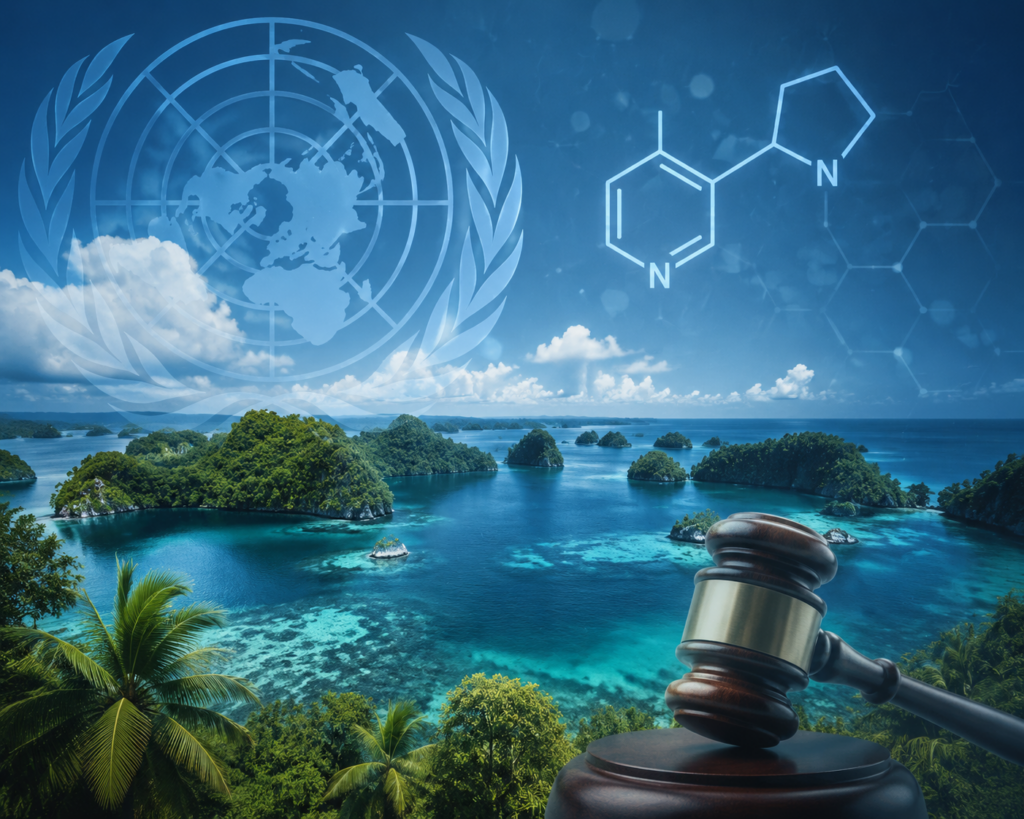
The Republic of Palau formally notified the United Nations Secretary-General on June 10, 2026 under Article 2 of the 1971 UN Convention on Psychotropic Substances, initiating a process that could classify nicotine as an internationally controlled substance. The WHO Expert Committee on Drug Dependence will conduct a critical review starting late 2026, with a recommendation expected by October 2027 and a UN Commission on Narcotic Drugs vote targeted for March 2028.
The proposal targets nicotine in its non-tobacco forms (as used in vapes, nicotine pouches, inhalers, and NRT products) while explicitly exempting tobacco and medical nicotine uses. Tobacco harm reduction expert Clive Bates described the initiative as “the worst idea in the history of tobacco control,” noting it constitutes a frontal attack on non-pharmaceutical nicotine alternatives used for smoking cessation.
The Palau government argues that regulating nicotine at the molecular level addresses the problem at source, since new delivery systems (pouches, synthetic nicotine, novel devices) fall outside existing regulatory frameworks. The WHO-ECDD evaluates substances on four criteria: dependence potential, abuse risk, threat to public health, and therapeutic usefulness. The FDA Center for Tobacco Products has previously determined that nicotine itself, when separated from combustion, presents substantially lower health risks than smoking.
If nicotine is internationally scheduled, countries that are signatories to the 1971 UN Convention would be required to control nicotine production, distribution, and possession under their domestic drug laws. This could effectively ban all non-medical nicotine products (including vapes, nicotine pouches, and snus) except when sold as pharmaceutical smoking cessation aids.
The experience of countries that have restricted safer nicotine products shows likely consequences. Australia’s approach, where nicotine products face heavy restrictions, has produced a $7 billion illicit market with contaminated products. THR experts warn the same pattern would repeat globally if scheduling passes.
Harm Reduction Stakes
The central scientific question is whether nicotine itself (separated from tobacco combustion) warrants international drug scheduling. Nicotine is addictive but its risk profile is comparable to caffeine. It is not the direct cause of smoking-related cancers, heart disease, or respiratory problems. Combustion creates the carcinogens and toxins that kill millions of smokers annually.
Recent Global State of Tobacco Harm Reduction research highlights that people with drug use problems have smoking rates two to four times higher than the general population. THR advocates argue that scheduling nicotine would harm exactly those groups by pushing them toward combustible tobacco.
The WHO-ECDD review is expected to begin in late 2026, with a window for stakeholder input. Harm reduction organizations including GSTHR and the Global Forum on Nicotine are coordinating responses. Vapers and industry stakeholders should monitor the ECDD process and submit evidence during the review period. The CND vote in March 2028 will be the decisive moment: national governments and public health bodies will need to take positions well before that date.


Follow the wider vape market
Read the latest vape news
Track regulation, launches and industry updates.
Open vape news →Browse product data
Move from market news to device specifications.
Open product data →Check product reviews
Read independent testing and comparison reports.
Read review coverage →