

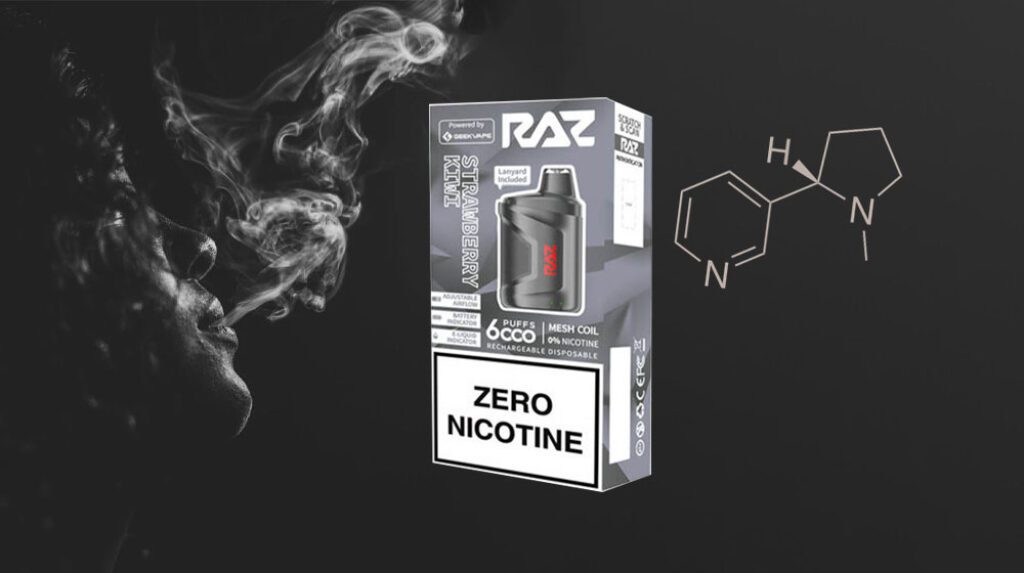
A lot of people assume that removing nicotine from a vape removes the risk. It doesn’t.
The question “are nicotine-free vapes safe” has a short answer and a long one. The short answer: no, they are not risk-free. The long answer requires understanding what’s actually in a 0mg vape and what happens when you heat and inhale those ingredients.
Let’s walk through what the evidence shows, including some 2025 studies that changed the picture.
What’s actually in a nicotine-free vape?
A nicotine-free vape contains the same base ingredients as a regular vape, just without the nicotine. That means:
| Ingredient | What it does | What happens when heated |
|---|---|---|
| Propylene glycol (PG) | Carries flavor, creates throat hit | Decomposes into formaldehyde, acetaldehyde, methylglyoxal |
| Vegetable glycerin (VG) | Produces vapor clouds | Decomposes into acrolein, formaldehyde |
| Flavoring chemicals | Taste (varies by product) | Can form VOCs and other degradation products |
| Heavy metals | Not an ingredient , leaches from device | Released into aerosol from coils and solder |
Notice what’s missing: nicotine. But notice what’s still there: everything else. The base liquids, the flavorings, the thermal byproducts, the metal contamination. These don’t disappear just because the nicotine does.
If you want the full breakdown of what chemicals are in vapes and how they form, see our detailed examination of e-cigarette ingredients.
The big 2025 finding: nicotine-free vapes still damage blood vessels
This is the study that should change how people think about 0mg vapes.
A 2025 systematic review published in the Journal of Clinical Medicine (Jukic et al.) examined all available research on nicotine-free e-cigarettes and cardiovascular health. The team searched PubMed, Scopus, Web of Science, and the Cochrane Library up to August 2025 and found nine studies that met their criteria.
The findings were clear:
- Human trials consistently showed acute vascular impairments after using nicotine-free e-cigarettes, including endothelial dysfunction, oxidative stress, increased arterial stiffness, and transient blood pressure elevations
- Animal studies confirmed these effects and also found systemic inflammation, mitochondrial injury, and developmental cardiotoxicity
- The researchers concluded that nicotine-free e-cigarettes “produce reproducible acute cardiovascular effects” and “should not be regarded as risk-free”
Let that sink in. These are nicotine-free products. No nicotine at all. And they still damaged blood vessels in study after study.
The mechanism? The PG and VG in the e-liquid, along with their thermal degradation products, appear to be the culprits. When you heat PG, it breaks down into compounds like formaldehyde and methylglyoxal, both of which can damage endothelial cells. A separate 2025 UC Riverside study showed that methylglyoxal is particularly toxic to lung cells, disrupting mitochondrial function even at low concentrations.
What about the lungs?
Nicotine-free vapes can still irritate and inflame the respiratory tract. Here’s why:
Thermal byproducts. Formaldehyde, acetaldehyde, methylglyoxal, and acrolein all form when PG and VG are heated, regardless of whether nicotine is present. These are respiratory irritants. Some are carcinogens. The amounts are lower than in cigarette smoke, but they are not zero.
Flavoring chemicals. Diacetyl, benzaldehyde, cinnamaldehyde , these are the same flavoring agents used in nicotine-containing e-liquids, and they carry the same risks. Diacetyl has been linked to bronchiolitis obliterans (“popcorn lung”), an irreversible condition. A 2025 study in the Journal of Separation Science found that flavoring chemicals can also degrade during storage and use, creating compounds that don’t appear on the label.
Heavy metals. A 2025 UC Davis study published in ACS Central Science tested disposable e-cigarettes, including 0% nicotine devices, from brands like Elf Bar, Flum Pebble, and Esco Bar. The results: some devices released more lead in a day of use than roughly 20 packs of cigarettes. Nickel and antimony levels exceeded cancer risk limits in several devices. The metals come from the device hardware , leaded bronze alloy components, degrading heating coils , not from the e-liquid itself. Removing nicotine from the liquid does nothing to prevent this.
If you have asthma or other respiratory conditions, vaping without nicotine can still trigger symptoms. The aerosol is not harmless water vapor, despite what marketing suggests.
“Nicotine-free” doesn’t always mean zero nicotine
This is something most people don’t realize. A growing body of evidence shows that “nicotine-free” labeling does not guarantee zero nicotine content.
Trace amounts can appear in 0mg e-liquids due to manufacturing variability and cross-contamination in facilities that also produce nicotine-containing products. One study found measurable nicotine in some products labeled as nicotine-free.
If you’re using nicotine-free vapes specifically to avoid nicotine , whether for pregnancy, addiction recovery, or personal preference , this is worth knowing. The amounts are usually small, but they’re not always zero.
Do nicotine-free vapes help you quit smoking?
This is where the logic gets tricky. Some people use 0mg vapes as a stepping stone: they gradually reduce nicotine concentration from, say, 12mg to 6mg to 3mg to 0mg, keeping the physical habit while removing the addictive substance.
This approach makes sense in theory. A 2025 Cochrane Living Systematic Review found that nicotine e-cigarettes help more people quit smoking than nicotine replacement therapy. But the evidence for nicotine-free vapes as a cessation tool is much thinner.
The problem: if you’re still inhaling PG, VG, flavorings, and thermal byproducts, you haven’t eliminated the health risks , you’ve just removed the addictive component. Your lungs and blood vessels don’t care whether the formaldehyde came from a 0mg or a 50mg e-liquid.
If you’re trying to quit, the goal should be to stop inhaling anything into your lungs entirely. See our comprehensive guide to quitting vaping for evidence-based strategies.
Nicotine-free vapes vs nicotine vapes: what’s the actual difference?
| Risk factor | With nicotine | Without nicotine (0mg) |
|---|---|---|
| Addiction | Yes , nicotine is highly addictive | No (or minimal if trace nicotine present) |
| Cardiovascular damage | Yes , from nicotine and aerosol | Yes , from aerosol alone (2025 evidence) |
| Lung irritation | Yes | Yes , same irritants from PG/VG heating |
| Heavy metal exposure | Yes , from device hardware | Yes , same hardware, same risk |
| Formaldehyde and carbonyls | Yes , from thermal degradation | Yes , same degradation process |
| Brain development risk (under 21) | Yes , nicotine affects development | Lower, but aerosol exposure still not safe |
The only meaningful difference is the addiction potential. Everything else , the cardiovascular effects, the respiratory irritation, the heavy metals, the thermal byproducts , is the same. Removing nicotine removes one risk. It does not remove all of them.
What about people who never smoked?
This is the group that concerns public health researchers the most. Nicotine-free vapes are often marketed as a “safe” entry point for people who don’t smoke. The flavors, the cloud production, the social aspect , none of that requires nicotine.
But starting a habit of inhaling heated chemicals into your lungs when you have no reason to is not a health-neutral choice. The CDC’s position is clear: if you don’t smoke, don’t vape. That applies to 0mg products too.
The bottom line
Are nicotine-free vapes safer than nicotine-containing vapes? Yes, in one specific way: they’re not addictive. That matters.
Are they safe? No. The 2025 evidence shows that 0mg vapes still damage blood vessels, still irritate lungs, still expose you to formaldehyde and heavy metals, and still carry risks we don’t fully understand because long-term studies haven’t been done.
If you’re a current smoker or vaper looking to reduce harm, stepping down to 0mg and then eventually quitting entirely is a reasonable approach. But using nicotine-free vapes as a long-term habit, or starting them when you’ve never used nicotine products , that’s adding risk you don’t need to take.
FAQ
Can nicotine-free vapes damage your lungs?
Yes. Even without nicotine, the aerosol contains formaldehyde, acetaldehyde, methylglyoxal, and other irritants produced when PG and VG are heated. Flavoring chemicals can also degrade into harmful compounds. Heavy metals from the device hardware are present regardless of nicotine content.
Are 0mg vapes truly nicotine-free?
Not always. Studies have found trace amounts of nicotine in some products labeled as 0mg, likely due to cross-contamination during manufacturing. The amounts are usually small but not always zero.
Do nicotine-free vapes cause cardiovascular problems?
Yes, according to a 2025 systematic review in the Journal of Clinical Medicine. Human trials showed acute vascular impairments, including endothelial dysfunction and increased arterial stiffness, even from nicotine-free e-cigarettes.
Can nicotine-free vapes help me quit smoking?
They can be part of a step-down strategy (gradually reducing nicotine concentration to 0mg), but the evidence specifically for 0mg vapes as a cessation tool is limited. The goal should ultimately be to stop inhaling anything into your lungs.
Are nicotine-free disposables safer than refillable ones?
Not necessarily. The 2025 UC Davis study tested disposable e-cigarettes, including 0% nicotine devices, and found that some released more toxic metals than traditional cigarettes. The hardware is the same regardless of nicotine content.
Is it safe to vape 0mg while pregnant?
No. The CDC recommends avoiding all vaping products during pregnancy. Even without nicotine, the aerosol contains chemicals that can affect fetal development.
—
Sources: Journal of Clinical Medicine/Jukic et al. (2025), UC Riverside/Frontiers in Toxicology (2025), UC Davis/ACS Central Science (2025), Journal of Separation Science (2025), Cochrane Living Systematic Review (2025), CDC, Johns Hopkins Medicine.




Build your vape knowledge
Read more guides
Find explainers, how-to articles and reference material.
Open guide library →Compare vape products
Check specifications across the product database.
Open product data →Read hands-on reviews
See tested devices and documented trade-offs.
Read review coverage →