


June 5, 2026 — The weekend of May 30–31 saw two global health messages collide head-on. World Vape Day 2026, organized by the World Vapers’ Alliance (WVA), carried the theme “One Switch – Everyone Wins.” One day later, the WHO’s World No Tobacco Day used an eerily similar slogan — “One Switch, Benefits Everyone” — but delivered a completely different message. Instead of celebrating smokers who switch to less harmful alternatives, the WHO called vapes and nicotine pouches “industry tricks designed to hook a new generation.”
Two Days, Two Irreconcilable Positions
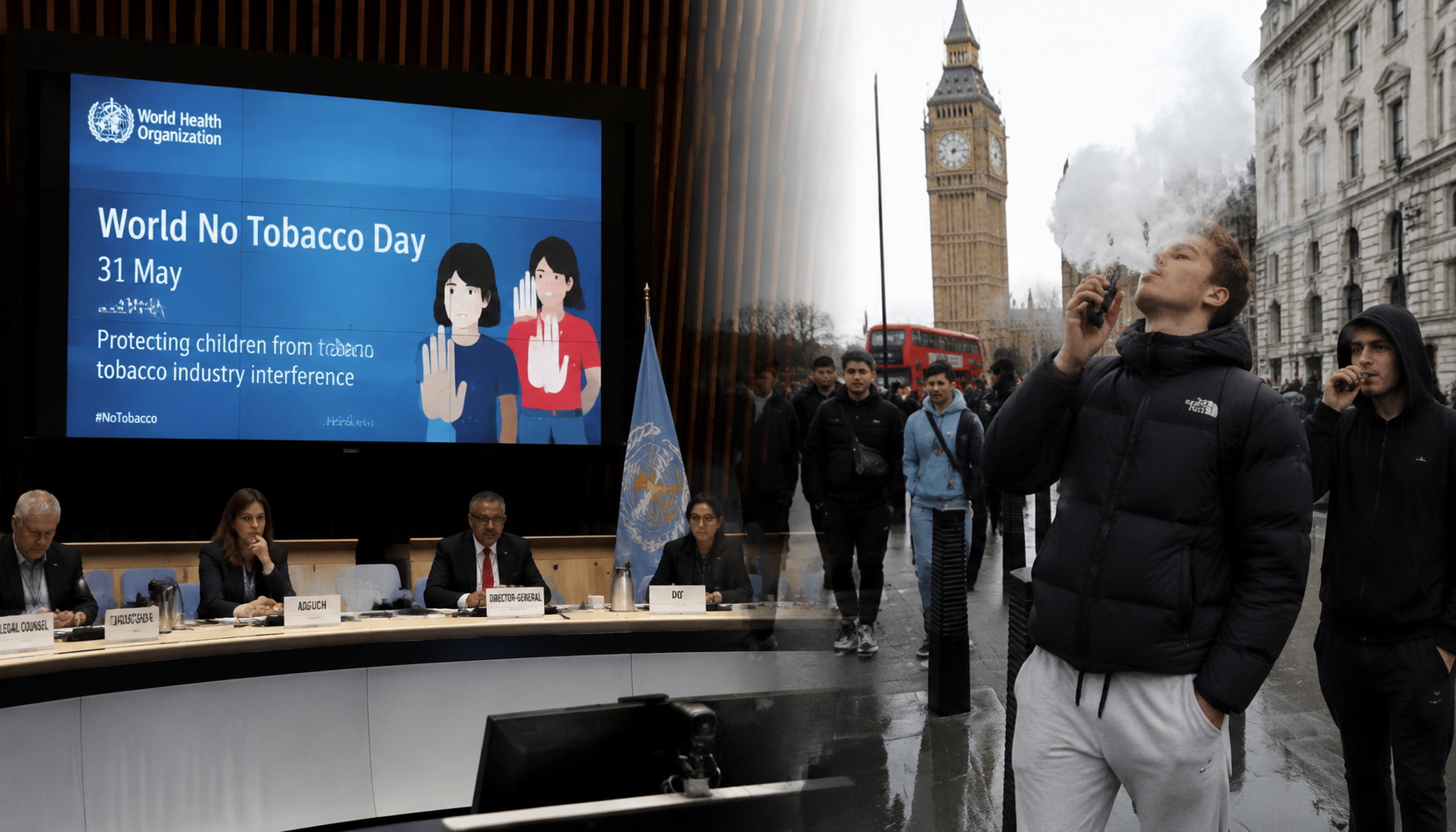
On Friday May 30, vapers, former smokers, and harm reduction advocates in Germany, South Africa, Argentina, and beyond took to the streets and social media to demand access to safer nicotine alternatives. Their message was straightforward: switching from smoking to vaping saves lives, and the data backs it up. The WHO itself has documented that there are now more than 100 million vapers globally, even as smoking rates decline but remain stubbornly high in many regions.
The WHO’s counter-message treated all nicotine products — combustible and non-combustible alike — as equally dangerous, a stance that harm reduction advocates argue ignores decades of scientific evidence. The United Kingdom, which has taken one of the most science-led approaches to vaping policy, stands as the strongest counterargument.
“The WHO has been running the same playbook for years,” said Michael Landl, Director of the World Vapers’ Alliance. “Nicotine is the enemy, alternatives are industry tactics, and anyone who disagrees is compromised. Meanwhile, 8 million people a year die from smoking. That is not a public health record to be proud of.”
The Scientific Divide
At the core of the conflict lies a crucial distinction that is often lost in policy debates. Nicotine is addictive, but it is not what kills smokers. Combustion is. When tobacco burns at temperatures exceeding 800°C, it releases thousands of chemicals, dozens of which are known carcinogens. Vaping, nicotine pouches, and heated tobacco products all dramatically reduce exposure to those chemicals because they involve no combustion.
This distinction is not controversial among independent researchers. Public Health England has repeatedly stated that vaping is at least 95% less harmful than smoking. The UK’s NHS promotes vaping as an effective cessation tool. Cancer Research UK and the Royal College of Physicians have taken the same position. But the WHO’s regulatory framework has consistently recommended treating all nicotine products under the same restrictive rules — a one-size-fits-all approach that critics say costs lives.
The Countries That Changed Course
Several nations have already demonstrated what happens when policymakers embrace harm reduction rather than prohibition — and the results are difficult to dismiss.
Sweden has effectively become smoke-free, with smoking rates below 5%. The country achieved this not through bans but by making safer nicotine alternatives — including snus and vapes — widely available and socially acceptable. The United Kingdom halved its smoking rate over the past decade. According to the Office for National Statistics, vapers now outnumber smokers in Britain — approximately 5.4 million vapers versus 5.1 million smokers. Action on Smoking and Health (ASH) reports that 2.7 million UK adults have quit smoking in the last five years using vaping products. New Zealand cut smoking among under-25s to around 3%, giving the country what many consider the first smoke-free generation.
These outcomes stand in sharp contrast to countries that have pursued total prohibition. Mexico now imposes prison terms for vape sales. Bangladesh has enacted a full ban on e-cigarettes. Uzbekistan shut down its legal vape market in March. Kazakhstan’s anti-tobacco measures, despite being aggressive in scope, have failed to meaningfully reduce smoking rates — a pattern echoed in the illicit markets that emerge wherever legal alternatives are suppressed.
Beyond the Individual: Secondhand Smoke
The WVA’s “One Switch – Everyone Wins” theme extends the argument beyond the individual smoker to everyone around them. Secondhand smoke raises children’s risk of asthma, pneumonia, and bronchitis. Maternal smoking is linked to low birth weight, preterm birth, and stillbirth. Children of smokers are up to four times more likely to become smokers themselves. When a smoker switches to a non-combustible alternative, almost all of that secondhand risk disappears. The aerosol from vaping contains significantly lower levels of harmful chemicals than cigarette smoke, and no carbon monoxide — the primary cause of smoking-related cardiovascular disease.
“Every country that has cut smoking fast did it by giving smokers real alternatives,” Landl added. “World Vape Day exists to remind policymakers that the evidence is there. That we consumers are not anecdotes, we are the evidence.”
The South Africa Flashpoint
The WVA used World Vape Day to criticize South Africa’s nicotine policy direction, arguing that the government is aligning with WHO’s restrictive stance. In a press release, the Alliance pushed back against Health Minister Motsoaledi’s characterization of harm reduction as a flawed premise. Liza Katsiashvili, the group’s Director of Operations, argued that restricting or banning less harmful alternatives leaves families exposed to smoke rather than protecting them. South Africa is not alone in this tension — EU member states are similarly divided, with Bulgaria recently receiving EU approval to ban disposable vapes even as other member states push back.
The black-market argument carries weight. Countries that have enacted total bans — including Mexico, Bangladesh, and others — have seen illicit trade flourish while regulated alternatives disappear from shelves. Consumers who would have purchased tested, labeled products instead turn to unregulated sources where product safety is unknown.
Not Everyone Agrees
The WHO’s position does have its defenders, and the concerns are not simply rhetorical. In India, oncologists used World No Tobacco Day to warn that switching from cigarettes to vapes or chewing tobacco does not eliminate cancer risk. Dr. Saadvik Raghuram Y, Director of Medical Oncology at CARE Hospitals, told the Times of India that “switching products often changes the form of exposure rather than removing the risk itself.” Respiratory specialists further cautioned that many vapers continue smoking occasionally even after switching, and that the goal should be cessation rather than substitution. For a broader look at the health concerns surrounding vaping, see our Alarming Facts About Vaping guide.
These objections highlight a genuine tension that neither side fully resolves. Harm reduction advocates point to 8 million annual smoking deaths as an urgent crisis demanding pragmatic solutions that work at population scale. Critics argue that the safest alternative to smoking is not vaping — it is not using nicotine at all. The two positions are not reconcilable, and the weekend’s competing messages make that starkly clear.
What the Numbers Actually Show
| Metric | Source | Value |
|---|---|---|
| Annual smoking deaths worldwide | WHO | 8 million |
| UK vapers (est. 2025–2026) | ONS / ASH | ~5.4 million |
| UK smokers (est. 2025–2026) | ONS / ASH | ~5.1 million |
| UK adults who quit via vaping (5 yr) | ASH | 2.7 million |
| NZ smoking under-25s | NZ Government | ~3% |
| Vaping vs smoking relative risk | PHE / UK Gov | ~95% less harmful |
| Global vapers (2026) | WHO | 100+ million |
What Comes Next
The clash between World Vape Day and World No Tobacco Day 2026 is not an isolated event. It reflects a growing global divide in public health strategy that touches everything from FDA authorization decisions to national legislation across every continent — including Canada’s menthol cigarette regulations. Countries like Sweden, the UK, and New Zealand are doubling down on harm reduction as a proven pathway to smoke-free populations. Others — including Mexico, Bangladesh, and Uzbekistan — are moving toward total prohibition, framing all nicotine products as inherently unacceptable.
The World Vapers’ Alliance has signaled it will continue its campaigns throughout 2026, with particular focus on EU member states considering vape bans and on developing countries where smoking rates remain high. The WHO, meanwhile, is preparing for the next FCTC Conference of the Parties (COP11), where harm reduction will almost certainly be the central battleground.
“The tools are there,” Landl said. “The only thing missing is the political will in too many countries.”
The question that remains — and that neither side fully answers — is whether harm reduction and youth protection can coexist in a single coherent policy, or whether the global community must ultimately choose one over the other.
Sources
- World Vape Day 2026: One Switch – Everyone Wins — GlobeNewswire / Markets Insider
- Vapers’ Alliance Faults South Africa’s Nicotine Policy on World Vape Day — Tobacco Reporter
- World No Tobacco Day — World Health Organization
- Action on Smoking and Health (ASH) — UK smoking and vaping statistics
- World No Tobacco Day: Why doctors call tobacco a silent epidemic — Times of India
Last updated: June 5, 2026




Follow the wider vape market
Read the latest vape news
Track regulation, launches and industry updates.
Open vape news →Browse product data
Move from market news to device specifications.
Open product data →Check product reviews
Read independent testing and comparison reports.
Read review coverage →