


UK vaping has overtaken smoking for the first time, marking what public health experts describe as a significant moment in the country’s push to end tobacco use. New 2024 data from the Office for National Statistics (ONS) show 10% of people aged 16 and over now vape regularly, compared with 9.1% who smoke cigarettes—an estimated 5.4 million vapers versus 4.9 million smokers.
“For the first time, the number of users of e-cigarettes or vapes has overtaken the number of smokers,” said David Mais of the ONS, noting the crossover aligns with a decade-long decline in smoking rates.
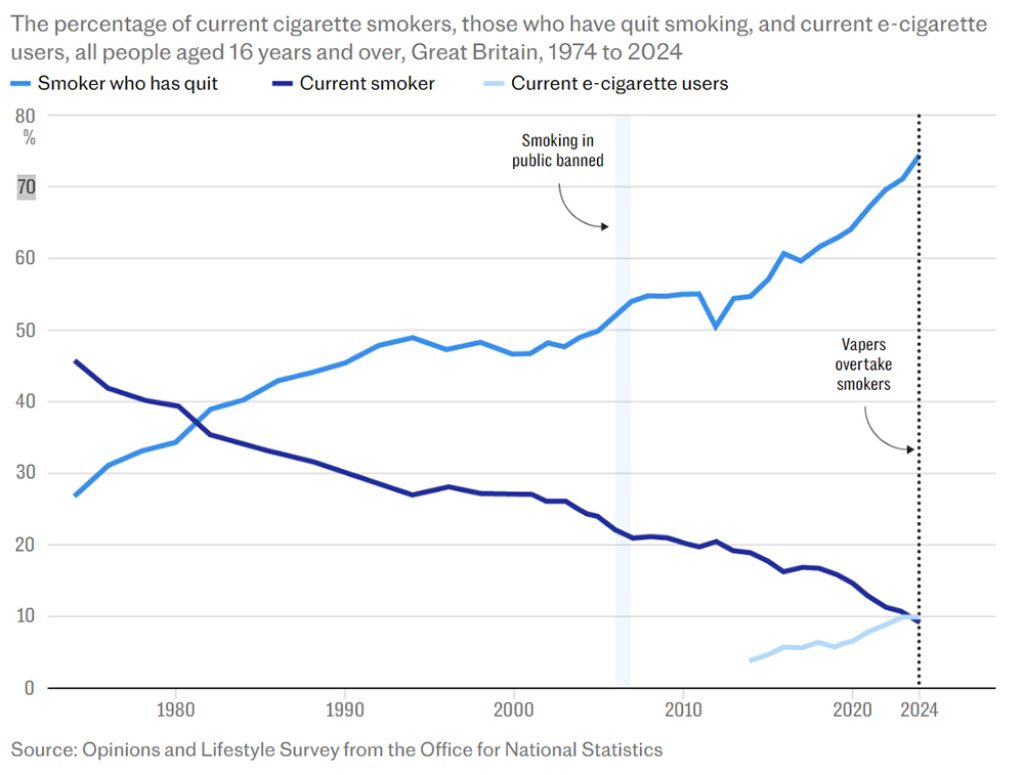
The demographic picture is nuanced. Vaping among men dipped from 11% in 2023 to 10.1% in 2024, while use among women rose from 8.5% to 10%. Young adults aged 16–24 remain the most likely to vape daily or occasionally at 13%—about one in eight. Smoking prevalence is now highest among 25–34-year-olds at 12.6% and lowest among those aged 65+ at 7.1%. The largest smoking decline since 2011 has come among 18–24-year-olds, dropping from more than one in four to fewer than one in ten.
Health advocates and industry voices framed the milestone through different lenses. Hazel Cheeseman, chief executive of Action on Smoking and Health (ASH), called the shift “a significant moment,” adding that growth in vaping has “almost certainly contributed to the fall in smoking and is therefore to be welcomed,” while cautioning about uptake among non-smokers and young people. Deborah Arnott, an honorary associate professor at University College London, urged “greater regulation,” stressing that vaping is not risk-free and should be used to help smokers quit. Simon Clark, director of smokers’ rights group Forest, said falling smoking rates are long-standing, driven by education about risks, and that reduced-risk alternatives such as vapes and nicotine pouches have helped many smokers switch or quit voluntarily.
Policy is moving quickly. The Government’s Tobacco and Vapes Bill—now being scrutinized in the House of Lords—would introduce a “generational” smoking ban by prohibiting cigarette sales to anyone born from 2009 onwards. It would also place new restrictions on e-cigarette packaging, marketing, and flavors amid concern about youth uptake. In a parallel step, the Government confirmed a ban on under-18s purchasing nicotine pouches and plans to set rules on nicotine strength, flavors, and packaging. Fruity flavors and high nicotine levels in pouches would be prohibited, vending machine sales and free distribution banned, and retailers selling to under-18s face £200 fines. Health officials say these measures aim to keep young people safe; critics counter that tighter controls risk limiting access to products many smokers use to quit.
Analysis: a turning point with trade-offs
- The ONS crossover cements vaping’s role in the UK harm reduction landscape, reflecting a decade of sliding cigarette use and a rapid uptick in nicotine alternatives.
- Gender and age shifts matter: Women’s vaping growth and the exceptionally sharp fall in smoking among 18–24s suggest changing social norms and the reach of alternatives.
- Regulation will likely reshape the market—especially around flavors, packaging, and retail practices. The Government appears set on balancing adult access for smoking cessation with youth protection.
- For industry, clearer rules on strengths, flavors, and presentation are coming. Compliance, responsible marketing, and evidence-backed cessation positioning will be critical to maintain public trust and adult access.
- For public health, the task is twofold: leverage vaping’s quitting potential for smokers while minimizing new uptake among never-smokers and young people.
The UK has entered a new phase: more adults now reach for a vape than a cigarette. Whether this accelerates the endgame for smoking depends on steady, proportionate regulation and how effectively the sector and health services help smokers switch and ultimately quit nicotine altogether.




Follow the wider vape market
Read the latest vape news
Track regulation, launches and industry updates.
Open vape news →Browse product data
Move from market news to device specifications.
Open product data →Check product reviews
Read independent testing and comparison reports.
Read review coverage →