

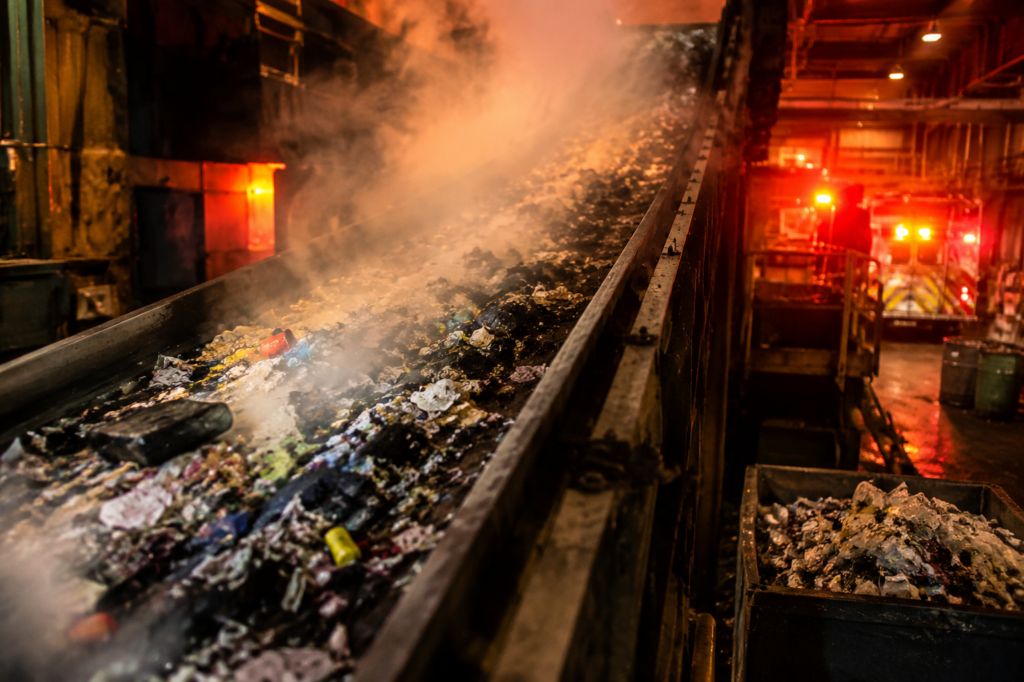
Recycling facilities across the US and Canada recorded 448 fires in 2025, the highest number since tracking began in 2016. Lithium-ion batteries from disposable vaping devices drove much of the increase. That figure is 12.6% higher than 2024’s 398 publicly reported incidents, continuing a trend of sharply accelerating fire rates since 2022. Annual costs from lithium-ion battery fires hit an estimated $2.5 billion for the waste and recycling sector.
Ryan Fogelman, Partner and VP at Fire Rover, coined the term “vape effect” to describe how disposable vapes fuel these fires. Unlike other battery-powered devices, vapes pack three distinct hazards into one product: a biohazard from the mouthpiece, hazardous liquid from nicotine or THC, and a lithium-ion battery that is hard to remove and prone to ignition when crushed or punctured in processing equipment.
Record-Breaking Fire Data
July 2025 saw 56 incidents, the highest single month ever recorded. August followed with 49, also a record for that month. Tobacco Reporter covered how the increase rate accelerated from roughly 20.6% when comparing 2016-2021 against 2022-2025. Fire Rover estimates 1.2 billion vapes enter waste streams globally each year, and the vast majority contain non-removable lithium-ion batteries.
“Waste and recycling operators are the victims of this,” Fogelman told WasteDive. “They’re having these hazards just dumped on their front door and they’re being left to deal with it.” He has called for “Uber-local” battery drop-off options funded by Extended Producer Responsibility programs rather than by municipalities and waste operators alone. Ars Technica noted that the fire problem extends beyond vapes, but disposables are uniquely difficult to manage because of their size and the way they’re discarded.
Pilot Programs Seek Solutions
The Product Stewardship Institute is running two pilot programs to test scalable collection and disposal methods for vaping devices.
In New York State, PSI partnered with SUNY ESF’s Center for Sustainable Materials Management on a pilot running through August 2026. The program places collection sites at schools, community organizations, and municipalities. Its goals include separating lithium-ion batteries and nicotine components for critical mineral recovery, and collecting data on volumes, consumer behavior, costs, and processing pathways.
In Southwest Missouri, a six-month pilot launched in Fall 2025 became the first vape waste program in the state. Free drop-off sites accept vape pens, pods, cartridges, and e-liquid containers. Partners include PSI, Missouri Solid Waste Management District O, and the Missouri Department of Natural Resources. The program tracks safe handling protocols, transportation and disposal costs, and participation levels.
Industry and Legislative Response
The National Waste and Recycling Association and the Solid Waste Association of North America launched a joint effort in January 2025 to address lithium-ion battery disposal. NWRA’s “Battery Safety Now” campaign revived the Woodsy Owl mascot with the message “Skip the Bin, Turn Your Batteries In.”
On the legislative front, four states introduced vape EPR bills in 2025, up from just one in 2024. California’s AB 762, which passed the Assembly and is now in Senate committee review, would ban disposable nicotine vapes outright by 2028. New Jersey’s SB 681 would establish an EPR framework requiring producers to fund collection and processing of discarded devices. Resource Recycling reported that the “vape effect” has become a central talking point in state-level waste policy discussions.
Quebec, Canada, remains the only jurisdiction with an operational EPR program for vapes, and recently expanded it to include cannabis vapes.
The Recycling Facility Challenge
Disposable vapes are particularly problematic for material recovery facilities because their small size makes them difficult to identify on tipping floors and in processing equipment. When crushed by sorting machinery, the lithium-ion batteries can short-circuit and ignite, often starting fires that spread rapidly through accumulated paper and plastic materials.
Volume compounds the problem. Unlike larger electronics such as laptops or power tools, vapes are small enough to slip through manual sorting and rarely reach dedicated e-waste recycling streams. With 1.2 billion vapes discarded annually worldwide, even a small ignition rate translates into hundreds of facility fires each year. Most end up in household trash or curbside recycling bins instead.
What’s Needed
The scale of the problem demands a multi-pronged response. Industry experts and environmental groups agree that no single solution will solve the vape waste crisis. Bans on disposable devices, as California is pursuing, can reduce the volume of problematic products entering the market. EPR programs, as New Jersey and Quebec have adopted, can fund the collection and processing infrastructure that currently doesn’t exist. And consumer education campaigns, like NWRA’s Battery Safety Now initiative, can help keep batteries out of recycling bins where they cause the most damage.
But with 448 facility fires in a single year and costs mounting into the billions, the window for voluntary action is closing. As Fogelman put it: “We need solutions funded by EPR, not exclusively by municipalities, waste and recycling operators, and the battery pros.” For a deeper look at how these waste concerns are driving state-level policy, see our coverage of California’s AB 762 disposable vape ban and the UK’s experience with its own ban. The FDA’s evolving enforcement stance adds another layer of complexity to the regulatory picture.




Follow the wider vape market
Read the latest vape news
Track regulation, launches and industry updates.
Open vape news →Browse product data
Move from market news to device specifications.
Open product data →Check product reviews
Read independent testing and comparison reports.
Read review coverage →