

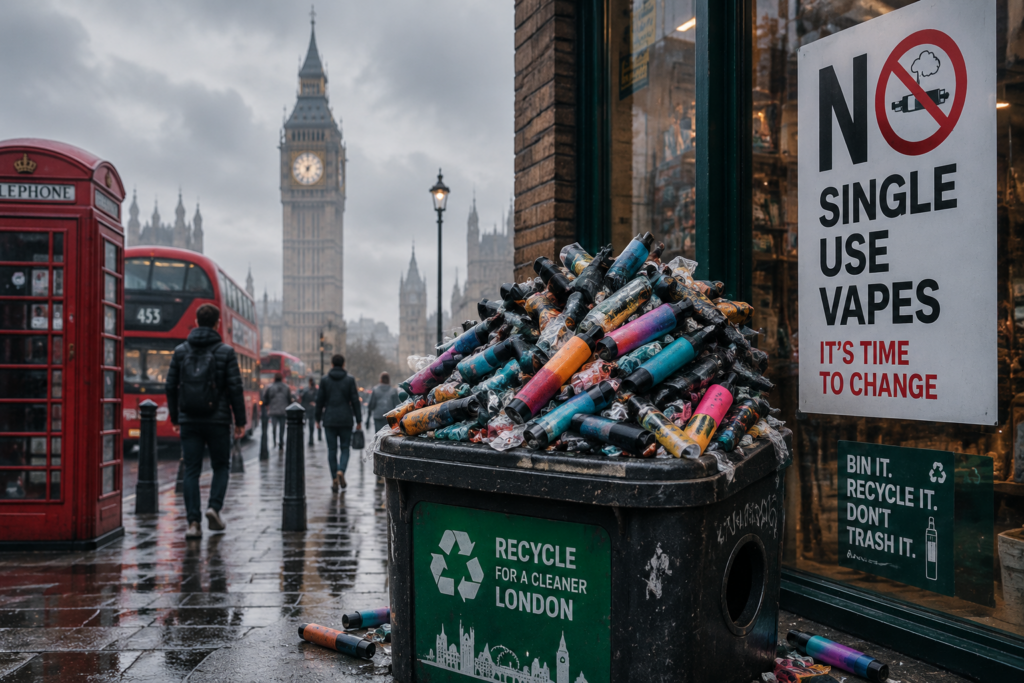
One year after the UK banned single-use vapes on June 1, 2025, the policy has delivered measurable reductions in disposable vaping alongside significant remaining challenges. Youth disposable vape use among 11- to 17-year-olds dropped from 42% to 13%, according to ASH/YouGov survey data published in June 2026, a 69% decline from pre-ban levels. Adult disposable use fell from 24% to 8%, a 67% reduction. At their peak in 2023, 69% of youth vapers and 31% of adult vapers used disposables.
The ban, enacted under single-use plastics regulations and reinforced by the Tobacco and Vapes Act 2026, prohibits the sale of non-rechargeable or non-refillable vaping devices across England, Scotland, Wales, and Northern Ireland. Retailers face £200 fines for first offenses. The UK government’s official guidance confirms the legislation applies to all sales channels including online retailers.
Academic Confirmation of Impact
A peer-reviewed interrupted time-series study by Tattan-Birch and colleagues, published on medRxiv in June 2026, analyzed vaping and smoking trends from 2022 through February 2026. By February 2026, vaping prevalence stood at 13.6% among adults compared to a no-ban counterfactual estimate of 18.8%, a statistically significant difference of 5.2 percentage points. Among young adults, the gap was even wider: 27.8% versus 39.1%, a difference of 11.3 percentage points.
Smoking findings were more ambiguous. Adult smoking prevalence was similar to the counterfactual, showing a non-significant increase of 0.9 percentage points. Among young adults, smoking was possibly higher by 3.3 percentage points, though the confidence interval crossed zero (−0.5 to +7.1), meaning the result was not statistically significant. A separate qualitative study on PMC found that 13% of pre-ban disposable vapers reported the ban led them to increase cigarette use, while 70% reported no impact on their smoking. The BMJ also covered the potential for unintended consequences on smoking rates among young adults.
The Waste Problem Isn’t Solved
Despite the sharp decline in disposable use, Material Focus reported in June 2026 that 6.3 million vapes and pods are still discarded weekly in the UK — down 23% from pre-ban levels but still a massive waste stream. Purchases of disposable-style products fell 31%, suggesting that some consumers have switched to rechargeable pod systems while others continue buying disposables through non-compliant channels.
Scott Butler of Material Focus cautioned: “Banning one type of vape is not, on its own, a behaviour-change strategy.” LetsRecycle noted that Biffa, a major UK waste management company, reported a 7% rise in incorrect vape disposals at material recovery facilities in June and July 2025 immediately following the ban, with a 24% surge at its Teesside facility where 232,500 outlawed vapes were found in recycling streams. More than 1,200 battery fires were recorded in UK waste facilities during 2023/24, and Biffa notes that rechargeable devices may present a greater fire risk when discarded because their batteries retain higher charge levels — a problem that mirrors the vape waste crisis playing out in US recycling facilities.
Consumer Behavior Shifts
The ban has prompted significant changes in how vapers use products. According to industry surveys, 60% of adult vapers now report reusing products, with 46% reusing devices 10 times or more. However, 18% still rarely or never reuse their devices, effectively treating rechargeable systems as disposables. An encouraging sign for potential deposit schemes: 85% of respondents said they would be more likely to return vapes with a financial incentive, and consumers indicated willingness to pay approximately £4 as a deposit.
Biffa and the Environmental Services Association have proposed a small refundable deposit on vaping devices, collected at point of purchase and returned when the device is brought back to a participating retailer. The proposal has drawn support from environmental groups but faces logistical questions about implementation across thousands of retail locations.
Upcoming Policy Changes
UK vaping regulations are about to get significantly more complex. On October 1, 2026, the Vaping Products Duty takes effect, requiring VPD stamps on all products and imposing a £2.20 per 10ml duty. A grace period runs until April 1, 2027, after which unstamped products can be seized. HMRC has warned that processing applications may take up to 45 working days, creating potential supply chain bottlenecks.
The Tobacco and Vapes Act 2026, which has already passed, gives the government powers to restrict vape marketing, packaging, and flavor names. These regulations are expected to be phased in over the coming year.
European Developments Add Pressure
Across the Channel, the EU is moving toward its own restrictions on disposable vapes. Ecigator’s TPD3 explainer notes that the TPD3 revision, initially planned for 2025, has been pushed to mid-2026 with negotiations stalled due to deep divisions among member states. The final scope remains uncertain, but key areas expected include flavor restrictions, nicotine pouch regulation, plain packaging, and track-and-trace requirements.
More consequential in the near term is the EU Battery Regulation, which from February 2027 will ban devices with non-replaceable batteries from the EU market. This effectively prohibits disposable vapes across all 27 member states, regardless of whether TPD3 passes. The regulation will reshape the European vaping market, forcing manufacturers to redesign products with removable, recyclable batteries.
Lessons for the US
The UK’s one-year experience with a disposable vape ban offers valuable data for US states considering similar legislation. The ban clearly reduced youth disposable use and overall vaping prevalence. However, it did not eliminate the waste problem, and the evidence on smoking substitution remains inconclusive. As California advances AB 762 and New Jersey pursues its own EPR legislation, policymakers would do well to study both the successes and the shortcomings of the UK approach. A ban on its own is not a complete solution — as the FDA’s evolving enforcement policies demonstrate, regulatory approaches to vaping remain a work in progress on both sides of the Atlantic.




Follow the wider vape market
Read the latest vape news
Track regulation, launches and industry updates.
Open vape news →Browse product data
Move from market news to device specifications.
Open product data →Check product reviews
Read independent testing and comparison reports.
Read review coverage →