


Choosing the right device is the first step. Our Best Vape Pens & Kits guide covers the top options for beginners and experienced vapers alike. If you have ever stared at a wall of e-liquid bottles wondering what “50/50” or “70/30” actually means, you are in the right place. The PG vs VG debate is one of the first things every vaper runs into, and for good reason: the ratio of propylene glycol to vegetable glycerin in your vape juice shapes everything from how much vapor you blow to how harsh the throat hit feels. I remember my first month of vaping, when I bought a bottle of max VG juice for my little pod system and spent three days wondering why everything tasted like burnt plastic. Turns out, the juice was too thick for my device. That mistake cost me two coils and a lot of frustration, but it also taught me something valuable: understanding your PG VG ratio is not optional knowledge. It is the difference between a satisfying vape and a miserable one.
This guide breaks down every detail you need to know about propylene glycol and vegetable glycerin, how they behave on their own, how they work together, and which ratio you should pick based on your device, your vaping style, and your nicotine preferences. I will also cover the 2026 FDA updates that changed the safety conversation around both ingredients. Let us get into it.
What Is PG (Propylene Glycol)?
Propylene glycol, usually called PG, is a synthetic organic compound that belongs to the same chemical family as antifreeze. Before you panic, that family connection is purely structural. The PG used in e-liquids is pharmaceutical grade and completely different from ethylene glycol, the toxic antifreeze ingredient. PG is also widely used in asthma inhalers, theatrical fog machines, food flavorings, and medications. The FDA classifies it as GRAS (Generally Recognized as Safe) for ingestion.
Here is what PG brings to your e-liquid:
- Flavor carrier: PG is thin and carries flavor compounds efficiently. If you want the purest, most accurate flavor from your juice, PG is your friend. This is why most flavor concentrates are dissolved in PG.
- Throat hit: PG produces a sharp, noticeable throat hit that many former smokers actually want. That hit mimics the sensation of smoking a cigarette, which is a big part of why some vapers prefer higher PG blends.
- Low viscosity: PG is a thin liquid. It wicks easily through the small openings in pod systems and MTL tanks. You will not have dry hit problems with high PG juice in most devices.
- Less vapor: The trade-off for that strong throat hit and flavor clarity is vapor production. PG produces noticeably less vapor than VG. If you want big clouds, PG alone will not get you there.
PG is not without its downsides. Roughly 3 to 5 percent of vapers experience some degree of PG sensitivity, ranging from mild throat irritation to allergic reactions. If you notice unusual throat dryness, a persistent cough, or skin irritation after vaping high PG juice, switching to a higher VG blend often resolves the issue. I have a friend who could not figure out why vaping made her throat scratchy for weeks until she switched from a 60/40 PG/VG blend to a 70/30 VG/PG. Problem solved overnight.
What Is VG (Vegetable Glycerin)?
Vegetable glycerin, or VG (also called glycerol), is a natural compound derived from plant oils, typically palm, soy, or coconut. Like PG, the FDA classifies VG as GRAS for ingestion. It is used in food products, cosmetics, and pharmaceuticals. In the vaping world, VG is the cloud maker.
Here is what VG brings to your e-liquid:
- Vapor production: VG is the reason cloud chasers exist. It produces thick, dense, voluminous vapor that PG simply cannot match. If you have ever seen someone blow a massive cloud at a vape shop, they were running high VG juice through a sub-ohm setup.
- Sweetness: VG has a naturally sweet taste. Some vapers enjoy this, while others find it mutes the intended flavor of the juice. That sweetness also means VG tends to gunk up coils faster than PG.
- Smoothness: VG delivers a much smoother throat hit compared to PG. For vapers who find PG harsh or irritating, high VG juice feels gentler on the throat.
- High viscosity: VG is a thick, syrupy liquid. This thickness is a double-edged sword. It creates dense vapor, but it also means VG-heavy juice struggles to wick through small coil openings. If you put 80/20 VG/PG juice in a standard pod system, you are asking for dry hits and burnt coils.
One thing I want to be upfront about: before vaping became popular, there was essentially no inhalation toxicology data for glycerol. The safety data that existed was for ingestion and topical use. The theatrical fog studies (which involved glycol mixtures, not pure VG) found links between regular exposure and acute cough or dry throat. That does not directly translate to vaping, but it is worth knowing. I will dig deeper into the safety side later in this guide.
PG vs VG: Key Differences
Let me put the main differences side by side so you can see how PG and VG compare across every category that matters to vapers.
| Property | PG (Propylene Glycol) | VG (Vegetable Glycerin) |
|---|---|---|
| Consistency | Thin, water-like | Thick, syrupy |
| Flavor | Odorless, flavorless (carries flavor well) | Slightly sweet (can mute some flavors) |
| Throat Hit | Strong, sharp | Smooth, gentle |
| Vapor Production | Low to moderate | High, dense clouds |
| Wicking Ability | Excellent (wicks fast) | Poor in small ports (can cause dry hits) |
| Coil Life | Longer (less gunk) | Shorter (sugars cause buildup) |
| Allergy/Sensitivity Risk | 3-5% of vapers report sensitivity | Rare |
| FDA Status (Ingestion) | GRAS | GRAS |
| FDA Status (Inhalation) | Added to HPHC list (April 2026) | Added to HPHC list (April 2026) |
| Other Uses | Asthma inhalers, fog machines, food additives | Skin care, food sweetener, pharmaceuticals |
The bottom line: PG gives you flavor and throat hit, VG gives you clouds and smoothness. Most e-liquids blend both to get a balance of each quality. The ratio you choose determines where you land on that spectrum.
Which PG/VG Ratio Is Right for Your Vaping Style?
There is no universal “best” ratio. The right PG VG ratio depends on how you vape, what device you use, and what you want out of the experience. Let me break this down by the three main vaping styles.
MTL Vaping (50/50 or 60/40 PG/VG)
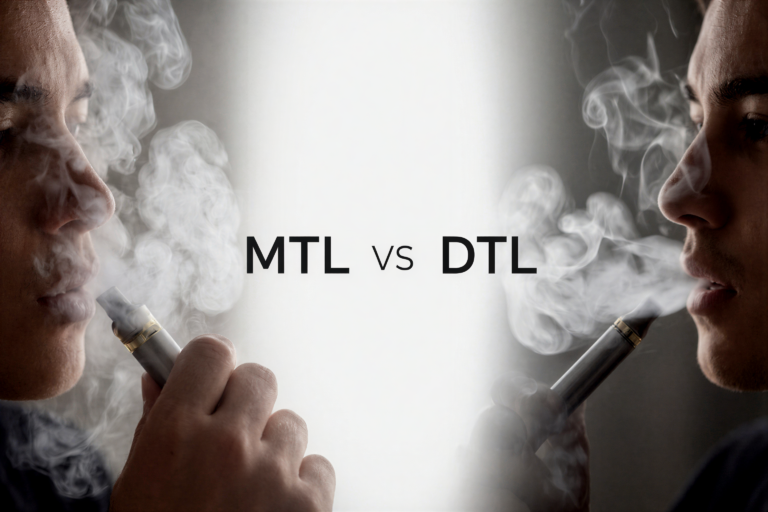
MTL stands for mouth-to-lung, which is the style where you draw vapor into your mouth first, then inhale it into your lungs. This is the same breathing pattern most people use when smoking a cigarette, which is why MTL is the go-to style for people transitioning from smoking. You can learn more about the differences in our MTL vs DTL vaping guide.
For MTL, you want a thin juice that wicks quickly through the small coil openings in pod systems and disposable vapes. A 50/50 or 60/40 PG/VG blend gives you exactly that. The higher PG content delivers a satisfying throat hit and clean flavor, which closely replicates the sensation of smoking.
Device types: Pod systems, vape pens, MTL tanks
Wattage range: 9 to 16W
Nicotine: Nicotine salts at 12 to 20mg, or freebase nicotine at 6 to 12mg
When I first switched from cigarettes, I used a 50/50 juice with 12mg nic salt in a basic pod. That setup felt so close to smoking that the transition was almost smooth. The throat hit was there, the flavor was clear, and the device just worked without any fuss. If you are just starting out, check out our complete beginner’s guide to vaping.
RDL Vaping (60/40 to 70/30 VG/PG)
RDL, or restricted direct-to-lung, sits between MTL and full DTL. You inhale vapor directly into your lungs but through a tighter draw than a wide-open DTL setup. Think of it as the middle ground. RDL gives you more vapor and flavor intensity than MTL, with a looser draw, but it is not the full cloud-chasing experience.
For RDL, a 60/40 or 70/30 VG/PG blend works well. You get more vapor production than a 50/50 juice, a smoother throat hit, and enough thickness to perform well in mid-power devices without wicking problems.
Device types: Mid-power pod mods, small sub-ohm tanks, adjustable airflow pods
Wattage range: 20 to 40W
Nicotine: Nicotine salts at 6 to 12mg, or freebase nicotine at 3 to 6mg
DTL Vaping (70/30 or 80/20 VG/PG)
DTL, or direct-to-lung, is where you inhale vapor straight into your lungs in one smooth draw. This is the style that produces those massive clouds you see in vape shops and on social media. DTL vaping requires sub-ohm tanks or high-wattage mods with wide airflow, and it needs thicker juice that can handle higher temperatures without burning.
The 70/30 VG/PG ratio is the most popular choice for DTL. It delivers a great balance of vapor density and flavor. If you want to push cloud production even further, 80/20 VG/PG is the next step up. Just know that 80/20 juice is thick and requires a device with large wicking ports and enough wattage to vaporize it properly.
Device types: Sub-ohm tanks, box mods, high-wattage devices (see our 18650 battery guide for power recommendations)
Wattage range: 40 to 100W+
Nicotine: Freebase nicotine at 0 to 6mg
I tried an 80/20 juice in my sub-ohm tank once, and the clouds were impressive. But the flavor was noticeably muted compared to my usual 70/30. It is a trade-off: more vapor means the flavor compounds are spread across a larger volume of air. For some vapers, that trade is worth it. For me, 70/30 hits the sweet spot.
Matching Ratios to Your Device
Choosing the right PG VG ratio is not just about preference. Your device physically limits which ratios will work well. Here is a quick reference table to help you match juice to hardware.
| Device Type | Recommended Ratio | Why | Wattage |
|---|---|---|---|
| Pod Systems (refillable) | 50/50 | Small wicking ports need thin juice | 9-16W |
| Vape Pens | 50/50 to 60/40 PG/VG | Similar to pods, thin juice prevents dry hits | 10-18W |
| MTL Tanks | 50/50 to 60/40 PG/VG | Tight draw, small coils, needs easy wicking | 10-20W |
| Mid-Power Pod Mods | 60/40 to 70/30 VG/PG | Larger wicking ports handle thicker juice | 20-40W |
| Sub-Ohm Tanks | 70/30 VG/PG | Big coils and ports, high wattage vaporizes thick juice | 40-80W |
| High-Wattage Mods | 70/30 to 80/20 VG/PG | Plenty of power to handle viscous juice | 60-100W+ |
| Rebuildable Atomizers (RDAs/RTAs) | 70/30 to Max VG | Custom wicking, user controls flow rate | Varies |
The most common mistake I see is people putting thick VG-heavy juice into pod systems. The juice cannot wick fast enough, the coil dries out, and you get that awful burnt taste. If your vape starts tasting burnt and you are using high VG juice in a pod, that is almost certainly the culprit. For more on this, see our guide on how to fix a vape that will not hit.
PG/VG and Nicotine: How They Work Together
The PG VG ratio and your nicotine level are not independent choices. They interact in ways that affect the overall vaping experience, and understanding these interactions helps you dial in your perfect setup.
High PG + High Nicotine: This combination delivers a sharp, cigarette-like throat hit. It is the reason 50/50 juice with 12 to 20mg nicotine salts feels so satisfying for new vapers. The PG amplifies the throat hit that nicotine naturally provides, so the two work together to create that smoking-like sensation.
High VG + Low Nicotine: This is the standard DTL setup. The VG smooths out the throat hit, and because you are inhaling large volumes of vapor, even low nicotine levels (0 to 6mg) deliver enough nicotine per puff. If you tried 12mg freebase in a sub-ohm tank with 70/30 juice, the throat hit would be harsh and uncomfortable.
Nicotine salts vs freebase: Nicotine salts are formulated to be smooth at high concentrations, which is why they work so well with high PG blends in pod systems. Freebase nicotine is harsher at higher levels, so it is typically used at lower concentrations with higher VG blends in sub-ohm setups. Mixing these up (nic salts in a sub-ohm, or high freebase in a pod) usually leads to a bad experience.
One practical tip: If you are dropping your nicotine level, consider moving slightly toward higher VG at the same time. The smoother throat hit of VG compensates for the reduced throat hit from lower nicotine, making the transition less jarring. When I went from 12mg to 6mg, switching from 50/50 to 60/40 VG/PG made the step down feel natural instead of empty.
Is PG or VG Safe to Inhale?
This is where the conversation gets serious, and where I need to be completely honest with you. The safety picture for inhaled PG and VG has shifted in 2026, and anyone who tells you these ingredients are definitively safe to inhale is not giving you the full story.
Both PG and VG are classified as GRAS by the FDA for ingestion. That means they are considered safe to eat and drink. But GRAS status for ingestion does not equal safety for inhalation. Your digestive system processes substances very differently from your lungs, and the FDA has never approved PG or VG for inhalation.
Breaking update (April 22, 2026): The FDA added both propylene glycol and glycerol to its Harmful and Potentially Harmful Constituents (HPHC) list. This is a significant regulatory shift. Being on the HPHC list does not mean these substances are definitively harmful at the levels found in e-cigarette aerosol, but it does mean the FDA has determined there is enough evidence to flag them as potentially harmful when inhaled. This changes the risk conversation in a way every vaper should be aware of.
Here is what the science tells us so far:
Heating PG and VG produces aldehydes. When heated to high temperatures, both PG and VG can decompose into formaldehyde, acetaldehyde, and acrolein. These are known irritants and carcinogens. The amount produced depends heavily on the temperature of your coil and the wattage you are running. Higher wattage devices tend to produce more of these compounds. This is one reason temperature control matters.
2025 research adds to the picture. A 2025 study published in PubMed reviewed the toxicity of PG/VG humectants and found that thermal degradation byproducts are the primary concern.
Some studies show reassuring results. A 90-day rat inhalation study (Suber 1989) found no effects on larynx, trachea, or lung tissues from PG exposure. A more recent PMI 90-day inhalation study (Phillips 2017) found that PG/VG aerosols showed “very limited biological effects with no signs of toxicity” in the test subjects.
But the evidence gaps are real. Before vaping, there was no inhalation toxicology data for glycerol at all. The NCBI Public Health Consequences of E-Cigarettes report highlights significant uncertainties around long-term inhalation of both compounds. The American Lung Association has raised concerns about the potential for lung irritation and damage from heated PG and VG aerosols.
Airway inflammation research. A 2024 study found that PG/VG aerosols can induce airway inflammation and increase mucus production.
My take: vaping is almost certainly less harmful than smoking cigarettes, but “less harmful” is not the same as “safe.” The 2026 FDA HPHC listing is a reminder that we are still learning about the long-term effects of inhaling these substances. If you do not smoke, do not start vaping. If you are vaping to quit smoking, be informed about what you are inhaling. You can read more about safety considerations in our article on whether nicotine-free vapes are safe.
Common Mistakes When Choosing E-Liquid Ratios
Over the years, I have seen (and made) plenty of mistakes for picking e-liquid ratios. Here are the most common ones, so you can avoid them.
1. Using high VG juice in a pod system. This is the number one mistake, and I already mentioned making it myself. Pod systems have tiny wicking ports that cannot handle thick juice. The coil starves, you get dry hits, and your coil dies fast. Stick with 50/50 or 60/40 PG/VG for pods.
2. Using high PG juice in a sub-ohm tank. The reverse problem. High PG juice is too thin for most sub-ohm setups. It can flood the coil, leak through the airflow, and deliver a harsh throat hit that is unpleasant at high wattage. If you are running a sub-ohm tank, go with 70/30 VG/PG or higher.
3. Chasing max VG for no reason. Max VG (90/10 or higher) juice is for specific setups, usually rebuildable atomizers with custom wicking. Running max VG in a standard sub-ohm tank often leads to muted flavor and wicking issues. The 70/30 sweet spot exists for a reason.
4. Ignoring nicotine type when choosing ratio. Nicotine salts are designed for high PG, low wattage setups. Freebase nicotine is designed for high VG, high wattage setups. Mixing these up leads to either harsh hits or unsatisfying nicotine delivery.
5. Assuming all 50/50 or all 70/30 juices are the same. Two 50/50 juices from different brands can vape very differently. Flavoring percentages, nicotine type, and base ingredient quality all affect the experience. Do not be afraid to experiment within a ratio range to find what works for you.
6. Not changing coils when switching ratios. If you switch from 50/50 to 70/30, your existing coil is saturated with the old juice. The mix of old and new juice tastes terrible and can gunk up the coil faster. Always put in a fresh coil when you change ratios significantly.
How to Switch Between Ratios
Switching your PG VG ratio is not complicated, but doing it wrong can waste coils and juice. Here is the process I recommend.
Going from high PG to high VG (for example, 50/50 to 70/30):
- Empty your tank or pod completely.
- Install a fresh coil. This is not optional. The old coil is saturated with thin juice, and mixing it with thick juice creates a gunky mess that tastes bad and kills coil life. For more on coil lifespan, see our guide on how long a vape lasts.
- Fill with the new juice and let it sit for 5 to 10 minutes so the wick saturates properly. High VG juice takes longer to wick than thin juice.
- Start at a lower wattage than you were using before and increase gradually. High VG juice needs more heat, but you want to break in the coil gently.
Going from high VG to high PG (for example, 70/30 to 50/50):
- Same process: empty the tank and install a fresh coil.
- Fill with the new juice and wait 3 to 5 minutes. Thin juice wicks quickly.
- Start at your normal wattage or slightly lower. High PG juice vapes cooler, so you may need to adjust wattage up slightly after the break-in period.
A note on mixing ratios: Some vapers like to blend their own ratios by mixing two bottles together. For example, mixing equal parts 50/50 and 70/30 VG/PG gives you roughly a 60/40 VG/PG blend. This works in a pinch, but the math gets tricky if the two juices have different nicotine levels or flavors. I have done this when I wanted to try a ratio I could not find in stores, and it worked fine. Just keep track of your nicotine math so you do not end up with way more or less nicotine than you expected.
If your device starts acting up after a ratio switch, check out our guide on why your vape might be blinking for troubleshooting tips.
Frequently Asked Questions
Can I use 50/50 e-liquid in a sub-ohm tank?
Technically, yes. Practically, I would not recommend it. 50/50 juice is thin and will likely flood a sub-ohm coil, causing leaking and gurgling. The throat hit will also be very harsh at sub-ohm wattages, especially if you are using any nicotine at all. If you only have 50/50 juice and a sub-ohm tank, run the wattage as low as your coil allows and close the airflow down to reduce flooding. But really, pick up some 70/30 juice. It will be a much better experience.
Can I use 70/30 e-liquid in a pod system?
Some pod systems can handle 70/30 VG/PG juice, but most will struggle. The juice is too thick to wick through the small coil openings quickly enough, which leads to dry hits and burnt coils. If your pod has adjustable wattage and you can run it a bit higher, you might get away with it. But 50/50 is the safe choice for pods, and it will save you money on replacement coils.
What ratio is best for nicotine salts?
Nicotine salts work best with 50/50 PG/VG blends. The higher PG content helps carry the nicotine salt formulation efficiently and delivers the throat hit that nic salt vapers usually want. Some nic salt juices come in 60/40 PG/VG for an even stronger hit. I would not go below 50% PG with nicotine salts unless your device calls for it.
Why does my vape taste burnt with high VG juice?
Burnt taste with high VG juice almost always means the wick is not saturated fast enough. VG is thick, and if your coil cannot pull it through the wicking ports quickly enough to keep up with your vaping pace, the wick dries out and the coil burns the cotton. Solutions: lower your wattage, take shorter puffs, let the device rest between hits, or switch to a device with larger wicking ports. You can also try a slightly lower VG ratio (70/30 instead of 80/20) to thin the juice a bit. For detailed troubleshooting, check our guide on fixing a vape that will not hit properly.
Is PG or VG better for flavor?
PG is better for pure, accurate flavor. It is a thin, neutral carrier that does not interfere with the flavor compounds in your juice. VG has a natural sweetness that can alter the taste of some flavors, particularly menthol, mint, and fruit profiles. That said, the difference is not enormous at common ratios. A 70/30 VG/PG juice will still taste good. It just will not taste quite as crisp and defined as a 50/50 version of the same flavor. Most vapers find the flavor difference at 70/30 acceptable, and the cloud production more than makes up for it.
Can I be allergic to PG?
Yes. While a true PG allergy is rare, PG sensitivity affects approximately 3 to 5 percent of vapers. Symptoms include throat irritation, dry cough, skin rashes, and sinus congestion. If you experience any of these symptoms consistently after vaping, try switching to a high VG juice (70/30 or higher) and see if the symptoms clear up. In most cases, they do. If symptoms persist even with high VG juice, consult a doctor, as you may be reacting to a flavoring ingredient rather than the PG itself.
What ratio should a beginner start with?
If you are a beginner transitioning from smoking, start with a 50/50 PG/VG e-liquid in a pod system. This combination gives you the closest experience to smoking: a satisfying throat hit, clear flavor, and a device that is easy to use. Use nicotine salts at a level that matches your previous cigarette intake (typically 12 to 20mg for heavy smokers, 6 to 12mg for light smokers). Once you are comfortable and want to explore, you can experiment with different ratios and devices. Our beginner’s guide to vaping in 2026 covers this in more detail.
Final Thoughts on PG vs VG
Understanding the PG vs VG equation is foundational knowledge for any vaper. The ratio in your e-liquid is not just a number on the bottle. It determines how your device performs, how your juice tastes, how much vapor you produce, and how the throat hit feels. Getting it right means a satisfying experience. Getting it wrong means dry hits, burnt coils, and wasted money.
The simple version: pod systems and MTL vaping need 50/50 or 60/40 PG/VG. Sub-ohm and DTL vaping need 70/30 or 80/20 VG/PG. When in doubt, check your device manual or ask at your local vape shop. And stay informed about the evolving safety research, especially after the 2026 FDA HPHC update. Vaping is a harm reduction tool for smokers, not a risk-free activity. The more you know about what you are inhaling, the better decisions you can make.
If you found this guide helpful, bookmark it and share it with anyone who is confused about PG VG ratios. I update this article regularly as new research and regulations emerge, so check back for the latest information.



Build your vape knowledge
Read more guides
Find explainers, how-to articles and reference material.
Open guide library →Compare vape products
Check specifications across the product database.
Open product data →Read hands-on reviews
See tested devices and documented trade-offs.
Read review coverage →