

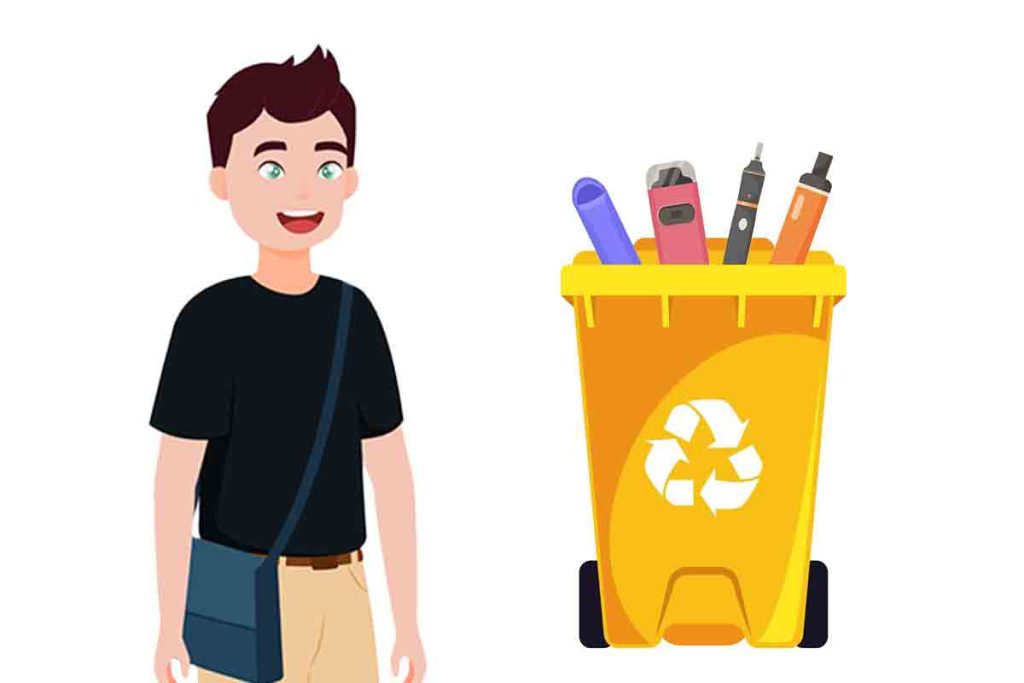
Why Vape Recycling Matters More Than Ever
Americans threw away 5.7 disposable vapes every second in 2023, according to CDC Foundation data analyzed by U.S. PIRG. That is nearly 500,000 devices per day, and the number keeps climbing. In the UK, more than 6 million vapes and vape pods are still discarded every week as of early 2026, even after a nationwide ban on single-use disposables took effect.
The environmental stakes are real. Every disposable vape contains a lithium-ion battery, plastic housing, electronic circuitry, and leftover e-liquid. Tossed into household trash, those batteries get crushed in waste trucks and compactors. They catch fire. U.S. PIRG estimates that vape-related fires at waste facilities cost at least $95 million per year. The lithium inside discarded disposables adds up to roughly 30 tons annually, enough to build about 3,350 electric vehicle batteries.
This guide lays out what is inside a used vape, why improper disposal is dangerous, what the regulations actually say in 2026, and exactly how to recycle your device. No fluff. Just the steps you need.
What Is Inside a Used Vape?
Whether you are holding a disposable vape or a rechargeable pod system, the components are essentially the same:
- Lithium-ion battery, Typically 400 to 1,000 mAh in disposables. This is the most dangerous component when mishandled. Damaged cells can short-circuit, overheat, and ignite.
- Plastic housing, Polycarbonate or ABS casing. Non-biodegradable. Most recycling centers cannot process it alongside regular plastics because of contamination from e-liquid residue.
- Electronic circuitry, Small printed circuit boards with wiring, sensors, and in newer models, LED screens. These contain trace amounts of copper, gold, and other recoverable metals.
- E-liquid reservoir and wicking material, The pod or tank holds nicotine salt e-liquid. The cotton or silica wick is saturated with it. Both are hazardous waste. Nicotine is toxic to aquatic life and can be absorbed through skin.
Why does this matter? Because each of those materials requires a different disposal pathway. You cannot toss the whole device in a blue bin and call it done.
The Environmental Cost of Throwing Vapes in the Trash
Battery Fires
This is the most immediate risk. When a lithium-ion battery is punctured, crushed, or exposed to heat, it can enter thermal runaway, a chain reaction that produces intense heat and toxic gases. Waste facilities across the U.S. and UK have reported a sharp rise in fires linked to vape batteries. Fire Rover, which monitors waste facility incidents, notes that what used to be a summertime spike has flattened into a year-round elevated baseline of risk.
These fires endanger workers, destroy equipment, and push up insurance costs for recycling facilities. Some facilities have had to shut down temporarily after battery fires contaminated entire loads of recyclable material.
Toxic Contamination
Nicotine is classified as an acute toxic hazard by the EPA. When a vape leaks in a landfill, residual e-liquid can seep into groundwater. The plastic casings do not decompose for hundreds of years. Heavy metals from circuit boards, including lead and cadmium traces, accumulate in soil.
Wasted Resources
Lithium is not infinite. Mining it carries significant environmental and human costs. Every disposable vape that ends up in a landfill is a small but real loss of a material that could be recovered and reused. U.S. PIRG calculates that the 178.7 million disposable vapes sold annually in the U.S. alone contain approximately 30 tons of lithium. Recovering even a fraction of that would offset the need for new mining.
Regulatory Landscape in 2026
United States
The EPA’s current guidance is clear: do not put e-cigarettes in household trash or recycling. Take them to a household hazardous waste (HHW) collection site. The agency warns that lithium batteries can cause fires and that nicotine is toxic to both workers and the environment.
There is no federal mandate requiring vape manufacturers to run take-back programs. Some states are moving on their own. California, which already bans flavored tobacco sales, treats vape cartridges as hazardous waste that can only be disposed of at authorized facilities. But enforcement and infrastructure vary wildly from state to state.
The Vape Waste Project, a non-profit launched in 2025, is trying to fill the gap. It offers a 10-cent credit for each used vape sent in for recycling and is pushing for design changes that make devices easier to dismantle and recycle at scale.
United Kingdom
The UK banned the sale of single-use disposable vapes on June 1, 2025. Fines for retailers start at £200, with unlimited fines or jail time for repeat offenders. According to the UK government, the proportion of vapers using single-use devices fell from 30% in 2024 to 24% in 2025, and among 18-to-24-year-olds it dropped from 52% to 40%.
But here is the catch: the ban only covers single-use disposables. Pod-based systems and “big puff” refillable devices are not included, and Material Focus, the UK’s WEEE compliance organization, has warned that these products pose the same environmental risks. Over 6 million vapes and pods are still being discarded weekly, straining recycling systems.
Under the Tobacco and Vapes Act 2026, the UK is also introducing a vape tax of £2.20 per 10 mL starting October 2026, which may further shift consumption patterns but does not directly address waste.
Canada
Call2Recycle (now operating as The Battery Network in the U.S.) runs the Recycle Your Vapes program across multiple provinces. Nearly 200 participating vape shops and municipal eco-centres in Québec alone accept single-use and rechargeable devices. The program is expanding into other provinces through 2026.
EU and Beyond
Under the WEEE Directive, vapes are classified as electronic waste. Bulgaria received European Commission approval to ban disposable vapes entirely. Several other EU member states are considering similar measures. Globally, more than 40 countries now restrict e-cigarette sales in some form. For a detailed breakdown, see our country-by-country vape regulation analysis.
How to Recycle a Used Vape: Step-by-Step
Step 1: Prepare Safely
Before you do anything with a dead vape:
- Put on disposable gloves. Nicotine absorbs through skin. If the device is leaking, this is not optional.
- Work in a ventilated area. If the battery is swollen or hissing, move it outside immediately and keep it away from flammable materials.
- Do not try to charge a damaged device. If the battery looks swollen, dented, or hot, do not plug it in.
- Tape the battery terminals. If they are exposed, cover them with non-conductive tape (electrical tape or masking tape) to prevent short circuits.
Step 2: Find a Recycling Location
This is where most people get stuck. You have a few options, and some are better than others:
| Option | What They Take | How to Find One |
|---|---|---|
| Household Hazardous Waste (HHW) site | Whole devices, batteries, e-liquid | Search your county or city waste authority website |
| Vape shop take-back | Whole devices (varies by store) | Call ahead; not all shops participate |
| Call2Recycle / The Battery Network | Batteries, some full devices | call2recycle.org/locator |
| Vape Waste Project (mail-in) | Whole disposable and rechargeable devices | vapewasteproject.org (10¢ credit per device) |
| Retail drop-off (Best Buy, Home Depot) | Batteries only (not full devices) | Check store websites for restrictions |
The single best option for most people is an HHW collection site. They are free, equipped to handle hazardous materials, and available in most counties. The EPA recommends this route.
If you cannot find an HHW site nearby, the Vape Waste Project offers a mail-in option and pays a small incentive. Call2Recycle’s drop-off network is extensive for batteries, though not all locations accept full vape devices.
Step 3: Disassemble If You Can (and Only If You Can)
Some devices are designed to be opened. Others are glued shut. If yours has screws and you can safely separate the battery from the e-liquid pod, do it. Separate components are easier for recyclers to process.
If the device is sealed and you would need to pry it open with force, do not bother. Take the whole thing to an HHW site or mail it to the Vape Waste Project. Forcing open a sealed vape can puncture the battery, and that is how fires start.
Step 4: Handle Each Component Properly
- Battery: Take to a battery recycling drop-off (Call2Recycle, HHW, or retail store). Never put it in regular trash or curbside recycling.
- Plastic casing: If clean and free of e-liquid residue, it can go in e-waste recycling. If contaminated, treat as hazardous waste.
- E-liquid and wicks: Always hazardous waste. Do not rinse them out. Do not dump e-liquid down the drain. Seal in a small container and bring to HHW.
- Circuit board: Goes in e-waste. Contains recoverable metals.
What About the UK After the Ban?
If you are in the UK, the process is similar but the infrastructure is different. Local council recycling centres accept vapes as small electrical waste (WEEE). Many vape shops participate in take-back schemes funded through producer compliance schemes. Material Focus runs the Recycle Your Electricals locator to find your nearest drop-off point.
The ban on single-use disposables does not mean zero vape waste. Pod systems and big puff devices still end up in the bin. The same rules apply: take them to a WEEE recycling point, not household waste.
What Retailers and Manufacturers Should Be Doing
Consumers can only do so much when the infrastructure is patchy and the devices are not designed for recycling. The real shift needs to happen upstream:
- Removable batteries. EU battery regulations taking effect in 2027 require portable devices to have user-replaceable batteries. This would make recycling dramatically easier.
- Producer take-back mandates. Some jurisdictions are requiring manufacturers to fund collection and recycling programs. The UK’s WEEE system already does this for electronics broadly, and vapes should be no exception.
- Standardized recycling labeling. Most vapes have no recycling information on the packaging. That needs to change.
- Design for disassembly. Glued-shut devices are difficult to recycle. Snap-fit or screwed assemblies would allow recyclers to separate components quickly and safely.
Until those changes happen, the burden falls on you to seek out proper disposal. It is not convenient, but it matters.
Quick-Reference FAQ
Can I throw a vape in the regular trash?
No. The EPA explicitly advises against this. The lithium-ion battery can cause fires, and nicotine is toxic. Take it to a household hazardous waste collection site instead.
Can I put a vape in my curbside recycling bin?
No. Vapes are not accepted in any curbside recycling program. The batteries and e-liquid contaminate the recycling stream and pose fire risks to workers and facilities.
What if my vape is still half full of e-liquid?
Do not try to empty it into a sink or drain. The e-liquid is hazardous waste. Take the whole device to an HHW site or use a mail-in program like the Vape Waste Project.
Are vape shops required to accept used devices?
Not federally in the U.S. Some states and localities have their own rules. In the UK, many shops participate in WEEE-funded take-back schemes, but it is not universal. Call ahead to confirm.
What about refillable pod systems, do those count as e-waste?
Yes. Any device with a battery and electronic components is e-waste. The recycling process is the same: take it to an HHW site, WEEE recycling point, or participating vape shop.
Is the Vape Waste Project legitimate?
It is an independent non-profit that collects used vapes by mail and pays a 10-cent credit per device. They partner with certified recyclers. For details, visit vapewasteproject.org.
The Bottom Line
Vape waste is not going away on its own. The UK ban on single-use disposables is a step, but pods and big puff devices are already filling the gap. In the U.S. there is no federal framework, and the recycling infrastructure is a patchwork of local programs that most consumers do not know about.
What you can do right now: do not throw vapes in the trash. Find your nearest HHW site or battery recycling drop-off. Use the Vape Waste Project if you do not have a local option. Switch to a refillable device if you have not already. And if you want to push for systemic change, support legislation that holds manufacturers responsible for the waste their products create.
For more on what disposables are and how they work, see our complete guide to disposable vapes. For regulatory details by country, check our global vape regulation analysis.



For me, it’s still too troublesome. I like to use vape at home? You still want me to spend money to mail the vape that I have already smoked?
You want me to pay? I definitely won’t pay for recycling.