

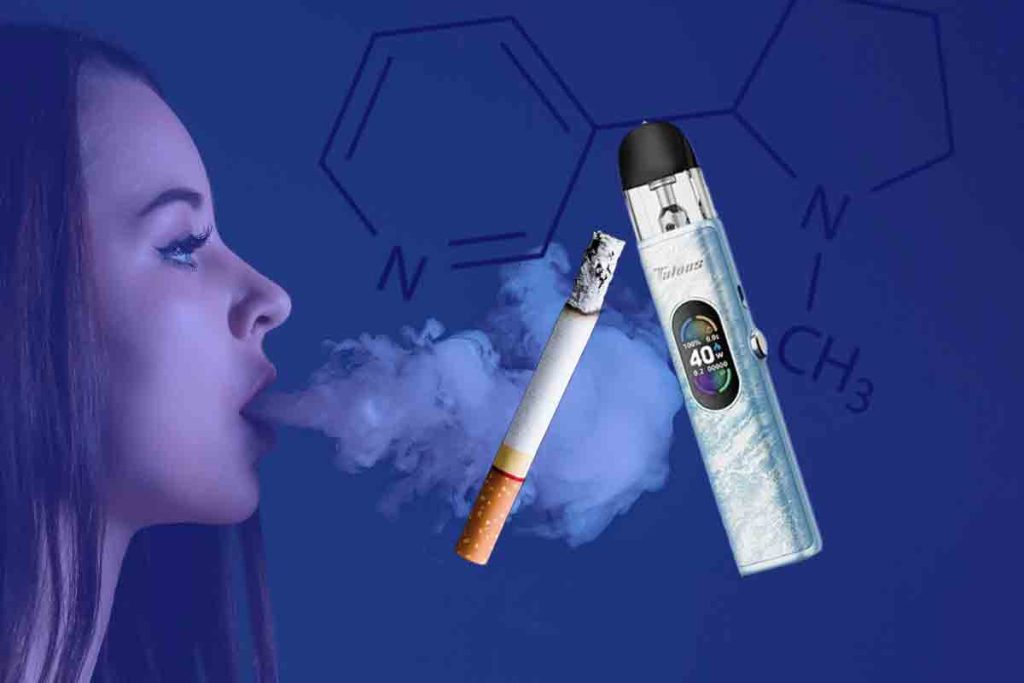
A cigarette delivers about 1 to 2 mg of nicotine to your bloodstream. A JUUL pod at 5% nicotine, vaped over roughly 200 puffs, delivers a comparable amount. But the numbers alone do not tell the whole story, because the way nicotine reaches your brain from a cigarette is different from how it gets there from a vape.
Here is what the pharmacokinetic research shows, what the CDC and other health authorities say, and why it matters if you are switching from smoking to vaping.
Nicotine content: cigarettes vs. vapes
A typical cigarette contains 10 to 12 mg of nicotine total. Only about 1 to 2 mg is actually absorbed. The rest is lost in side-stream smoke (the smoke that drifts from the lit end between puffs) and in exhalation.
Vapes work differently. There is no side-stream loss because the device only produces aerosol when you puff. But the total nicotine in a vape can be much higher than in a single cigarette:
| Product | Total nicotine | Nicotine absorbed (approx.) |
|---|---|---|
| 1 cigarette | 10-12 mg | 1-2 mg |
| 1 pack of cigarettes (20) | 200-240 mg | 20-40 mg |
| 1 JUUL pod (0.7 mL, 5%) | ~41 mg | Roughly 1 pack equivalent* |
| Elf Bar BC10000 (16 mL, 5%) | ~800 mg | Varies widely |
| Refillable pod (2 mL, 20 mg/mL) | 40 mg per fill | Varies by usage |
| Sub-ohm tank (5 mL, 3 mg/mL) | 15 mg per fill | Lower per puff, more puffs |
*JUUL has stated that one 5% pod delivers nicotine roughly equivalent to a pack of cigarettes. Independent research broadly supports this, though individual results vary.
The key difference: a cigarette is a fixed dose (1-2 mg absorbed), while a vape is variable. How much nicotine you get from a vape depends on the device, the e-liquid, your puffing style, and how experienced you are.
How nicotine absorption differs
This is where the comparison gets interesting. Nicotine from a cigarette reaches peak blood concentration (Cmax) in about 2 to 5 minutes. It hits fast and hard. That rapid spike is a big part of what makes cigarettes so addictive.
With vaping, the rise is generally slower. Peak blood nicotine levels are typically reached in 5 to 10 minutes. A 2017 study published in the Annual Review of Physiology found that experienced e-cigarette users could achieve plasma nicotine levels similar to smokers, but it took longer to get there.
| Parameter | Cigarette | Vape (nicotine salts) | Vape (freebase) |
|---|---|---|---|
| Time to peak (Tmax) | 2-5 min | 5-8 min | 8-15 min |
| Peak concentration (Cmax) | High | Moderate-high | Low-moderate |
| Total exposure (AUC) | Baseline | Comparable in experienced users | Lower |
| Subjective “hit” | Immediate, intense | Quick, smoother | Gradual, noticeable |
| Addiction potential | Highest | High (concentrated delivery) | Moderate |
Why the difference? Cigarette smoke contains nicotine in particles small enough to deposit deep in the alveoli, where absorption into the bloodstream is nearly instantaneous. Vape aerosol particles are larger on average, and more nicotine deposits in the upper airways where absorption is slower.
Nicotine salts narrow this gap. The benzoic acid in nicotine salt formulations produces smaller aerosol particles and allows higher concentrations without the harsh throat hit, making the absorption profile closer to that of a cigarette.
Why experience matters
One of the most consistent findings in the research is that experienced vapers absorb significantly more nicotine than new vapers using the same device. A 2016 study in the journal Nicotine and Tobacco Research found that naive e-cigarette users achieved only about 35 to 50 percent of the blood nicotine levels of experienced users during the same session.
The reason is behavioral. Experienced vapers learn to take longer, deeper puffs. They hold the vapor in their lungs longer. They know how to prime the coil and adjust power settings for maximum delivery. New vapers tend to take short, tentative puffs that produce less aerosol and absorb less nicotine.
This has real implications for smokers trying to switch. If you pick up a vape for the first time and it does not feel like it is “working,” it might not be the device. It might be your technique. MTL (mouth-to-lung) vaping, which mimics the draw of a cigarette, tends to deliver nicotine more efficiently for new users than DTL (direct-to-lung) draws.
Freebase nicotine vs. nicotine salts: what smokers need to know
If you are comparing vape nicotine to cigarette nicotine, the type of nicotine in your e-liquid makes a big difference.
- Freebase nicotine (0-12 mg/mL typical range) is alkaline and harsh at higher concentrations. At 6 mg/mL, a vaper gets a moderate dose per puff with a noticeable throat hit. Blood nicotine rises gradually. This formulation is better suited for sub-ohm devices that produce large vapor volumes at low concentrations.
- Nicotine salts (20-50 mg/mL typical range) are smoother and absorb faster. A 50 mg/mL salt formulation in a pod system can deliver blood nicotine levels approaching those of a cigarette within minutes. This is why most disposable vapes and pod systems use nicotine salts. It is also why these products are the most effective at satisfying smokers’ cravings and the most addictive.
The practical takeaway: if you are a pack-a-day smoker switching to vaping, a nicotine salt device at 20-50 mg/mL will feel closer to smoking than a freebase device at 3-6 mg/mL. But the nicotine salt device also carries a higher dependence risk because it delivers nicotine more efficiently.
Health implications
Nicotine is nicotine, regardless of whether it comes from a cigarette or a vape. It is the same molecule. It has the same effects on the body: it raises heart rate and blood pressure, it is highly addictive, it harms adolescent brain development, and it is toxic to fetuses.
What differs is everything else that comes with it.
| Cigarette smoke | Vape aerosol | |
|---|---|---|
| Nicotine | Present, rapid delivery | Present, slower delivery |
| Tar | Present (from combustion) | Not present |
| Carbon monoxide | Present | Not present |
| Known carcinogens | 70+ | A few, at lower levels |
| TSNAs | High | Trace |
| Heavy metals | Present | Present (from coils), generally lower |
| Formaldehyde | High | Low-moderate (depends on power) |
Public Health England has stated that vaping is “a fraction of the risk of smoking.” The CDC says e-cigarettes “may have the potential to benefit adults who smoke” as a complete substitute. The critical word is “complete.” Dual use, where someone both smokes and vapes, does not eliminate the risks of smoking.
If you are choosing between smoking and vaping, the evidence clearly favors vaping. If you are choosing between vaping and not using nicotine at all, the evidence favors not using nicotine. Nicotine itself is not a carcinogen, but it is not harmless either.
Nicotine dependence: cigarettes vs. vapes
Cigarettes are engineered to maximize nicotine delivery and dependence. The tobacco industry spent decades optimizing puff count, filter ventilation, and nicotine formulation to ensure rapid absorption and a strong reinforcement loop. The faster nicotine reaches the brain, the stronger the associative learning, and the harder it is to quit.
Vapes can deliver comparable nicotine levels, especially with nicotine salts at high concentrations, but the delivery profile is generally slower. This matters for dependence in two ways:
- Slower delivery may reduce abuse potential. The National Academies of Sciences, Engineering, and Medicine concluded in 2018 that e-cigarettes generally deliver lower peak nicotine levels than cigarettes, which could mean lower dependence risk per session.
- But availability and frequency can offset this. Vapes do not burn out after 5 minutes. You can take a puff here and there all day long, which some users do. This constant low-level dosing can maintain dependence even without the sharp peaks that cigarettes produce.
The 2018 National Academies report also noted that there is “substantial evidence” that e-cigarette use results in symptoms of dependence, and that more frequent use is associated with higher dependence levels.
Frequently asked questions
Is vape nicotine the same as cigarette nicotine?
Chemically, yes. It is the same nicotine molecule regardless of the delivery system. The difference is in how much reaches your bloodstream and how quickly. Cigarettes deliver it faster; vapes deliver it more slowly but can deliver comparable total amounts, especially with nicotine salts.
How many puffs of a vape equal one cigarette?
There is no fixed answer. Rough estimates suggest 10 to 15 puffs on a 5% nicotine salt pod system might deliver nicotine comparable to one cigarette, but this varies based on puff duration, device power, and individual absorption. A JUUL pod (about 200 puffs) is marketed as roughly equivalent to a pack of 20 cigarettes.
Can vaping deliver more nicotine than smoking?
In terms of total nicotine content, yes. A 10,000-puff disposable at 5% contains about 800 mg of nicotine, compared to about 200-240 mg in a pack of cigarettes. But total content does not equal absorption. Actual blood nicotine levels depend on how much aerosol you inhale and how efficiently your body absorbs it.
Why does vaping feel different from smoking?
Two reasons. First, the nicotine from a cigarette hits faster, producing a more intense immediate sensation. Second, cigarette smoke contains monoamine oxidase inhibitors (MAOIs) that amplify nicotine’s effect on the brain. Vape aerosol does not contain MAOIs, which is one reason some smokers find vaping less satisfying even at comparable nicotine doses.
Is it easier to quit vaping than smoking?
The evidence is mixed. Some studies suggest that because vaping delivers nicotine more slowly, it may be easier to step down. Other research shows that the constant availability of a vape (no need to go outside, no burning end that forces you to stop) can make it harder to quit. If you want to quit vaping, the same evidence-based approaches that help with smoking cessation (NRT, varenicline, counseling) are recommended.
Does vaping cause stronger nicotine dependence than smoking?
Not necessarily. Cigarettes deliver nicotine faster, which is associated with higher abuse potential. But high-nicotine disposable vapes used frequently throughout the day can maintain strong dependence. The 2018 National Academies report concluded that e-cigarettes produce dependence symptoms, but the evidence on whether they cause stronger or weaker dependence than cigarettes is inconclusive.
What about dual use?
The CDC is clear: dual use (smoking some cigarettes and vaping some) “is not an effective way to safeguard health.” You get the toxicants from cigarettes plus the chemicals from vape aerosol. The health benefit of switching only comes from switching completely.




I used to smoke cigarettes, but now I use vape, and for me there is not much difference between the two.