

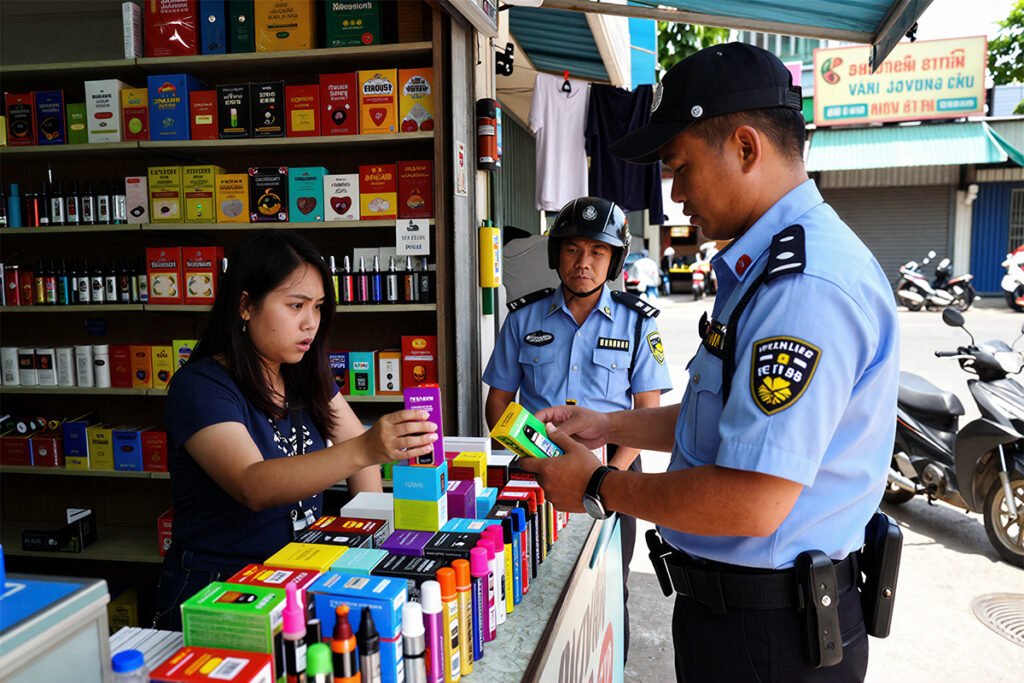
Vietnam has moved from policy intent to penalty-backed enforcement on e‑cigarettes and heated tobacco, approving a decree that fines users and obliges destruction of products while raising liability for venues that tolerate use. The measures come on the heels of a National Assembly decision to prohibit manufacturing, trade, import, harboring, transport, and use of these products from 2025 in the name of public health.
Key provisions in Decree 371, which takes effect on December 31, 2025:
- Users face fines of 3–5 million VND (roughly US$120–$210) and must destroy the products.
- Individuals who host or tolerate users at premises they own or manage face 5–10 million VND in fines (about US$210–$420); penalties double for organizations (10–20 million VND).
- Definitions are expansive: e‑cigarettes include the electronic device, any container that holds e‑liquid, and the e‑liquid itself; heated tobacco includes the device and specially designed tobacco sticks.
The Ministry of Health has framed the crackdown as a public health necessity. Minister Dao Hong Lan cited nicotine addiction, a growing body of toxicants detected in aerosols, and rising hospitalizations as drivers. The ministry says at least 60 chemical compounds are present in e‑liquids, with additional harmful substances in emissions during use. In 2023, hospitals recorded 1,224 admissions linked to e‑cigarettes and heated tobacco, according to official figures.
Use is rising, especially among youth:
- Adults (15+): e‑cigarette use rose from 0.2% in 2015 to 3.6% in 2020.
- Students (ages 13–17): prevalence increased from 2.6% in 2019 to 8.1% in 2023.
- Girls (ages 11–18): preliminary data from 11 provinces shows 4.3% in 2023.
Vietnam becomes the sixth ASEAN country—and one of 43 globally—to prohibit e‑cigarettes and heated tobacco outright. The Government has been tasked by the National Assembly to implement the ban and intensify public education, particularly for adolescents.
What the penalty design signals
- User-centric deterrence: Vietnam isn’t only targeting sellers and importers. By fining end users and mandating product destruction, the decree aims to shrink demand and reduce casual or social use, a lever some countries avoid for fear of criminalizing consumers.
- Third-party liability: The “harboring” clause effectively deputizes property owners and managers—from cafés and bars to landlords and event organizers—by exposing them to penalties if they allow vaping or heated tobacco use on-site. The doubled fines for organizations emphasize business compliance and venue-level enforcement.
- Closing definitional gaps: By specifying that components, containers, and e‑liquid fall under the definition, the rule curtails the common “parts and supplies” gray market in which devices or refills circulate separately from finished kits.
Public health calculus vs. harm reduction arguments
Vietnam’s stance is clear: youth protection and risk prevention outweigh any harm-reduction rationale for adult smokers. The ministry’s messaging centers on nicotine dependence, toxicant exposure, acute lung injury, cardiovascular and respiratory risks, and mental health impacts—areas where evidence is still evolving but where precautionary policy has gained political traction.
By contrast, proponents of regulated vaping argue that adult smokers benefit from access to lower-risk alternatives when products are standardized, taxed, and age-gated. Vietnam’s prohibition removes that pathway and will likely funnel cessation efforts through traditional nicotine replacement therapies and counseling within the health system. The Government’s parallel push for public awareness campaigns suggests it understands enforcement alone won’t meet its objectives without shifting perceptions and behavior.
Implementation risks and likely pressure points
- Illicit market dynamics: Prohibitions can suppress visible retail while shifting supply to informal channels and cross‑border flows. Vietnam’s long coastline and porous land borders will test customs and market surveillance. Expect a pivot to small‑parcel shipping, social commerce, and encrypted messaging groups unless digital enforcement keeps pace.
- Platform responsibility: The harboring provision will extend to digital marketplaces and payment facilitators if authorities interpret “management” broadly. Watch for takedown orders, keyword bans, and coordinated sweeps across e‑commerce and social platforms.
- Venue enforcement: Bars, cafés, karaoke lounges, student housing, and event spaces become frontline actors. Clear signage, staff training, and routine inspections will follow if authorities want compliance rather than symbolic deterrence.
- Product disposal: The requirement to destroy seized or surrendered products needs practical guidance—chain‑of‑custody, environmental handling of batteries and nicotine liquids, and audit trails to prevent re‑circulation.
- Measurement and transparency: With prevalence already climbing among teens, the credibility of the policy will depend on whether youth uptake falls over the next two to three school years and whether hospital admissions decline. Publicly available indicators will be important to assess outcomes beyond seizures and fines.
Business implications
- Immediate chilling effect on legitimate supply: The National Assembly’s 2025 prohibition has already deterred investment and import plans. Decree 371 codifies penalties that reach end users and venues, further shrinking visible demand.
- Compliance uncertainty window: The decree’s effective date is December 31, 2025, while the legislative ban begins in 2025. Expect implementing circulars to clarify sequencing, transitional inventory treatment, and agency roles. Retailers and logistics firms will look for guidance on existing stock and contract wind‑downs.
- Tobacco portfolio shifts: As heated tobacco falls under the same prohibition, multinational and domestic tobacco strategies in Vietnam will refocus on combustible products and non‑tobacco categories not covered by the decree. This reduces any near‑term commercial rationale for alternative-nicotine lines in the country.
Regional context without the noise
ASEAN is split between prohibition and regulation. Vietnam’s move aligns with countries prioritizing deterrence and youth protection via bans. Others have opted for stringent regulation, taxation, and adult-only retail frameworks. The practical outcomes hinge less on the label—ban or regulate—and more on the execution: border control, digital enforcement, retailer oversight, and sustained health communication.
What to watch next
- Implementing guidance: Expect circulars detailing enforcement protocols, disposal standards, and agency coordination.
- Digital enforcement: Rules for online marketplaces and social media, plus cooperation with telecoms and payment providers.
- Cross‑border controls: Customs advisories, postal inspections, and cooperation with neighboring states.
- Public-health metrics: Youth prevalence (13–17), adult smoking substitution patterns, and hospital admission trends through 2026.
- Litigation or petitions: Any industry or civil-society challenges to the scope of definitions or the proportionality of fines.
Vietnam has chosen prohibition backed by user-level fines, venue liability, and expansive product definitions to arrest the rise of vaping and heated tobacco. The policy’s success will be judged not by the number of seizures or press releases, but by whether youth uptake falls, hospitalizations decline, and illicit markets are contained. The Government’s next step—clear, operational guidance—will determine whether this becomes a durable public-health intervention or a regulatory push that drives the market further underground


Follow the wider vape market
Read the latest vape news
Track regulation, launches and industry updates.
Open vape news →Browse product data
Move from market news to device specifications.
Open product data →Check product reviews
Read independent testing and comparison reports.
Read review coverage →