


News Summary
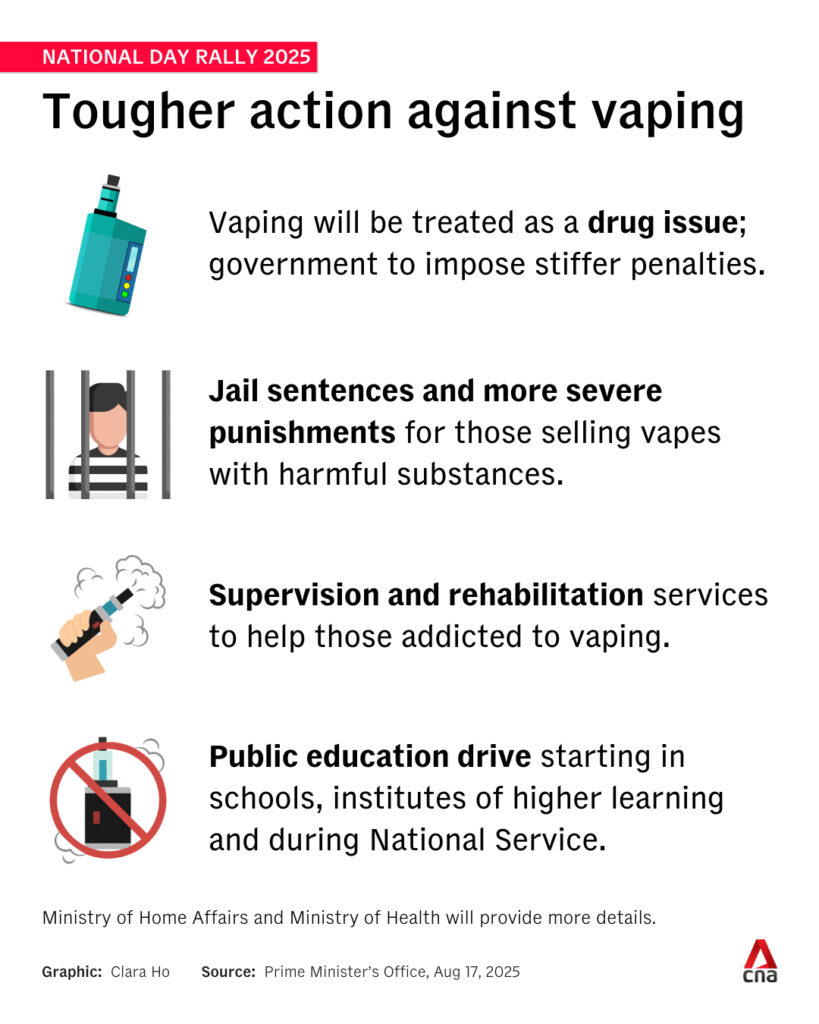
Singapore’s Prime Minister Lawrence Wong announced a drastic pivot in vaping policy during his National Day Rally address (August 17), reclassifying vaping from a “tobacco-like” issue to a “drug-equivalent” offense. Three key measures were unveiled:
- Severe Penalties: Jail terms for selling/possessing vapes with harmful substances (replacing prior fines), especially targeting youth sales;
- Crackdown on Toxic Additives: Focus on intercepting illicit vapes laced with anesthetic Etomidate (“Kpods“), with PM warning of “future adulterants being more dangerous”;
- Nationwide Education Campaign: Led by Home Affairs and Health ministries across schools, universities, and national service camps to build a “whole-society defense framework”.
The PM cited dual crises driving this shift:
- Youth Epidemic: Despite a ban, vaping prevalence surges among teens;
- Safety Black Hole: Smuggled devices often contain unlabelled addictive substances (e.g., Etomidate), which can cause respiratory failure outside medical settings.
Commentary: The Double-Edged Sword of Zero Tolerance
Singapore’s radical move establishes the world’s strictest vaping regime. Yet, equating vaping with narcotics raises critical questions: Does this truly serve youth protection and public health—or risk undermining science?
I. Policy Logic: The Thin Line Between Pragmatism & Dogma
The drug classification offers short-term enforcement leverage:
- Etomidate Crisis: This ICU anesthetic, found at 5x overdose levels in seized “Kpods” (per Malaysia customs), caused multiple teen hospitalizations in 2023; Vape products containing Kpods have recently become popular in Singapore, posing a challenge to social stability.
- Black Market Dismantling: With 300% profit margins for Indonesia-sourced “Kpods”, criminal penalties may disrupt supply chains.
However, blanket criminalization obscures core complexities:
“Vapes are just delivery devices. The real danger is what’s inside.” (PM’s core argument)
If devices are mere “vessels”, targeting illicit additives—not the vessel itself—should be prioritized. Lumping devices with drugs invalidates vaping’s harm-reduction potential, contrasting sharply with the UK’s NHS prescribing e-cigarettes for smoking cessation.
II. The Youth Protection Paradox: When Bans Breed Black Markets
History reveals prohibition’s unintended consequences:
- Demand Resilience: Singapore’s 2022 vape seizures rose 48% YoY, with teens sharing “detection-evasion” tactics;
- Quality Freefall: Categorizing all vapes as “drugs” eliminates user discernment, incentivizing black markets to develop deadlier concoctions.
Norway’s balanced approach offers lessons: Strict sales restrictions (pharmacies-only) paired with legal nicotine access cut youth smoking from 25% (2016) to 7% (2023). An enforcement-heavy model could trap Singapore in an endless “war on vapes.”
III. Solutions: Three-Tiered Policy Reformation
- Lab-Grade Regulation
Mandate e-liquid composition testing; deploy customs screening tools (e.g., Raman spectrometers) to identify Etomidate—reducing reliance on device-focused raids. - Generational Firewall
Adopt New Zealand’s “Smokefree Generations” model: Legalize regulated vaping for adults born before 1989 while banning sales/use for younger cohorts. - Defensive Technology
Roll out biometric locks (e.g., Australia’s VapeGuard) ensuring adult-only device activation, eliminating youth access,
Conclusion: Balancing Idealism and Realism
Singapore’s paradigm-shifting move reflects a small nation’s decisiveness against emerging threats. Yet its core contradiction—equating technology with criminality—risks missing precision-regulation opportunities. As the UK plans to distribute free vapes to 1 million smokers, Singapore may inadvertently push youth toward toxic alternatives. One certainty remains: Policy experimentation extracts its highest cost from the young.
Sources: Singapore Health Ministry’s 2023 Drug Control Report; Norwegian Institute of Public Health (NIPH); ASEAN Narcotics Monitoring Network.




Follow the wider vape market
Read the latest vape news
Track regulation, launches and industry updates.
Open vape news →Browse product data
Move from market news to device specifications.
Open product data →Check product reviews
Read independent testing and comparison reports.
Read review coverage →