

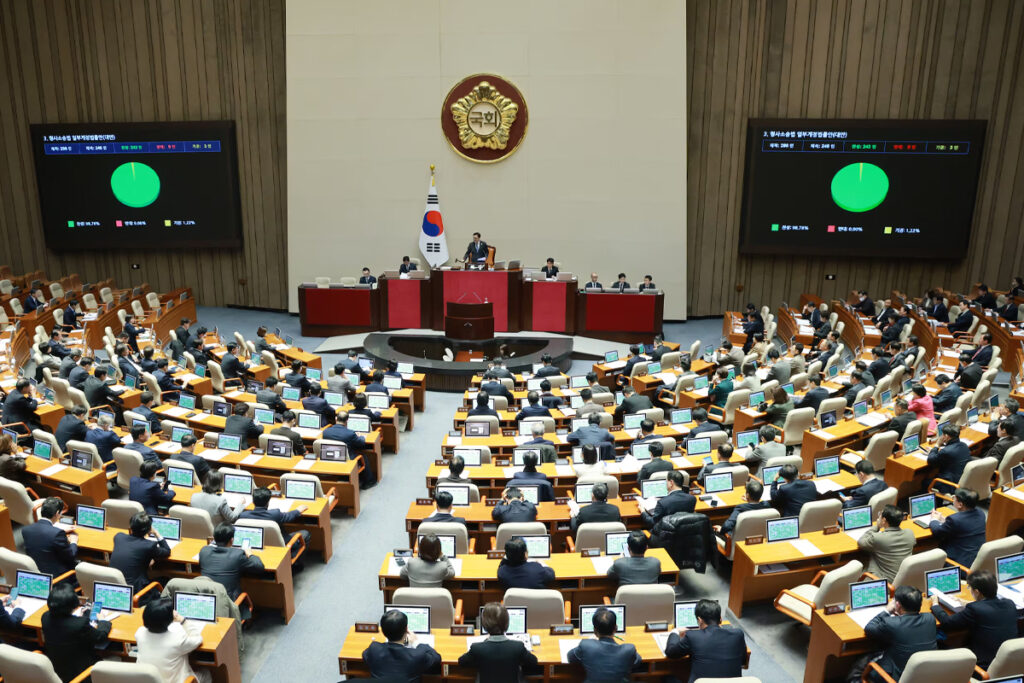
South Korea’s National Assembly on the 2nd pushed through a sweeping package of 79 non-contentious, livelihood-focused bills and 16 budget-related measures, headlined by a landmark amendment that classifies liquid e‑cigarettes using synthetic nicotine as “tobacco” under the Tobacco Business Act. The move closes a long-criticized regulatory gap and paves the way for substantial new tax revenue.
What changed for vapes
- Synthetic-nicotine liquids redefined as tobacco: Until now, products using lab-made nicotine were not legally “tobacco,” escaping tobacco-specific taxation and controls. With the amendment, synthetic-nicotine vape liquids will fall under the tobacco category and become taxable and more tightly regulated.
- Market impact: Roughly 95% of Korea’s liquid e‑cigarette market is estimated to use synthetic nicotine. The new classification effectively brings the vast majority of vape liquids into the tobacco regime.
- Fiscal effect: The National Assembly Budget Office projects approximately 930.1 billion won in additional tax revenue once the measure takes effect.
- Policy trajectory: Legislative attempts dating back to 2016 repeatedly stalled amid industry resistance. This passage signals a decisive policy realignment toward parity between synthetic and tobacco-derived nicotine products.
Why it matters for the vape industry
- Pricing and demand: New excise burdens typically translate into higher retail prices. Expect a near-term price reset across liquid e‑cigarette SKUs, with potential demand elasticity effects—particularly among price-sensitive adult users.
- Compliance and labeling: Manufacturers and importers will need to align with tobacco-product registration, labeling, reporting, and distribution rules. Distributors and retailers should prepare for tobacco-category licensing and audit requirements.
- Product strategy: Brands built around “synthetic” positioning will lose their tax advantage. Reformulations will not bypass tobacco status if nicotine is present; non-nicotine SKUs may see renewed interest but face their own regulatory considerations.
- Competitive balance: The change levels the playing field between synthetic and tobacco‑derived nicotine products. Heated tobacco and closed-system pods may regain share depending on final tax incidence and consumer switching behavior.
Other major measures passed
- Healthcare workforce: A “regional doctor training support act” mandates a regional doctor track for a portion of medical school seats. Tuition for selected students will be publicly funded in exchange for a 10‑year service commitment at regional public medical institutions post-licensure.
- Industry and criminal law:
- Petrochemical sector restructuring support with tax, fiscal, and employment measures.
- Child and juvenile protection law amendment removing statutes of limitations for sexual violence involving relatives.
- Criminal Act amendment raising the maximum penalty for fraud from up to 10 years imprisonment or 20 million won fine to up to 20 years or 50 million won.
Tax and budget package
- Corporate tax: Lawmakers approved the government’s plan to raise corporate tax rates by 1 percentage point across all brackets, reversing part of the prior administration’s cuts after last-ditch talks failed to bridge party differences.
- Education tax: The rate applicable to financial companies with operating revenue of 1 trillion won or more doubles from 0.5% to 1.0%.
- Income tax changes:
- The childbirth/childcare corporate payment exemption expands from “200,000 won per month” to “200,000 won per month per child.”
- Education expense credits now include arts and physical education academy fees for children in grade 2 or below (or under age 9).
- Additional enacted items: Amendments to the Corporate Tax Act, Education Tax Act, Inheritance and Gift Tax Act, National Finance Act, and International Tax Coordination Act passed as drafted, with several others—covering real estate taxation, special accounts for early childhood and higher/lifelong education, national tax procedures, VAT, customs, and individual consumption tax—approved in revised or substitute forms.
What to watch next for vape stakeholders
1) Implementation timeline and guidance: Expect enforcement notices clarifying tax rates per mL, SKU classification criteria, licensing, and labeling timelines. Transition provisions will be decisive for inventory already in market.
2) Tax structure specifics: How Korea calibrates excise (ad valorem vs. specific, or hybrid) across nicotine concentration tiers will shape product economics and flavor/NIC strategy.
3) Cross-category consistency: Alignment with heated tobacco and traditional cigarettes will inform consumer switching paths and illicit trade risks.
4) Legal challenges and lobbying: The industry may test definitions, taxation bases, or administrative burden in court or seek refinements in enforcement decrees.
5) Consumer response: Monitor shifts to disposables, DIY, or non‑nicotine liquids, and any uptick in parallel imports.
Korea’s reclassification of synthetic‑nicotine vape liquids as tobacco is a structural pivot that brings nearly the entire e‑liquid segment into the tobacco tax and regulatory net. For brands and retailers, the priority now is compliance readiness and swift pricing, labeling, and supply‑chain adjustments. For policymakers, the move promises sizable revenue and regulatory clarity—while the real test will be consumer behavior, market adaptation, and enforcement fidelity over the coming quarters




Follow the wider vape market
Read the latest vape news
Track regulation, launches and industry updates.
Open vape news →Browse product data
Move from market news to device specifications.
Open product data →Check product reviews
Read independent testing and comparison reports.
Read review coverage →