

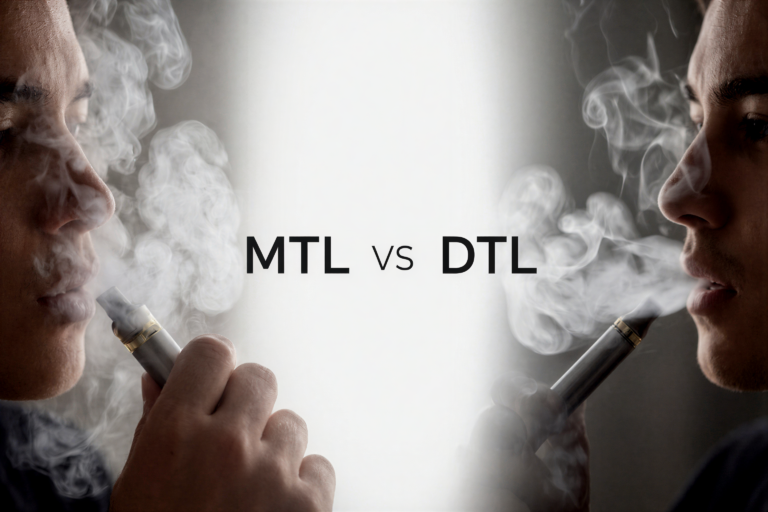
Buy a vape today and you’ll face an immediate question nobody explains properly: how do you actually inhale from this thing? The answer depends on whether you’re vaping mouth-to-lung (MTL), direct-to-lung (DTL), or somewhere in between with restricted direct-to-lung (RDL). These aren’t just jargon, they describe fundamentally different inhalation techniques that dictate what device you need, what e-liquid works, what nicotine strength makes sense, and what the experience feels like.
Get it wrong and you’ll cough, get a burnt hit, or wonder why vaping feels nothing like smoking. Get it right and everything clicks. Here’s how each style works, who it’s for, and how to choose.
MTL Vaping (Mouth to Lung)
MTL is how most people smoke a cigarette. You draw the vapor into your mouth, hold it briefly, then inhale into your lungs. Two steps. The draw is tight and deliberate, you feel resistance, similar to pulling air through a straw or a cigarette filter.
This is the style most switching from smoking to vaping start with, and for good reason. The mechanics match what your body already knows how to do. The throat hit, the scratchy sensation at the back of your throat that smokers associate with satisfaction, is pronounced and familiar.
How MTL Works
MTL devices use high-resistance coils (typically 1.0–1.8 ohm) at low wattage (8–20W). The airflow is restricted, which is what creates that tight draw. Because less air moves through the coil, less e-liquid is vaporized per puff, so the clouds are small and discreet, similar to cigarette smoke in volume.
The restricted airflow and lower wattage mean MTL devices run cooler. The vapor is warmer than ambient but not hot. And because you’re vaporizing less liquid per puff, you can use higher nicotine concentrations without overwhelming yourself.
Best E-Liquid for MTL
MTL vaping works best with 50/50 PG/VG or high-PG e-liquids (up to 60/40 PG/VG). Here’s why: propylene glycol (PG) is thinner than vegetable glycerin (VG), so it wicks through the small juice ports on high-resistance coils without issue. PG also carries flavor better and produces a sharper throat hit, both desirable for MTL vapers. High-VG liquids in an MTL device will give you dry hits and burnt coils because the liquid can’t flow through fast enough.
Nicotine strength: 12–20 mg/mL for freebase nicotine, or 20–50 mg/mL for nicotine salts. The nicotine salt formulation is what makes pod systems viable for smokers, high nicotine delivery with a smooth throat hit instead of the harshness that freebase nicotine produces at those concentrations.
Who MTL Is For
- New vapers transitioning from smoking
- People who want a discreet vape (small clouds, minimal odor)
- Vapers who prioritize throat hit and flavor intensity over cloud production
- Anyone using vaping as a step-down tool from nicotine, higher strengths are available, and the familiar draw makes the switch easier
Popular MTL Devices (2026)
- Uwell Caliburn G3 , Adjustable wattage, excellent flavor, 0.9 ohm and 1.2 ohm pods
- Vaporesso XROS 4 , Top-fill, long-lasting pods, consistent performance
- OXVA Xlim Pro , Compact, adjustable airflow, strong flavor from 0.6–1.2 ohm pods
- SMOK Novo 5 , Budget-friendly with 0.9 ohm mesh pods
DTL Vaping (Direct to Lung)
DTL is the opposite of MTL in almost every way. You skip the mouth entirely and inhale the vapor straight into your lungs, like taking a deep breath through the device. The draw is open and airy, more like breathing through a wide tube than a straw. There’s almost no resistance.
DTL vaping produces substantially more vapor per puff than MTL. We’re talking clouds that fill a room versus wisps that dissipate quickly. The flavor is different too, bigger, broader, but less concentrated than the tight, intense flavor from an MTL device.
The throat hit is lighter. Because DTL devices use lower nicotine e-liquids (more on that below), the scratch at the back of your throat is gentler. Some DTL vapers describe the sensation as smoother and more relaxed; others find it unsatisfying because they’re used to the sharper hit of MTL or cigarettes.
How DTL Works
DTL devices use low-resistance coils (typically 0.15–0.5 ohm) at high wattage (40–200W+). These are “sub-ohm” coils, coils with resistance below 1.0 ohm. The airflow is wide open, allowing large volumes of air to pass over the coil. More air + more wattage + lower resistance = more e-liquid vaporized per second = massive clouds.
The trade-off is e-liquid consumption. A DTL vaper can go through 5–10 mL of e-liquid per day, compared to 1–3 mL for an MTL vaper. The devices are also larger, heavy box mods with sub-ohm tanks aren’t pocket-friendly in the way a slim pod system is.
Best E-Liquid for DTL
DTL vaping requires high-VG e-liquids, typically 70/30 VG/PG or 80/20 VG/PG. VG is thicker and produces denser, smoother vapor. It’s also sweeter, which complements the dessert and fruit flavors popular among DTL vapers. The wide juice ports on sub-ohm coils handle thick liquid without problems.
Don’t use high-PG liquids in a DTL device. The thin liquid will flood the coil and leak through the airflow. And don’t use high nicotine, DTL devices vaporize so much liquid per puff that 12 mg/mL freebase nicotine would make most people nauseous.
Nicotine strength: 0–6 mg/mL freebase. Most DTL vapers use 3 mg/mL. That’s it. The volume of vapor compensates for the low concentration, you still get nicotine, just delivered through quantity rather than concentration.
Who DTL Is For
- Experienced vapers who want maximum vapor production
- Cloud chasers and hobbyist vapers
- People who’ve already quit smoking and no longer need a cigarette-like experience
- Anyone who vapes at low nicotine and wants a smoother, more relaxed draw
Popular DTL Devices (2026)
- GeekVape Aegis Legend 3 + Zeus Sub-Ohm , Rugged, waterproof, excellent flavor from Z-series coils
- VOOPOO Drag 5 + UFORCE-L Tank , High-wattage capable, PnP coils offer versatility
- Freemax Maxus 3 + Fireluke 4 , Top-tier mesh coil flavor
- Smok Mag Solo + TFV18 , Large capacity, extreme cloud production
RDL Vaping (Restricted Direct to Lung)
RDL sits between MTL and DTL. You inhale directly into your lungs like DTL, but the airflow is restricted, tighter than full DTL but looser than MTL. The draw feels like a loose MTL or a tight DTL, depending on your airflow setting.
This style has exploded in popularity since 2023 because it addresses a real gap. MTL can feel too tight and limiting. DTL can feel too loose and wasteful. RDL hits a sweet spot: enough airflow for a satisfying direct lung hit, enough restriction to keep flavor concentrated and nicotine effective at moderate strengths.
Some vapers also call this RDTL (Restricted Direct to Lung), same thing, different abbreviation. The industry hasn’t standardized the naming.
How RDL Works
RDL devices use coils in the 0.5–1.0 ohm range at moderate wattage (15–40W). The airflow is adjustable, you can tighten it toward MTL or open it toward DTL. This flexibility is the whole point. One device, one coil, multiple experiences depending on how you set the airflow.
Most modern pod systems now ship with RDL-capable coils alongside MTL coils. The Uwell Caliburn series, Vaporesso XROS series, and OXVA Xlim series all offer 0.6–0.8 ohm pods that work beautifully for RDL. This is why RDL has become the default for many vapers, it doesn’t require buying a separate device.
Best E-Liquid for RDL
RDL works with 50/50 PG/VG or 60/40 VG/PG e-liquids. The middle ground extends to the liquid, you need something thin enough to wick through mid-range coils but thick enough to produce satisfying vapor.
Nicotine strength: 6–12 mg/mL freebase, or 10–20 mg/mL nicotine salt. The moderate vapor production means you need more nicotine than DTL but less than MTL. Nicotine salts at 20 mg/mL work well in RDL pods for smokers who want a stronger hit.
Who RDL Is For
- MTL vapers who want more vapor without going full DTL
- DTL vapers scaling down to something more portable and discreet
- Anyone who can’t decide between MTL and DTL, RDL lets you adjust airflow to taste
- Smokers who find MTL too tight and restrictive
Side-by-Side Comparison
| Feature | MTL | RDL | DTL |
|---|---|---|---|
| Inhalation | Mouth → Lungs | Direct to lungs (restricted) | Direct to lungs (open) |
| Draw feel | Tight (like a cigarette) | Medium (adjustable) | Open and airy |
| Coil resistance | 1.0–1.8 ohm | 0.5–1.0 ohm | 0.15–0.5 ohm |
| Wattage range | 8–20W | 15–40W | 40–200W+ |
| PG/VG ratio | 50/50 or high PG | 50/50 to 60/40 VG | 70/30 or 80/20 VG |
| Nicotine (freebase) | 12–20 mg/mL | 6–12 mg/mL | 0–6 mg/mL |
| Nicotine (salts) | 20–50 mg/mL | 10–20 mg/mL | Not recommended |
| Throat hit | Strong and sharp | Moderate | Mild to light |
| Vapor production | Small, discreet | Medium | Large clouds |
| E-liquid per day | 1–3 mL | 3–5 mL | 5–10+ mL |
| Best for | New vapers, smokers transitioning | Versatile middle ground | Experienced vapers, cloud chasers |
| Device type | Pod systems, pen-style kits | Pod systems with adjustable airflow | Box mods, sub-ohm tanks |
| Battery life | Excellent (low power draw) | Good (moderate power) | Variable (high drain) |
Coil Types Explained
The coil is the component that determines which vaping style your device supports. You can’t put a 0.15 ohm sub-ohm coil in a slim pod system and expect MTL vaping, it won’t work. The coil resistance, wire material, and wicking material all matter.
Round Wire Coils
The simplest design, single wire wrapped into a coil. Cheap, reliable, and common in MTL devices. They heat evenly but have less surface area than mesh, meaning slightly less vapor and flavor per watt.
Mesh Coils
A strip of metal with holes punched in it, shaped into a cylinder. The larger surface area contacts more e-liquid, producing better flavor and more consistent vapor. Mesh coils have become the industry standard for both MTL and DTL, most modern pod systems ship with mesh coils exclusively.
Clapton and Fused Clapton
A thinner wire wrapped around a thicker core wire, resembling a guitar string. The added surface area improves flavor over round wire. Mostly found in rebuildable atomizers (RDAs, RTAs) and some sub-ohm tanks. Overkill for MTL, excellent for DTL flavor chasing.
Ceramic Coils
Ceramic wicking material instead of cotton. Claims include longer coil life and cleaner flavor. In practice, the difference is subtle and ceramic coils are less common in 2026. Some earlier safety concerns about ceramic particle inhalation haven’t been conclusively resolved.
Which Style Should You Start With?
If you’re switching from smoking, start with MTL. This isn’t a controversial recommendation, every major vape manufacturer designs their “starter kits” around MTL for a reason. The draw feels familiar. The nicotine delivery works at the concentrations smokers need. The devices are simple, portable, and affordable.
If MTL feels too restrictive after a few weeks, like you can’t get enough air through the draw, try RDL with a 0.6–0.8 ohm pod on the same device. Most pod systems support this. Open the airflow slightly, drop your nicotine by roughly half, and see if the looser draw feels better.
Don’t start with DTL unless you’ve already been vaping for a while. The open draw, high vapor volume, and low nicotine concentrations are a poor match for someone who’s used to cigarettes. You’ll either get too much vapor and cough, or too little nicotine and crave a cigarette.
Transitioning Between Styles
Many vapers follow a natural progression: MTL → RDL → DTL as they become more experienced and gradually reduce nicotine. This isn’t mandatory, some vapers stay with MTL indefinitely and that’s fine. But if you find yourself wanting more vapor and a looser draw, the progression looks like this:
- Month 1–3 (MTL): 1.0–1.2 ohm pod, 50/50 e-liquid, 12–20 mg/mL nicotine salt
- Month 3–6 (RDL): 0.6–0.8 ohm pod, 50/50 e-liquid, 6–12 mg/mL freebase or 10–20 mg/mL salt
- Month 6+ (DTL if desired): 0.2–0.4 ohm coil, 70/30 VG/PG, 3–6 mg/mL freebase
Each step down in coil resistance should accompany a step down in nicotine. More vapor per puff means more nicotine per puff even at lower concentrations. If you move to DTL without reducing nicotine, you’ll get lightheaded and nauseous.
Common Mistakes
Using the Wrong E-Liquid for Your Style
This is the number one cause of bad experiences. High-VG liquid in an MTL device? Dry hits and burnt coils within hours. High-PG liquid in a sub-ohm tank? Leaking and flooding. Match your e-liquid to your device, 50/50 for MTL and RDL, 70/30+ VG for DTL.
Too Much Nicotine for DTL
12 mg/mL freebase in a sub-ohm device at 80W will make most people dizzy or sick within a few puffs. The math: an MTL puff delivers about 1 mL of aerosol, while a DTL puff can deliver 5–10 mL. Five times the vapor means five times the nicotine per puff. Drop your concentration accordingly.
Chain Vaping MTL at High Nicotine
Nicotine salts at 50 mg/mL make it easy to chain-vape because the throat hit is smooth. You don’t get the harshness that tells you to stop. This can lead to nicotine overdose symptoms, headache, nausea, racing heart. If you’re vaping a 50 mg/mL salt pod, pace yourself. A few puffs, then wait.
Ignoring Airflow Settings
Most pod systems have adjustable airflow. Closing the airflow makes the draw tighter (MTL direction). Opening it makes the draw looser (RDL/DTL direction). If your vape feels wrong, too airy, too tight, flavor is weak, try adjusting the airflow before buying a new device. You might just have it set incorrectly.
FAQ
What does MTL mean in vaping?
MTL stands for mouth-to-lung. You draw vapor into your mouth first, then inhale it into your lungs, same technique as smoking a cigarette. MTL devices use high-resistance coils (1.0+ ohm), lower wattage, and tighter airflow for a restricted draw with strong throat hit.
What does DTL mean in vaping?
DTL stands for direct-to-lung. You inhale vapor straight into your lungs without holding it in your mouth first, similar to taking a deep breath. DTL devices use sub-ohm coils (below 1.0 ohm), higher wattage, and wide-open airflow for maximum vapor production.
Is RDL the same as RDTL?
Yes. RDL (restricted direct to lung) and RDTL (restricted direct to lung) are the same vaping style with different abbreviations. The industry hasn’t standardized on one term. Both refer to a direct-lung inhale with restricted airflow that sits between MTL and DTL.
Can I use the same device for MTL and RDL?
In most cases, yes. Many modern pod systems offer both MTL coils (1.0+ ohm) and RDL coils (0.6–0.8 ohm) for the same device. You swap the pod or coil and adjust the airflow. The Uwell Caliburn G3, Vaporesso XROS 4, and OXVA Xlim Pro all support this.
Which vaping style is best for quitting smoking?
MTL. The tight draw and strong throat hit closely replicate the cigarette experience, which makes the transition easier. Our guide to vaping for smoking cessation covers this in detail, including device selection and nicotine matching.
Why does my vape taste burnt?
Usually because the coil is dry. This happens when e-liquid can’t wick to the coil fast enough, common if you’re using high-VG liquid in an MTL device, vaping at too high a wattage, or not letting a new coil saturate for 5–10 minutes before first use. Prime your coils and match your e-liquid viscosity to your device.
How much nicotine should I use?
It depends on your vaping style and smoking history. For MTL: 12–20 mg/mL freebase or 20–50 mg/mL nicotine salt if you smoke a pack a day. For RDL: 6–12 mg/mL freebase or 10–20 mg/mL salt. For DTL: 3–6 mg/mL freebase. When in doubt, start lower and increase, nicotine overdose is unpleasant.


2 Comments