

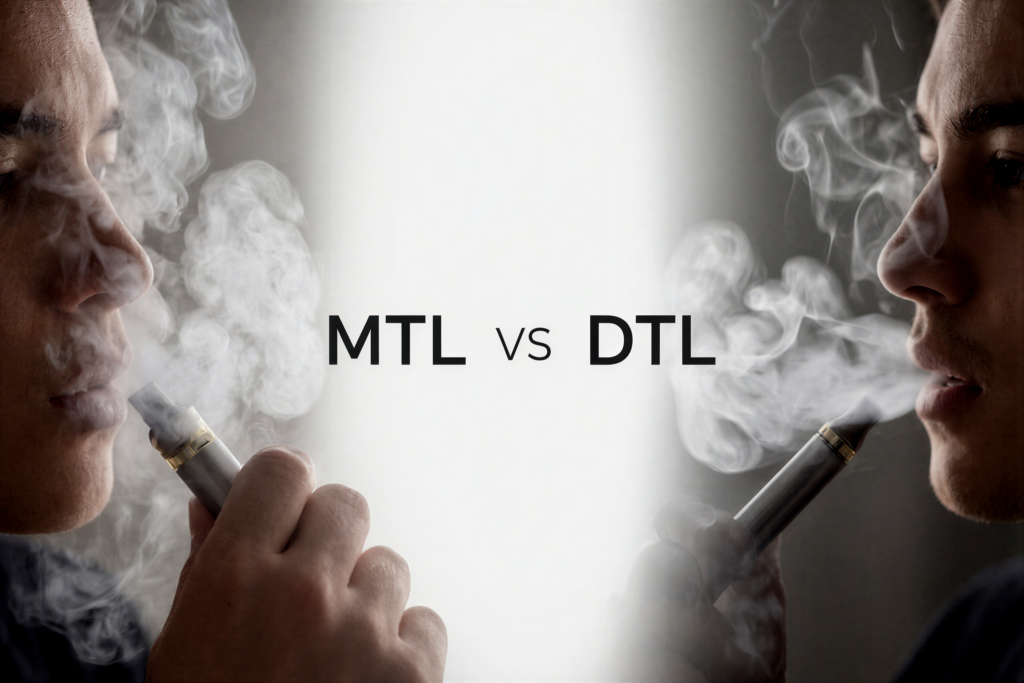
I still remember the first time someone handed me a box mod and said “just inhale.” Big mistake. I coughed for a solid minute while they laughed and told me I was an MTL vaper trying to do a DTL hit. That was years ago, and I’ve since spent way too much time thinking about the difference between mouth-to-lung and direct-to-lung vaping. Turns out, it’s one of the most important things to understand if you want to actually enjoy vaping instead of just tolerating it.
If you’re trying to figure out MTL vs DTL vaping and what the difference really means for your throat, your nicotine intake, and your wallet, you’re in the right place. I’ll also cover RDL vaping, the middle ground that more people are discovering lately.
MTL devices are the most common choice for nic salt vaping. For a curated ranking of the best devices for nicotine salts, check our Best Vapes For Nicotine Salts 2026 guide.
What Is MTL Vaping?
MTL stands for mouth-to-lung. You draw vapor into your mouth first, hold it for a second, then breathe it down into your lungs. It’s the same motion you’d use smoking a cigarette, which is why most people who switch from smoking start here.
The draw feels tight and restricted. You get a noticeable throat hit, especially with nicotine salts, and the vapor production stays on the discreet side. If you’ve ever used a disposable vape or a slim pod system, you were probably vaping MTL without realizing it had a name.
MTL Technical Specs
| Parameter | MTL Range |
|---|---|
| Coil resistance | 0.8Ω and above |
| Wattage | 8 to 25W |
| Airflow | Tight, restricted |
| Nicotine strength | 10 to 20mg nic salt, or 6 to 12mg freebase |
| E-liquid ratio | 50/50 VG/PG |
| Cloud size | Small |
| Throat hit | Strong |
Higher resistance coils (0.8Ω and above) draw less power from the battery, which means your device runs cooler, your e-liquid lasts longer, and your battery holds a charge for more of the day. The trade-off is smaller clouds and less vapor per puff. But for most MTL vapers, that’s exactly the point: it’s about satisfaction, not spectacle.
Who MTL Is Best For
If you’re switching from cigarettes, MTL is the natural starting point. The draw feels familiar, the throat hit gives you that sensory feedback you’re used to, and the higher nicotine strengths available in nic salts keep cravings in check. It’s also the way to go if you want something discreet, whether that’s at the office, in public, or just around people who don’t need to see you exhale a weather system.
What Is DTL Vaping?
DTL stands for direct-to-lung. You skip the mouth entirely and breathe the vapor straight into your lungs, like taking a deep breath. The airflow is wide open, the vapor is warm and dense, and the clouds can get very, very large.
There’s almost no throat hit with DTL, which surprises some people. Because you’re pulling so much air through the device alongside the vapor, the sensation is smooth and airy rather than sharp. The trade-off is that you go through e-liquid faster, batteries drain quicker, and you need to keep nicotine levels low or it gets harsh fast.
DTL Technical Specs
| Parameter | DTL Range |
|---|---|
| Coil resistance | Below 0.5Ω (sub-ohm) |
| Wattage | 40W and above |
| Airflow | Wide open |
| Nicotine strength | 0 to 6mg freebase |
| E-liquid ratio | 70/30 or 80/20 VG/PG |
| Cloud size | Large |
| Throat hit | Mild to none |
Sub-ohm coils (below 1.0Ω, but for true DTL usually below 0.5Ω) allow more current through, which generates more heat and more vapor. The high VG content in 70/30 and 80/20 e-liquids is what makes those thick, dense clouds possible. VG (vegetable glycerin) is thicker and sweeter than PG, producing more vapor but carrying less flavor intensity per milliliter. If you’ve ever wondered why cloud chasers use those giant bottles of shortfill e-liquid, now you know: they’re going through it fast.
Who DTL Is Best For
DTL appeals to experienced vapers who want maximum flavor volume and big clouds. If you’ve been vaping for a while and MTL feels too restrictive, or if you enjoy the ritual of building coils and tweaking wattage, DTL is your territory. It’s also the choice if you want zero or very low nicotine but still want a satisfying draw. I know several people who vape 0mg DTL purely for flavor and the hand-to-mouth habit.
RDL Vaping: The Middle Ground
Here’s something most guides gloss over: RDL (restricted direct lung) is becoming the most popular style among people who’ve been vaping for a year or more. You draw directly into your lungs like DTL, but the airflow is partially restricted so you get more resistance and better flavor than a fully open DTL hit.
I think of RDL as the Goldilocks zone. You get more vapor and warmth than MTL, but you don’t need a massive mod or go through 10ml of juice a day. Most modern pod systems with adjustable airflow can hit this sweet spot.
RDL Technical Specs
| Parameter | RDL Range |
|---|---|
| Coil resistance | 0.4 to 0.8Ω |
| Wattage | 15 to 35W |
| Airflow | Partially restricted |
| Nicotine strength | 6 to 10mg nic salt, or 3 to 6mg freebase |
| E-liquid ratio | 60/40 or 70/30 VG/PG |
| Cloud size | Medium |
| Throat hit | Moderate |
The 0.4 to 0.8Ω coil range is where most modern pod systems shine. You get enough power for warm, flavorful vapor without the battery drain of sub-ohm DTL setups. The 60/40 VG/PG ratio gives you decent clouds while still wicking well in the smaller coil heads that pod systems use. If your coil keeps burning out or you’re getting dry hits, you might be using a liquid that’s too thick for your coil’s resistance.
MTL vs DTL: Side-by-Side Comparison
| Feature | MTL | RDL | DTL |
|---|---|---|---|
| Draw style | Mouth first, then lungs | Direct to lungs, restricted | Direct to lungs, open |
| Feels like | Smoking a cigarette | A controlled deep breath | Taking a deep breath |
| Coil | 0.8Ω+ | 0.4 to 0.8Ω | Below 0.5Ω |
| Wattage | 8 to 25W | 15 to 35W | 40W+ |
| Nicotine | 10 to 20mg salt | 6 to 10mg salt | 0 to 6mg freebase |
| E-liquid | 50/50 | 60/40 or 70/30 | 70/30 or 80/20 |
| Clouds | Small, discreet | Medium | Large |
| Throat hit | Strong | Moderate | Mild |
| Juice usage | Low | Moderate | High |
| Battery drain | Low | Moderate | High |
Coil Types Explained
The coil is the component that determines which vaping style your device supports. You can’t put a 0.15 ohm sub-ohm coil in a slim pod system and expect MTL vaping — it won’t work. The coil resistance, wire material, and wicking material all matter.
Round Wire Coils
The simplest design: single wire wrapped into a coil. Cheap, reliable, and common in MTL devices. They heat evenly but have less surface area than mesh, meaning slightly less vapor and flavor per watt.
Mesh Coils
A strip of metal with holes punched in it, shaped into a cylinder. The larger surface area contacts more e-liquid, producing better flavor and more consistent vapor. Mesh coils have become the industry standard for both MTL and DTL — most modern pod systems ship with mesh coils exclusively.
Clapton and Fused Clapton
A thinner wire wrapped around a thicker core wire, resembling a guitar string. The added surface area improves flavor over round wire. Mostly found in rebuildable atomizers (RDAs, RTAs) and some sub-ohm tanks. Overkill for MTL, excellent for DTL flavor chasing.
Ceramic Coils
Ceramic wicking material instead of cotton. Claims include longer coil life and cleaner flavor. In practice, the difference is subtle and ceramic coils are less common in 2026. Some earlier safety concerns about ceramic particle inhalation haven’t been conclusively resolved.
Nicotine Absorption: Does Vaping Style Matter?
This is the part that caught me off guard when I first looked into it. The way you inhale actually changes how much nicotine your body absorbs.
A 2014 study published in Nature compared first-generation and newer e-cigarette devices and found that newer, higher-wattage devices produced roughly 70% higher plasma nicotine levels than first-generation devices at the 20-minute mark. Peak plasma nicotine concentration reached 23.47 ng/ml with an 18mg/ml e-liquid on a new-generation device, compared to 15.75 ng/ml on an older one. The nicotine hit also came faster: peak concentration was reached approximately 1.2 to 1.5 minutes after the last puff.
What does this mean for MTL vs DTL? DTL vaping produces larger vapor volumes per puff, which means more nicotine delivery per inhale at the same e-liquid concentration. That’s exactly why DTL vapers use lower nicotine strengths. A 20mg nic salt in a DTL setup at 60W would deliver way too much nicotine and feel extremely harsh. Meanwhile, an MTL vaper using the same 20mg gets a controlled, cigarette-like amount because they’re pulling less vapor per puff.
According to the Public Health Consequences of E-Cigarettes report from NCBI, nicotine absorption rates also depend on e-liquid pH, the PG/VG ratio, and even the flavor of the e-liquid. One pilot study found that a strawberry e-liquid at pH 8.29 produced higher plasma nicotine levels than a tobacco e-liquid at pH 9.10 from the same device. So it’s not just about the hardware. Your e-liquid formula matters too.
Related research: Nicotine salts vs freebase comparative analysis (PubMed 38253598).
Related research: Nicotine absorption pharmacokinetics study (PubMed 41043656).
If you want a deeper look at nicotine and health effects, check out our article on whether it’s better to smoke or vape.
PG/VG Ratios Explained: Why Your E-Liquid Choice Matters
I see people get this wrong all the time. They buy a thick 80/20 VG/PG shortfill and try to run it through a 1.2Ω MTL pod, then wonder why their coils keep burning out after two days. The viscosity of your e-liquid needs to match your coil’s wicking capacity.
PG (propylene glycol) is thin, carries flavor well, and produces a stronger throat hit. It’s what makes MTL vaping feel satisfying.
VG (vegetable glycerin) is thick, sweet, and produces dense vapor. It needs more heat and larger wicking ports to flow properly, which is why it pairs with sub-ohm DTL coils.
Here’s a simple rule I follow: match your liquid to your resistance. If your coil is 0.8Ω or above, stick with 50/50. If it’s between 0.4 and 0.8Ω, 60/40 or 70/30 works well. Below 0.4Ω, go with 70/30 or 80/20. When in doubt, thinner is safer for your coils. You can always adjust airflow and wattage to compensate for slightly thinner liquid, but you can’t un-burn a coil that couldn’t wick fast enough.
Vape Super Store’s beginner guide to e-liquids has a solid breakdown of PG/VG ratios if you want more detail on how these ingredients affect your experience.
Best MTL Devices in 2025 and 2026
Uwell Caliburn G4
The Caliburn line has been the gold standard for MTL pod systems for years, and the G4 continues that tradition with some real upgrades. It packs a 1300mAh battery (up from 900mAh in the G3), adjustable wattage from 5 to 35W, and two vaping modes: Storm Mode for maximum power delivery and Wave Mode for consistent, smooth output. The GPP pods use Uwell’s PRO-FOCS 4.0 flavor technology, and the 0.6Ω pod handles both MTL and RDL draws depending on your airflow setting. It has a 0.85-inch color screen, which is a nice touch for a device this compact.
According to Vaping360’s review, battery life was comparable to the G3 Pro despite the larger cell, taking about 44 minutes to charge via USB-C. Still, for an MTL-focused pod system with this much adjustability, it’s hard to beat.
VOOPOO Argus G3
The Argus G3 is what I’d recommend to someone who wants MTL with the option to dabble in RDL. It has a 1500mAh battery, 5 to 30W output, and ships with two pods: a 0.7Ω MTL pod that performs best at 16 to 18W, and a 0.4Ω RDL pod that shines at 28 to 30W. The 0.96-inch TFT color screen is bright and readable, and the airflow slider gives you precise control from tight MTL to a loose RDL draw.
VOOPOO’s iCOSM CODE 2.0 technology is the real differentiator here. According to VOOPOO’s official specs, it’s designed to maintain flavor consistency over the life of the pod, and in practice that holds up. The Argus Top Fill Cartridge V2 uses aerospace-grade golden cotton and a liquid-seal shield that really does reduce leaking compared to earlier Argus cartridges. At around $25, it’s one of the best values in the category.
Vaporesso XROS 4
The XROS line built its reputation on simplicity and reliability, and the XROS 4 keeps that going. It runs a 1000mAh battery with up to 16W output, and the pods range from 0.4 to 1.2Ω. The 0.6Ω pod is a great all-day MTL option, and the 1.2Ω pod gives you that tight, cigarette-like draw if you’re just switching from smoking. Vaporesso’s COREX heating tech keeps flavor consistent, and the SSS leak-resistant design actually works. If you want something that just works without needing to adjust wattage or modes, this is it.
Innokin Endura T20-S
This is the no-frills MTL workhorse. The 1500mAh battery and fixed 18W output mean there’s nothing to adjust. You fill the tank, wait a minute for the coil to saturate, and vape. The 1.5Ω Prism coil delivers a tight, satisfying MTL draw that’s very close to a cigarette. It’s not fancy, but at its price point, it doesn’t need to be. TABlites stocks it if you’re in the UK, and it’s widely available elsewhere.
Best DTL Devices in 2025 and 2026
VOOPOO DRAG X3
The DRAG X3 is built for serious DTL performance. It delivers up to 80W from a single 18650 or 21700 battery (your choice), with a 1.66-inch TFT touchscreen that makes wattage adjustments quick and easy. The PnP X coils come in 0.15Ω and 0.3Ω options, both designed for sub-ohm DTL vaping with PnP DTL pods. According to VOOPOO’s product page, the GENE.FAN 3.0 chip provides smart mode that auto-detects coil resistance and sets appropriate wattage limits, which is a nice safety feature if you’re new to sub-ohm vaping. The 21700 battery option gives you more runtime than 18650, which matters when you’re pushing 60 to 80W regularly.
Vaporesso LUXE XR MAX 2
This is the most versatile device on the list, and probably the one I’d pick if I could only own one vape. The LUXE XR MAX 2 houses a massive 3200mAh internal battery with 80W maximum output, and its adjustable airflow goes from tight MTL all the way to full DTL. It uses Vaporesso’s GTX coil platform, which gives you options from a 1.2Ω MTL coil all the way down to a 0.2Ω mesh coil for cloud production.
Vaping360’s review measured the usable battery capacity at 2604mAh (the 3200mAh is the rated cell capacity), and reported about 90 minutes to full charge via 2A USB-C. For MTL use with the 1.2Ω coil, you can expect multiple days on a single charge. For DTL at 60W, plan on charging daily. The 0.96-inch TFT screen with dynamic RGB lighting is a bit flashy for my taste, but the performance is what matters, and it delivers.
Common Mistakes When Choosing MTL or DTL
I’ve made most of these mistakes myself, and I’ve watched friends make the rest. Here are the ones that come up over and over.
Using High Nicotine with DTL
This is the big one. If you put 20mg nic salt into a sub-ohm tank at 60W, you’re going to have a bad time. The large vapor volume delivers way more nicotine per puff than MTL, and it will feel harsh, cause headaches, and possibly make you nauseous. For DTL, stick with 3 to 6mg freebase maximum. If you’re transitioning from MTL to DTL, cut your nicotine strength at least in half to start.
Using Thick E-Liquid in MTL Pods
80/20 VG/PG liquid in a 1.0Ω pod coil is a recipe for dry hits and burnt coils. The liquid is too thick to wick through the small coil openings fast enough, especially at lower wattages. MTL coils need thinner liquid. 50/50 is the safe bet. If your vape tastes burnt after a day or two, check your VG content before blaming the coil.
Confusing Airflow Settings
A fully open airflow on an MTL coil gives you a mouthful of hot air with no satisfaction. A fully closed airflow on a DTL coil gives you nothing at all. Match your airflow to your style: tight for MTL, partially open for RDL, wide open for DTL. Most devices with adjustable airflow have markings or notches that help you find your preferred setting. If you’re using a device like the disposable vape that’s blinking, airflow isn’t adjustable, so you’re stuck with whatever the manufacturer chose.
Ignoring Coil Resistance
Coil resistance tells you more about how a vape will perform than almost any other spec. Below 0.5Ω means DTL. Above 0.8Ω means MTL. Between 0.4 and 0.8Ω is the RDL sweet spot. If you’re running a 0.3Ω coil at 15W, you’re underpowering it and getting weak flavor. If you’re running a 1.0Ω coil at 30W, you’re burning it out. Stay within the recommended wattage range printed on the coil or in the manual.
Chain Vaping MTL at High Nicotine
Nicotine salts at 50 mg/mL make it easy to chain-vape because the throat hit is smooth. You don’t get the harshness that tells you to stop. This can lead to nicotine overdose symptoms — headache, nausea, racing heart. If you’re vaping a 50 mg/mL salt pod, pace yourself. A few puffs, then wait.
Which Style Should You Start With?
If you’re switching from smoking, start with MTL. This isn’t a controversial recommendation — every major vape manufacturer designs their starter kits around MTL for a reason. The draw feels familiar. The nicotine delivery works at the concentrations smokers need. The devices are simple, portable, and affordable.
If MTL feels too restrictive after a few weeks, like you can’t get enough air through the draw, try RDL with a 0.6–0.8 ohm pod on the same device. Most pod systems support this. Open the airflow slightly, drop your nicotine by roughly half, and see if the looser draw feels better.
Don’t start with DTL unless you’ve already been vaping for a while. The open draw, high vapor volume, and low nicotine concentrations are a poor match for someone who’s used to cigarettes. You’ll either get too much vapor and cough, or too little nicotine and crave a cigarette.
How to Switch from MTL to DTL (or Vice Versa)
MTL to DTL Transition
The biggest adjustment is the nicotine. If you’re currently vaping 20mg nic salt MTL, switch to 6mg freebase for DTL. Some people go even lower, to 3mg, because the larger vapor volume compensates. Start with the airflow about halfway open and gradually open it up as you get used to the sensation. The first few DTL hits feel weird if you’re used to MTL. You’ll probably cough. That’s normal. Take it slow.
You’ll also need a different device. Your MTL pod system won’t produce enough vapor for a satisfying DTL experience. Look for something with sub-ohm coils and at least 40W of power. The VOOPOO DRAG X3 or Vaporesso LUXE XR MAX 2 are both solid choices that give you room to grow.
DTL to MTL Transition
This usually happens when someone wants to be more discreet or reduce their e-liquid consumption. If you’re currently vaping 3mg DTL, try 12mg freebase or 10mg nic salt for MTL. The tighter draw and smaller vapor volume mean you need higher nicotine to get the same satisfaction. The throat hit will be more pronounced, which is actually what many people miss when they switch to DTL.
Any of the MTL devices above will work. The Uwell Caliburn G4 or VOOPOO Argus G3 are particularly good for people transitioning from DTL because they have enough adjustability to let you find a comfortable middle ground before going fully tight MTL.
The Natural Progression: MTL → RDL → DTL
Many vapers follow a natural progression as they become more experienced and gradually reduce nicotine. This isn’t mandatory — some vapers stay with MTL indefinitely and that’s fine. But if you find yourself wanting more vapor and a looser draw, the progression looks like this:
- Month 1–3 (MTL): 1.0–1.2 ohm pod, 50/50 e-liquid, 12–20 mg/mL nicotine salt
- Month 3–6 (RDL): 0.6–0.8 ohm pod, 50/50 e-liquid, 6–12 mg/mL freebase or 10–20 mg/mL salt
- Month 6+ (DTL if desired): 0.2–0.4 ohm coil, 70/30 VG/PG, 3–6 mg/mL freebase
Each step down in coil resistance should accompany a step down in nicotine. More vapor per puff means more nicotine per puff even at lower concentrations. If you move to DTL without reducing nicotine, you’ll get lightheaded and nauseous.
Can One Device Do Both MTL and DTL?
Sort of. Devices like the Vaporesso LUXE XR MAX 2 have adjustable airflow and multiple coil options that let you switch between styles by swapping pods and adjusting settings. The 1.2Ω GTX coil with tight airflow gives you MTL. The 0.2Ω mesh coil with open airflow gives you full DTL. The same battery and screen work for both.
The compromise is that nothing does both equally well. An MTL-focused pod system with a 0.6Ω coil can give you a loose MTL or tight RDL, but it won’t match a dedicated sub-ohm tank for DTL clouds. A DTL box mod can run an MTL tank, but it’s bulky and overpowered for what you need. Many experienced vapers end up with two devices: a compact MTL pod for during the day and a DTL setup for home use.
Frequently Asked Questions
Is MTL or DTL better for quitting smoking?
MTL is generally better for quitting smoking because the draw technique closely mirrors cigarette smoking. The tighter airflow and stronger throat hit feel familiar, and the higher nicotine strengths available in nic salts and 50/50 e-liquids help manage cravings more effectively. According to Riot E-Liquid’s guide, MTL vaping with nic salts delivers quicker nicotine satisfaction, which is critical in the early stages of switching.
Does DTL vaping give you more nicotine?
It depends on the nicotine concentration of your e-liquid. DTL vaping produces larger vapor volumes, which means more nicotine per puff at the same concentration. That’s why DTL vapers use lower nicotine levels, typically 0 to 6mg. If you used 20mg nic salt in a DTL setup, you’d absorb far too much nicotine per puff. The amount of nicotine you actually absorb depends on your e-liquid strength, your device wattage, and your inhalation style. Our article on nicotine-free vapes goes deeper into how nicotine works in different vaping contexts.
What is the difference between MTL and DTL coils?
MTL coils have higher resistance (0.8Ω and above) with smaller wicking ports and tighter airflow channels. They’re designed to run at lower wattages (8 to 25W) and work best with thinner 50/50 e-liquids. DTL coils are sub-ohm (below 0.5Ω) with larger wicking ports and wider airflow channels. They handle higher wattages (40W+) and thicker 70/30 or 80/20 VG/PG liquids. The physical construction is different too: DTL coils are typically larger with more surface area to vaporize more liquid per second.
What VG/PG ratio should I use for MTL vs DTL?
For MTL vaping, use 50/50 VG/PG e-liquids. The thinner consistency wicks properly through high-resistance coils and provides the throat hit that MTL vapers want. For DTL vaping, use 70/30 or 80/20 VG/PG. The higher VG content creates denser clouds and a smoother throat hit at high wattages. For RDL vaping, 60/40 or 70/30 works well as a middle ground.
Can I use nic salts for DTL vaping?
Technically yes, but I wouldn’t recommend it. Nic salts are formulated for high-nicotine, low-wattage MTL vaping. Using nic salts in a DTL setup would deliver too much nicotine too quickly. If you want a smooth DTL experience, stick with freebase nicotine at 3 to 6mg. If you absolutely must use nic salts in an RDL or loose MTL setup, keep it at 6 to 10mg maximum.
Why does my DTL vape make me cough?
Usually it’s one of two things: your nicotine is too high, or you’re not used to the direct lung inhale. DTL vapor is warmer and denser than MTL. If you’re coming from MTL, start with lower wattage and nicotine, and take shorter hits until your lungs adjust. It took me about a week to stop coughing when I first tried DTL. Also check that your airflow is fully open, as partially restricted DTL hits can feel harsh and awkward.
Is RDL vaping better than MTL or DTL?
Better is subjective, but RDL is increasingly popular because it offers more vapor and warmth than MTL without the high juice consumption and battery drain of DTL. Most modern pod systems with adjustable airflow and 0.4 to 0.8Ω coils are essentially RDL devices. If you find MTL too tight and DTL too airy, RDL is worth trying.


Build your vape knowledge
Read more guides
Find explainers, how-to articles and reference material.
Open guide library →Compare vape products
Check specifications across the product database.
Open product data →Read hands-on reviews
See tested devices and documented trade-offs.
Read review coverage →