

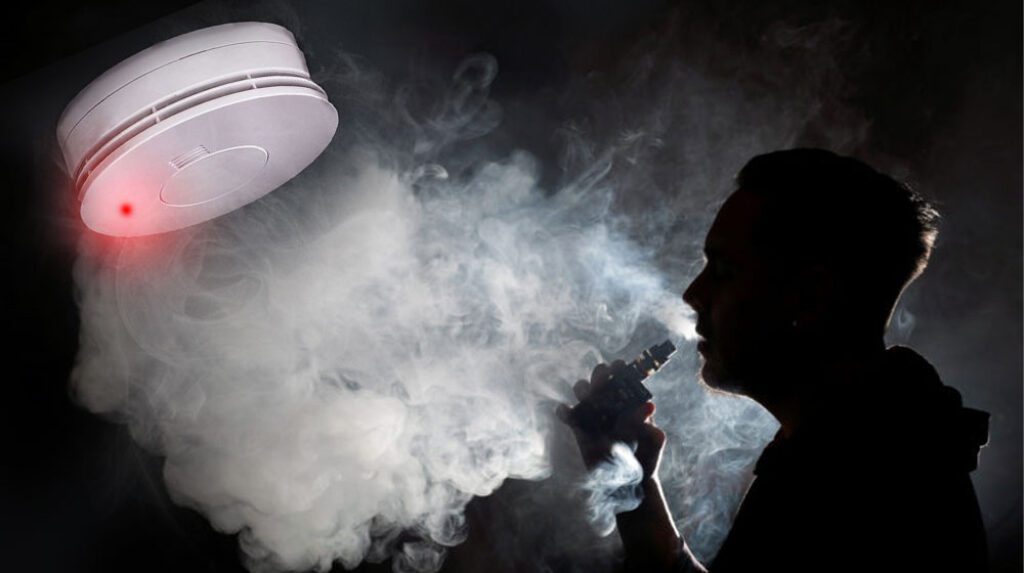
Yes, vaping can set off smoke alarms. Not every time, not every detector, but it happens enough that it’s a real problem, especially in hotels, dorm rooms, and apartments.
The consequences go beyond embarrassment. A triggered hotel alarm can mean a $250+ cleaning fee. A false fire department call can cost thousands. On a plane, it’s a federal offense with fines up to $4,000.
Here’s how different alarm types respond to vape aerosol, what the research says about particle detection, and how to avoid setting one off.
How smoke alarms detect particles (and why vape aerosol confuses them)
Smoke alarms don’t “smell” smoke. They detect physical particles in the air. Vape aerosol is made of particles, suspended ultrafine droplets of propylene glycol (PG), vegetable glycerin (VG), water, nicotine, and flavoring compounds. These droplets scatter light and disrupt electrical currents, which is exactly what the two most common smoke alarm types are designed to detect.
A 2019 study published in Nicotine & Tobacco Research confirmed that e-cigarette aerosol can trigger both ionization and photoelectric smoke detectors. The study also found that fewer than 20% of people (including vapers) believed indoor vaping could set off an alarm, which suggests a lot of false alarms happen because people simply don’t know the risk exists.
A 2024 study in Chemical Research in Toxicology measured particle size distributions from JUUL, VUSE, and VOOPOO devices, finding particles ranging from 5 nm to 1,000 nm at concentrations of 107 to 1010 per cubic centimeter. That’s a lot of particles in a small space, and more than enough to interfere with a detector’s sensing chamber.
Which alarm types are most likely to trigger
| Alarm type | How it detects | Vape trigger risk | Why |
|---|---|---|---|
| Photoelectric (optical) | Light beam scatters when particles enter the chamber | High | VG-heavy vapor scatters light effectively; large droplets are ideal triggers |
| Ionization | Disrupted electrical current between charged plates | Moderate | Concentrated clouds can disrupt the ion flow; less sensitive to larger particles |
| Heat detector | Triggers at about 57°C (135°F) or higher | Very low | Exhaled vapor is close to body temperature (~37°C), far below the threshold |
| Combined photo/ion | Both detection methods in one unit | High | Either mechanism can trigger the alarm |
Photoelectric alarms are the most common type in homes and hotels, and they are the most likely to go off from vaping. The reason is straightforward: VG-rich aerosol contains large liquid droplets that are very effective at scattering the infrared light beam inside the detector’s chamber. If you’ve ever set off a hotel alarm with a vape, it was almost certainly photoelectric.
Ionization alarms are tuned for the tiny particles produced by flaming fires. Vape particles are larger, so a single puff from a pod system probably won’t trigger one. But a big cloud from a sub-ohm tank, exhaled directly at the detector, can and does.
Heat detectors won’t respond to vaping at all. The air you exhale is around 37°C (98.6°F). Residential sprinkler heads activate at 57°C (135°F) minimum, per NFPA 13 standards. Some commercial heads are rated even higher at 74°C (165°F) or 100°C (212°F). That’s a gap no vape cloud can close.
What increases the chance of triggering an alarm
- High-VG e-liquid. Vegetable glycerin produces thicker, denser clouds that linger longer and scatter more light. A 70/30 VG/PG mix will trigger a photoelectric alarm faster than a 50/50 blend. For more on how PG and VG behave differently, see our guide to e-cigarette ingredients.
- High-wattage devices. A 2024 study in Aerosol Science and Technology found that higher heating power produces both more particles and larger particles (shifting from 0.49 µm toward 2.80 µm diameter). Sub-ohm tanks and box mods running at 50W+ generate far more aerosol per puff than a 12W pod system.
- Small, enclosed spaces. Bathrooms, hotel rooms, and dorms concentrate vapor. The same cloud that dissipates harmlessly in a living room can saturate a bathroom in seconds.
- Poor ventilation. No open window, no fan. The aerosol has nowhere to go but into the detector.
- Direct exhale toward the detector. Blowing vapor at the ceiling, where the alarm lives, is the fastest way to trigger it.
- Chain vaping. Multiple puffs in quick succession build up particle concentration faster than it can dissipate. The detector doesn’t care whether the particles came from a fire or a vape.
Will vaping set off a hotel smoke alarm?
It can, and the financial consequences are real. Hotels typically use photoelectric or combination detectors, and many have installed dedicated vape-detection systems in recent years.
If you trigger a hotel smoke alarm by vaping, you may face:
- A cleaning fee, typically $250 to $500 for smoke and aerosol residue remediation
- A fire department dispatch fee, which can run $1,000+ if the hotel’s alarm system auto-notifies the fire department
- Eviction without refund, since vaping violates the no-smoking policy in nearly all hotel chains
Some hotels have also installed sensor systems like the HALO Smart Sensor, which uses chemical detection to identify vape aerosol, THC, and volatile organic compounds specifically. These are far more sensitive than standard smoke alarms and are designed to catch exactly the kind of discreet vaping that wouldn’t trigger a smoke detector. Schools, hospitals, and commercial buildings are increasingly using them too.
The simplest solution: don’t vape in hotel rooms. Step outside.
Can vaping set off a fire sprinkler?
Almost certainly not. Fire sprinklers activate by heat, not by particles. The fusible link or glass bulb breaks when the ambient temperature reaches the sprinkler’s rated activation point, which is 57°C (135°F) at minimum for ordinary-temperature heads, per NFPA 13. Most residential and light commercial heads are rated at 57°C to 77°C (135°F to 170°F).
Exhaled vape aerosol is close to body temperature, around 37°C (98.6°F). That’s 20 degrees below the lowest sprinkler activation threshold. The only way a sprinkler could go off is if a smoke alarm triggers a deluge system in a commercial building, and that’s a completely different mechanism than the sprinkler responding to the vapor itself.
Will vaping set off an airplane smoke detector?
Yes, and the consequences are severe. Airplane lavatories have sensitive photoelectric smoke detectors. The FAA treats vaping the same as smoking, with federal fines up to $4,000 per violation. Passengers have been arrested, banned from airlines, and even faced criminal charges for vaping on flights.
The confined space of an airplane lavatory makes it almost impossible to vape without concentrating aerosol near the detector. Don’t try it. For more on traveling with vape devices, see our coverage of TSA’s crackdown on vapes.
Vape detectors: a different technology than smoke alarms
This is worth clarifying because the terms get mixed up. Smoke alarms detect particles broadly and are not designed to distinguish between smoke and aerosol. Vape detectors are a separate category of device, specifically calibrated to detect the chemical signature of e-cigarette aerosol.
Companies like HALO (now owned by Motorola) and Soter Technologies make multi-sensor devices that detect vaping aerosols, THC, volatile organic compounds, and even sound anomalies like aggression or gunshots. These are being deployed in schools, hotels, and healthcare facilities at a growing rate.
A vape detector will catch you even if your vape cloud is too thin to trigger a smoke alarm. They’re designed for exactly that scenario.
How to vape without setting off an alarm
- Open a window and use a fan. Ventilation is the most effective thing you can do. Point the fan so it pushes air toward the window, away from the detector.
- Blow vapor away from the detector. Toward the open window or down toward the floor. Never at the ceiling.
- Use a low-wattage device. A pod system at 12W produces a fraction of the aerosol that a sub-ohm tank at 80W does. If you’re looking for a low-output device, see our roundup of disposable vapes for options that produce smaller clouds.
- Switch to high-PG liquid. PG produces thinner, faster-dissipating vapor than VG. A 50/50 blend is safer than 70/30 VG.
- Take smaller puffs with pauses between them. Give the aerosol time to dissipate before adding more to the room.
- Don’t vape in the bathroom. It’s the worst combination: small space, poor ventilation, and the detector is usually right above you.
None of these are guarantees. The only guaranteed way to avoid setting off a smoke alarm is to not vape near one.
Can vaping set off a carbon monoxide detector?
No. CO detectors measure carbon monoxide gas, which is a product of combustion. Vaping doesn’t involve burning anything, so it doesn’t produce CO. A CO detector will not respond to vape aerosol under any normal circumstances.
However, if you’re concerned about the chemical contents of what you’re exhaling, our breakdown of chemicals found in vapes covers the full spectrum.
FAQ
Can a vape set off a smoke alarm?
Yes. Photoelectric smoke alarms are the most susceptible because vape aerosol scatters the light beam inside the detector. Ionization alarms can also be triggered by concentrated clouds.
Will a disposable vape set off a smoke detector?
It’s possible but less likely than with a sub-ohm device. Disposables produce less aerosol per puff. Still, chain-vaping in a small, poorly ventilated room can trigger a sensitive alarm.
Can vaping set off a carbon monoxide detector?
No. CO detectors measure carbon monoxide from combustion. Vaping doesn’t produce CO because there is no burning involved.
Do vape detectors exist?
Yes. Schools, hotels, and workplaces now install aerosol detection devices specifically calibrated for e-cigarette vapor. These are different from smoke alarms and are often more sensitive to low concentrations of vape aerosol.
Will vaping set off a fire sprinkler?
Extremely unlikely. Sprinklers activate at 57°C (135°F) or higher. Exhaled vape aerosol is close to body temperature, around 37°C (98.6°F).
Can vaping on a plane set off the smoke detector?
Yes. Airplane lavatories have sensitive photoelectric detectors. The FAA fines passengers up to $4,000 for vaping on a flight, and arrests are not uncommon.
Does vaping set off Nest/Ring smart smoke alarms?
It can. Smart smoke alarms like Nest Protect use both photoelectric and ionization sensors. They’re designed to detect particles in the air and don’t distinguish between smoke and vape aerosol. Some smart alarms are more sensitive than traditional hardwired models.
—
Sources: Nguyen et al. (2019), “Indoor E-cigarette Use Can Set Off Smoke Detectors,” Nicotine & Tobacco Research (PMC6934927); Zhao et al. (2024), “Characterizing the Transient Emission of Particles and Gases from Electronic Cigarette Puffs,” Chemical Research in Toxicology; Li et al. (2024), “Effects of heating power and nicotine concentration on aerosol size distributions,” Aerosol Science and Technology; NFPA 13 Standard for the Installation of Sprinkler Systems; FAA enforcement policy on in-flight smoking/vaping; HALO Smart Sensor product documentation; Johnson Controls (2024), “Can Smoke Detectors Detect Vaping?”




Build your vape knowledge
Read more guides
Find explainers, how-to articles and reference material.
Open guide library →Compare vape products
Check specifications across the product database.
Open product data →Read hands-on reviews
See tested devices and documented trade-offs.
Read review coverage →