

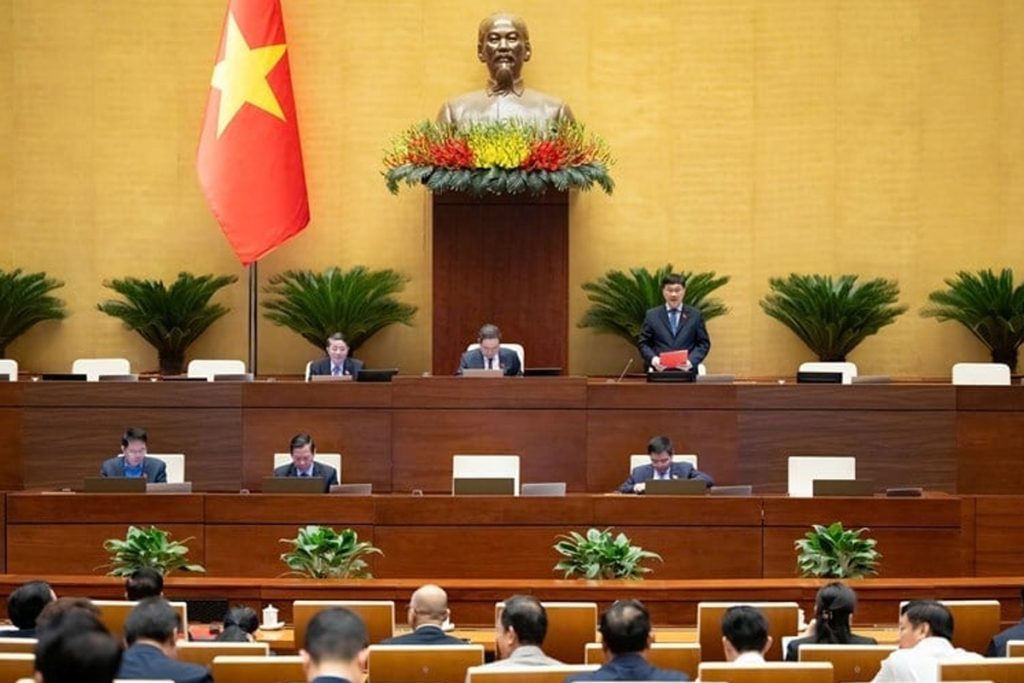
Vietnam’s 15th National Assembly has reached a broad consensus to ban e‑cigarettes, heated tobacco products (HTPs), and recreational nitrous oxide (N2O) as part of amendments to the Law on Investment, positioning the policy as a public health measure aligned with Resolution 173 and World Health Organization guidance.
During the November 27 plenary of the 10th session—chaired by National Assembly Chairman Tran Thanh Man and moderated by Vice Chairman Vu Hong Thanh—lawmakers strongly backed adding e‑cigarettes, HTPs, and recreational N2O (“laughing gas”) to the list of prohibited business lines. Delegates framed the step as necessary to protect youth, reduce hospitalizations, and restore regulatory control over fast‑evolving nicotine and psychoactive product markets.
Absolute Prohibition On Recreational N2O And New Psychoactive Substances
- Delegate Pham Trong Nhan (Ho Chi Minh City) urged a full ban on recreational N2O and new psychoactive substances (NPS), calling Article 6 of the draft “the first guard ring” that sets legal “red lines.”
- He described a “market of five no’s” around N2O: no license, no quality standards, no toxicity checks, no traceability, and no health reporting—completely outside state oversight.
- Citing Bach Mai Hospital data, he warned of severe spinal cord damage among N2O poisoning cases (60–100% injury rate), with limb paralysis reported in 82.9% of patients. Patients showed fivefold spikes in Cystatin—consistent with acute myelin sheath destruction—with long‑term sequelae in all cases studied.
- Mechanisms of harm highlighted: N2O inactivates vitamin B12, stripping neural protection and causing weakness/paralysis; it also produces opioid‑like euphoria, driving rapid dose escalation and dependence. “When risk is high and consequences severe, we cannot wait for more data—that is, wait for more lives to be harmed,” Nhan said, urging an explicit statutory ban and criteria to identify NPS.
Unified Support To Ban E‑Cigarettes And Heated Tobacco
- Delegate Nguyen Anh Tri (Hanoi) backed inclusion of e‑cigarettes and HTPs in the prohibited investment list, affirming consistency with National Assembly Resolution 173 to ban production, trade, import, storage, transport, and use from 2025.
- The WHO reportedly urged Prime Minister Pham Minh Chinh to reflect a comprehensive ban in the Investment Law “without any exceptions.”
- Tri pressed to spell out prohibitions beyond “business activity,” covering manufacture, import, possession, transport, and use to prevent loopholes.
- On transition rules (Article 152), he opposed allowing continued production for export, calling for a defined sunset period (6–12 months). Delegate Pham Van Hoa (Dong Thap) echoed concerns that export‑only production risks diversion back into the domestic market.
Youth Protection And Treaty Alignment
- Lawmakers emphasized shielding children and adolescents as the core aim. Reported prevalence of e‑cig/HTP use rose from 2.6% (2019) to 8.4% (2023) among 13–17‑year‑olds; among 13–15‑year‑olds, from 3.5% (2022) to 7.2% (2023).
- Nearly 700 health facilities reported 1,224 hospital admissions in 2023 linked to these products. Delegates cited concealment tactics and adulteration with addictive substances—especially in schools and public spaces—complicating enforcement.
- A total ban, they argued, aligns with the WHO Framework Convention on Tobacco Control (FCTC): preventing initiation and reducing exposure across all tobacco categories.
Government Position And Transition Concerns
- Finance Minister Nguyen Van Thang affirmed the draft imposes an absolute ban on e‑cigarettes and HTPs in business investment with no exceptions. However, transitional provisions are deemed necessary for certain foreign‑owned factories that began producing vaping devices in Vietnam before Resolution 173, to mitigate international litigation risk.
- On scope, the draft has incorporated N2O and NPS into the prohibited list, with the Finance Ministry coordinating with the Public Security and Health ministries to refine criteria, close loopholes, and update schedules as new substances emerge.
What To Watch Next
- Final statutory language for Article 6 (prohibited business lines) and Article 152 (transition) will determine the breadth of bans—particularly whether manufacture, import, possession, transport, and use are explicitly barred, and how any export‑only transition is time‑boxed.
- Implementation roadmap: timelines for enforcement, inspection protocols, and inter‑agency coordination will shape market exit, seizure policy, and penalties.
- Industry impact: foreign and domestic manufacturers may face decommissioning or relocation; importers and retailers will confront immediate compliance risks once the law takes effect.
Context For The Vape Industry
Vietnam is signaling a decisive public health stance that goes beyond regulation toward outright prohibition—mirroring positions taken by several Southeast Asian peers. For the vape supply chain, the key operational variables now are (1) the duration and scope of any transitional allowances and (2) enforcement intensity at borders and online channels. For public health stakeholders, the legislative momentum aligns with WHO recommendations and prioritizes adolescent protection amid rapid uptake and reported clinical harms.
We’ll continue tracking the final text, effective dates, and enforcement guidance as they emerge.


Follow the wider vape market
Read the latest vape news
Track regulation, launches and industry updates.
Open vape news →Browse product data
Move from market news to device specifications.
Open product data →Check product reviews
Read independent testing and comparison reports.
Read review coverage →