

Most vapers never touch their device’s power settings, and honestly, that’s a shame. A small tweak to your wattage or voltage can be the difference between a smooth, flavorful draw and a burnt hit that ruins your afternoon. If you’ve ever wondered what those buttons on your vape pen actually do, or stared at a screen showing numbers you don’t understand, this article is for you.
We’re going to walk through every power mode you’ll find on modern vape pens, from the basics of voltage and wattage to advanced features like temperature control. You’ll also get a wattage chart that tells you exactly where to set your device based on your coil resistance, plus tips on matching settings to your e-liquid. No fluff, just the stuff that actually matters.
The Basics: Voltage, Wattage, and Resistance
Before you adjust anything, you need to understand the three numbers that control your vape: voltage, wattage, and resistance. They’re all connected through Ohm’s Law, which is the only physics you’ll need here.
Resistance (measured in ohms) comes from your coil. A lower resistance coil lets more current flow, which produces more heat and more vapor. A higher resistance coil does the opposite, giving you a cooler, tighter draw that mimics a cigarette.
Voltage is the electrical pressure pushing current through your coil. Think of it like water pressure in a hose. More voltage means more energy hitting the coil, which means more heat.
Wattage is the actual power delivered to the coil. It’s the end result of voltage and resistance working together. The formula is straightforward:
Wattage = Voltage² / Resistance
So if you’re running 4.0 volts through a 0.5 ohm coil, you’re hitting about 32 watts. Drop the resistance to 0.25 ohm at the same voltage, and you’re suddenly pushing 64 watts. That’s why sub-ohm coils at the same voltage produce way more vapor than higher resistance ones.
Here’s the practical takeaway: when you adjust wattage on your device, it automatically calculates the right voltage for your coil’s resistance. That’s why variable wattage is easier to use than variable voltage. You set the power you want, and the device handles the math. If you want to double-check your own numbers, this Ohm’s Law calculator does the work for you.
Types of Power Modes on Vape Pens
Modern vape pens offer several power modes, and each one changes how your device delivers energy to the coil. Let’s break them down.
Variable Voltage (VV)
Variable voltage is the older system, and you’ll still find it on basic vape pens and ego-style devices. You dial in the voltage manually, and the resulting wattage depends on whatever coil you have installed. The downside is obvious: swap your coil to a different resistance, and the same voltage setting produces a completely different vaping experience. You have to recalculate and readjust every time.
That said, VV devices are simple and affordable. If you’re using the same coil consistently and don’t plan to experiment much, a variable voltage pen works just fine.
Variable Wattage (VW)
Variable wattage is the standard on most mid-range and advanced vape pens. You set the wattage, and the device’s chipset figures out the correct voltage based on the coil’s resistance. Swap your coil from 0.6 ohm to 0.4 ohm, and the device compensates automatically. This is the mode most vapers should use as their default.
Temperature Control (TC)
Temperature control is the most sophisticated power mode available. Instead of setting wattage, you set a target temperature (usually in Fahrenheit or Celsius), and the device monitors the coil’s resistance in real time to maintain that temperature. When the coil reaches your set temperature, the device reduces power to keep it there instead of letting it climb higher.
TC only works with specific wire types that have predictable resistance changes as they heat up. We’ll cover the details in the advanced section below, but the big benefit is consistency: your hit tastes the same from start to finish, and you can’t dry-burn your coil because the device cuts power when temperature spikes.
Bypass Mode
Bypass mode removes the regulated circuitry and sends power directly from the battery to the coil, similar to a mechanical mod. Your output depends entirely on the battery’s charge level and the coil’s resistance. A fully charged battery hits harder than one at 50% charge. It’s a simple, raw experience, but it means your vapor production declines as the battery drains.
Bypass is best for experienced vapers who understand battery safety and want an unfiltered feel. If you’re new to adjustable settings, skip this one for now.
Smart / Auto Mode
Many newer devices include a smart mode that reads the coil’s resistance when you install it and automatically selects a wattage within the recommended range. It’s convenient and prevents accidental overcooking of a fresh coil. Devices like the Vaporesso XROS series and several GeekVape models use this feature. You can usually override the auto setting if you want to fine-tune, but for most people, smart mode is a solid starting point.
Pulse / Boost Mode
This is a newer feature showing up on devices like the Geek Bar Pulse X and similar models. Pulse mode alternates the power delivery, firing in quick bursts rather than a constant stream. The idea is that pulsing the coil produces more even heating, which can enhance flavor and vapor density without cranking up the wattage. Some vapers love it; others don’t notice much difference. It’s worth trying to see if it suits your style.
How to Adjust Power Settings on Your Vape Pen
The actual process of changing settings varies by device, but the general flow is the same across most vape pens.
Devices with a Screen
- Press the fire button three times quickly to unlock the device (if locked).
- Use the adjustment buttons (usually marked + and -) to change the wattage or voltage.
- Some devices require you to hold the adjustment button to scroll through values faster.
- Navigate between modes (VW, TC, Bypass) through the menu, typically accessed by holding the fire button and an adjustment button simultaneously.
Devices without a Screen (LED Indicators)
Simpler vape pens use LED color codes to show voltage levels. The industry standard looks like this:
- Green = Low voltage (3.2 to 3.4V), best for higher resistance coils and MTL vaping
- Blue = Medium voltage (3.6 to 3.8V), a solid middle ground for most setups
- Red = High voltage (4.0V+), for lower resistance coils and direct-lung hits
To cycle through these settings, click the fire button (usually three times) until the LED color changes. It’s not as precise as a digital display, but it gets the job done for basic adjustments.
The Golden Rule for Adjusting Power
Always start at the low end of your coil’s recommended wattage range, then work up in small increments of 2 to 3 watts. This is probably the single best advice for anyone learning how to adjust vape power. Going too high too fast is how you get burnt hits and ruined coils. Going low just means slightly weak vapor, which is easy to fix by nudging the wattage up a bit.
Vape Pen Wattage Chart: Coil Resistance vs. Power
This chart is your quick reference for vape wattage settings based on coil resistance. These ranges come from cross-referencing manufacturer recommendations with verified data from ecigone.co.uk and vaporauthority.com.
| Coil Resistance | Wattage Range | Vaping Style | Recommended E-Liquid |
|---|---|---|---|
| 1.2 ohm | 8 to 14W | MTL | Nic salts (10 to 20mg) |
| 1.0 ohm | 10 to 16W | MTL | Nic salts or 50/50 |
| 0.8 ohm | 12 to 20W | MTL / loose MTL | Nic salts or 50/50 |
| 0.6 ohm | 15 to 25W | RDL | 50/50 or 60/40 |
| 0.4 ohm | 20 to 35W | RDL / DTL | 60/40 or 70/30 |
| 0.3 ohm | 30 to 50W | DTL | 70/30+ shortfills |
| 0.2 ohm | 40 to 70W | DTL | High VG shortfills |
| 0.15 ohm | 50 to 80W+ | DTL cloud chasing | High VG shortfills |
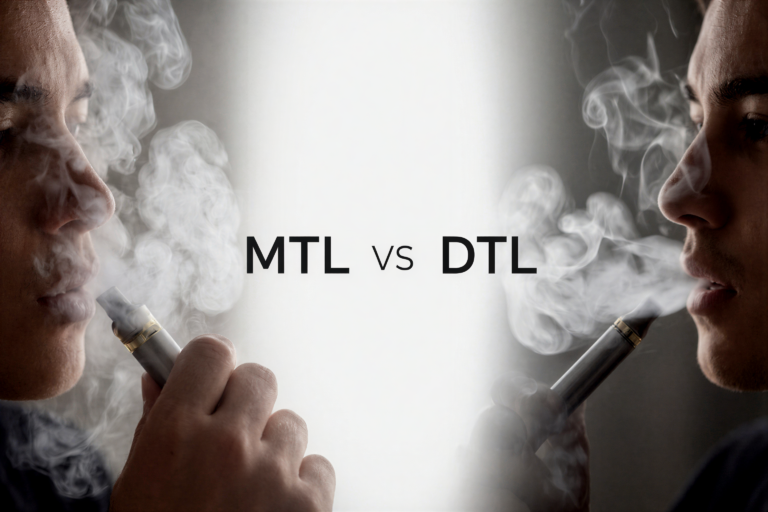
A few things to notice here. Coils above 0.8 ohm are designed for mouth-to-lung (MTL) vaping, which is the style most former smokers start with. You draw the vapor into your mouth first, then inhale it into your lungs. Below 0.6 ohm, you’re getting into restricted direct-lung (RDL) and direct-to-lung (DTL) territory, where you inhale straight to the lungs. The lower the resistance, the more power you need and the more vapor you produce.
Disposable vapes typically run at around 7 to 12 watts with 1.0 to 1.4 ohm coils. That’s why they feel consistent and don’t need adjustment. They’re locked into a sweet spot for MTL nic salt vaping.
Matching Power Settings to Your E-Liquid
Your coil and wattage settings need to match the e-liquid you’re using. Get this wrong, and you’ll either burn through juice too fast or get weak, unsatisfying hits.
Nicotine Salts (10 to 20mg)
Nic salts work best at low wattages (8 to 20W) with higher resistance coils (0.8 ohm and above). Keep your wattage below 20W when using nic salts in MTL coils. Pushing nic salts at high power produces harsh throat hits and wastes nicotine. If you’re using a nic salt device, you probably don’t need to change much. Just stay in the MTL range and you’re set.
50/50 Blends
Fifty-fifty VG/PG juices are versatile. They work in MTL setups at 10 to 20W and can handle RDL settings up to about 25W. They’re a safe middle ground if you vape at moderate power levels and want good flavor with decent vapor production.
High VG Shortfills (70/30 and above)
High VG e-liquids need more heat to vaporize properly because vegetable glycerin is thicker than propylene glycol. Use these with sub-ohm coils (0.4 ohm and below) at 25W and above. If you try to run high VG juice through a 1.0 ohm MTL coil at 12 watts, you’ll get muted flavor and the coil will struggle to wick, leading to dry hits.
Also worth knowing: the ingredients in your e-liquid affect how they respond to different power levels. PG carries flavor better at lower wattage, while VG needs more power to fully vaporize and produce thick clouds.
Advanced: Temperature Control Explained
Temperature control vaping is one of those features that sounds complicated but delivers real benefits once you understand it. The concept is simple: instead of controlling how much power goes to the coil, you control how hot the coil gets.
How TC Works
When metal heats up, its electrical resistance changes. Different metals change resistance at predictable, measurable rates. TC mode reads the coil’s resistance in real time, and as the coil heats up and resistance changes, the device adjusts power to keep the temperature at your set target. If the wick starts to dry out, the coil temperature rises faster than expected, and the device cuts power to prevent a burnt hit.
TC-Compatible Wire Types
- Ni200 (Nickel): The original TC wire. Very responsive resistance changes, but nickel is soft and some people have concerns about nickel sensitivity. Not commonly used anymore.
- Titanium (Ti): Good TC performance, but titanium can be dangerous if overheated (it can ignite at extreme temperatures). Most modern TC devices have safety cutoffs, but titanium has largely fallen out of favor.
- SS316L (Stainless Steel): The current standard for TC vaping. Stainless steel works in both wattage and TC modes, has a clean flavor profile, and is durable. If your device has a TC mode and you’re not sure which wire to use, SS316L is almost always the right choice.
Setting Up TC Mode
- Install a TC-compatible coil (check your coil packaging for wire type).
- Switch your device to TC mode through the menu.
- Select the correct wire type (Ni, Ti, or SS).
- Set your target temperature. A good starting point is 400 to 450°F (200 to 230°C).
- Take a drag and adjust up or down in 10-degree increments until you find your sweet spot.
One common mistake: using a regular kanthal coil in TC mode. Kanthal’s resistance doesn’t change enough with temperature for TC to work properly. The device will either throw an error or give you inconsistent performance. Always check that your coil is TC-compatible before switching modes.
Common Mistakes and How to Fix Them
Burnt or Harsh Hits
This is usually caused by wattage that’s too high for the coil, or a coil that hasn’t been properly primed. Fix: Drop your wattage to the low end of the coil’s range and let a fresh coil soak for 5 to 10 minutes before firing. If the coil is already burnt, it’s done. Replace it and start fresh at a lower wattage.
Weak Vapor or Muted Flavor
Wattage is too low for the coil, or the coil is nearing the end of its life. Fix: Increase wattage in 2 to 3W increments until flavor and vapor pick up. If that doesn’t help, swap the coil.
Flooding or Gurgling
Too much e-liquid is flooding the coil, often because wattage is too low to vaporize it efficiently. Fix: Increase wattage slightly. Also check that your tank isn’t overfilled and that the coil is screwed in properly.
Spitback (Hot Juice in Your Mouth)
E-liquid is pooling on the coil instead of being vaporized. This can happen when wattage is too low or when you fire the device without drawing. Fix: Bump up the wattage a bit and avoid “dry firing” without taking a drag. Some tanks also benefit from a drip tip splash guard.
Coil Burns Out Quickly
Running high wattage through a coil that’s designed for lower power will shorten its life dramatically. Sweet e-liquids also gunk up coils faster because the sugars caramelize on the wire. Fix: Stay within the coil’s recommended wattage range and consider switching to less sweet juices if coil life is a concern.
Safety Considerations
Vape pen power settings aren’t just about flavor and vapor. They’re also about safety. Here are the key points to keep in mind.
- Stay within recommended ranges. Your coil packaging lists a wattage range for a reason. Exceeding it risks damaging the coil, burning the wicking material, or in extreme cases with unregulated devices, causing battery issues.
- Understand battery limits. If you’re using a removable battery device, make sure your battery’s amp rating can handle the current draw at your chosen wattage and resistance. This is particularly important for sub-ohm builds.
- Don’t stack batteries. Using stacked batteries (two batteries in series) in an unregulated device is dangerous without proper knowledge of battery safety.
- Watch for overheating. If your device or tank gets uncomfortably hot during use, stop. Let it cool down and lower your wattage. This is especially important when vaping around others, as overheated devices can produce unpleasant aerosol compounds.
- Use the right charger. Charge your device through the manufacturer’s provided cable and adapter. Cheap aftermarket chargers can deliver incorrect voltage and damage the battery over time.
The FDA regulates e-cigarettes and vaping products in the United States, and part of that regulation involves product safety standards. Always buy from reputable manufacturers and avoid counterfeit products, which may not have proper safety circuitry.
Also, remember that vapes do contain nicotine (in most cases), which is an addictive substance. Understanding how your device works helps you control your intake more precisely.
FAQ
What wattage should I vape at?
It depends on your coil resistance and vaping style. Check the wattage chart above for specific ranges. The short version: start at the low end of your coil’s recommended range and adjust up in small increments until the flavor and vapor production feel right. For MTL vaping with nic salts, you’ll usually land between 8 and 20 watts.
What’s the difference between variable voltage and variable wattage?
Variable voltage lets you set the electrical pressure going to the coil. Variable wattage lets you set the actual power output, and the device calculates the correct voltage automatically. VW is more user-friendly because you don’t need to recalculate when you change coils. Most modern devices use VW as the default mode.
How do I change settings on my vape pen?
On devices with a screen, use the + and – buttons to adjust wattage or voltage, and access the menu to switch between power modes. On simpler devices, click the fire button three times to cycle through voltage settings indicated by LED colors (green for low, blue for medium, red for high). Check your device’s manual for the exact button sequence, as it varies between manufacturers.
Can I use temperature control with any coil?
No. Temperature control only works with coils made from specific wire types: nickel (Ni200), titanium (Ti), or stainless steel (SS316L). Standard kanthal coils don’t have enough resistance change with temperature for TC to function. Always check your coil packaging to confirm it’s TC-compatible before switching to TC mode.
Why does my vape taste burnt even at low wattage?
The most common cause is an improperly primed coil. When you install a new coil, let it sit with e-liquid for 5 to 10 minutes so the wicking material can fully saturate. Firing a dry or partially dry coil, even at low wattage, will scorch the cotton and produce a burnt taste that won’t go away. Other causes include e-liquid that’s too thick for the coil’s wicking capacity or a coil that’s simply reached the end of its life.
Is higher wattage always better for more vapor?
Not necessarily. More wattage produces more heat, but if you exceed what your coil and wick can handle, you’ll get dry, burnt hits instead of more vapor. You also need enough airflow and wicking speed to support higher wattage. A 0.4 ohm coil at 25 watts with good airflow can produce more satisfying vapor than the same coil pushed to 35 watts with inadequate wicking. Find the sweet spot within your coil’s range rather than just cranking it to the max.
Conclusion
Understanding your vape pen power settings isn’t complicated once you break it down. Voltage and wattage are just different ways of controlling how much energy hits your coil. Variable wattage is the easiest mode for most people, since the device handles the calculations for you. Temperature control adds another layer of precision if you’re willing to learn the setup process.
The wattage chart in this article gives you a reliable starting point based on your coil resistance. From there, adjust in small increments and pay attention to flavor, vapor production, and how the hit feels. If it tastes burnt, lower the power. If it feels weak, nudge it up. That’s really the whole process.
One last thing: always prime new coils and start at the low end of the recommended range. It takes a little patience, but it saves you money on replacement coils and gives you a better experience from the first puff.
Sources
- ecigone.co.uk: Coil resistance and wattage recommendation data
- vaporauthority.com: Cross-referenced wattage range verification
- vapinghardware.com: Ohm’s Law calculator and electrical reference
- U.S. FDA: E-cigarette regulation and safety information



One Comment