

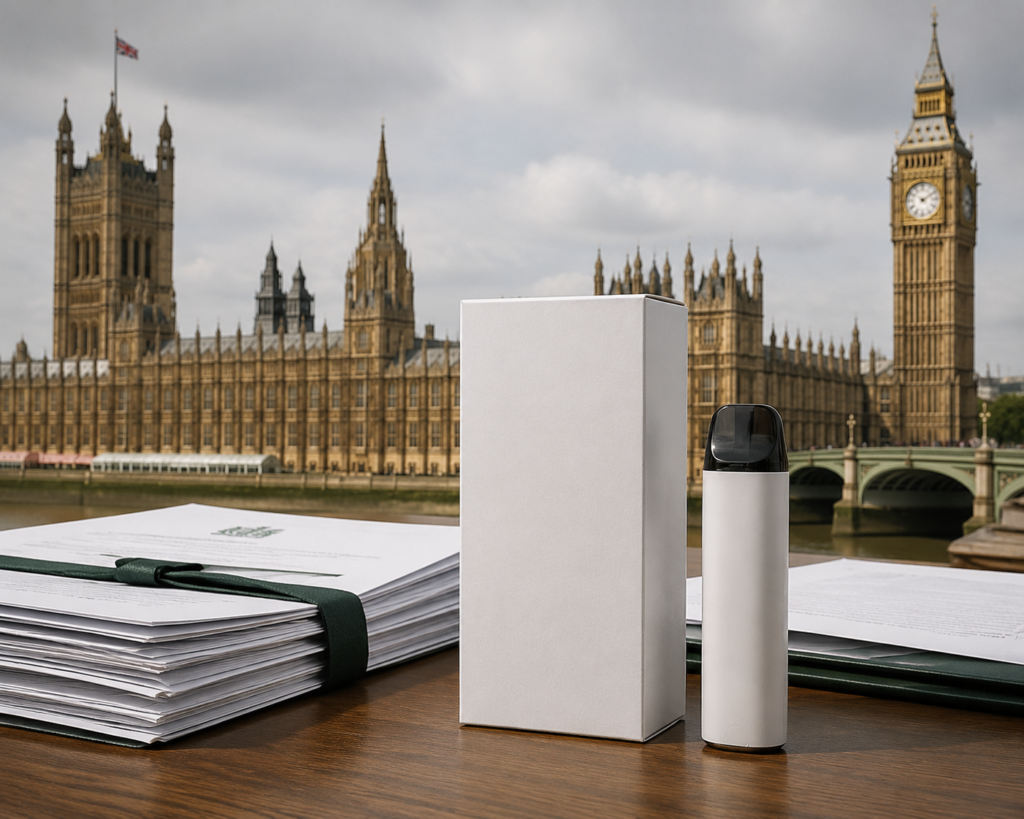
The UK Department of Health and Social Care launched a 12-week consultation on July 10, 2026 that proposes sweeping restrictions on vaping product packaging, retail display, and appearance. If adopted, all vapes would require standardized white packaging with limited branding, devices would be restricted to black, white, or gray colors, and vapes would be kept out of sight in retail stores.
The consultation runs through October 2, 2026 under powers granted by the Tobacco and Vapes Act 2026. It covers vaping products, tobacco, and nicotine products across the UK. The proposals include banning cosmetic lighting and non-essential digital screens on devices, limiting flavor names to simple descriptors like “berry” or “mint,” and extending standardized packaging rules to cigars, pipe tobacco, rolling papers, and heated tobacco kits. Tobacco packs would also need government-specified quit-line inserts. Duty-free stores and airports would lose their display exemptions.
Health Secretary James Murray said the measures aim to make vaping “less attractive for children and young people.” Action on Smoking and Health data shows 19% of 11- to 17-year-olds in Britain have tried vaping.
Industry and Harm Reduction Responses
Christopher Snowdon, Head of Lifestyle Economics at the Institute of Economic Affairs, called the proposals counterproductive. “Most people wrongly believe that vaping is at least as dangerous as smoking,” Snowdon said in a statement. “This ignorance has led to vapers switching back to cigarettes and to smokers not switching to vapes. The government should be hammering home the message that vaping is a much safer alternative.”
Dr. Marina Murphy, Head of External Affairs UK and Scientific Affairs at Haypp Group, warned that treating reduced-risk products the same as cigarettes makes it harder for adult smokers to find better alternatives. Both critics pointed to evidence from the UK’s disposable vape ban, where smoking rates rose from 14% to 16% in its first year.
If the proposals become law, UK vapers will see significant changes at retail. Vape products will shift to plain white packaging with minimal branding — similar to cigarette packaging introduced in 2016. Device colors will be limited to monochrome options. Flavor names like “Blue Razz Lemonade” would become simple descriptors. Vapes currently displayed behind counters would be stored out of sight, requiring customers to ask staff to see products.
Manufacturers will need to redesign packaging and update product lines. Retailers will need to modify store layouts. The proposed display ban mirrors Australia’s approach, where vapes are kept under the counter.
The government frames these as youth protection measures, but harm reduction advocates argue they will confuse consumers about relative risks. ELFBAR’s national survey found over half of UK respondents already believe vaping is equally or more harmful than smoking — a perception these rules could reinforce.
UK vapers and industry stakeholders have until October 2, 2026 to submit responses to the consultation. The Institute of Economic Affairs and Haypp Group have published detailed critiques. Consumers can respond individually through the UK government consultation portal. Retailers should begin evaluating how store layout changes would affect their operations. Vapers concerned about product availability should monitor legislative progress through the rest of 2026.




Follow the wider vape market
Read the latest vape news
Track regulation, launches and industry updates.
Open vape news →Browse product data
Move from market news to device specifications.
Open product data →Check product reviews
Read independent testing and comparison reports.
Read review coverage →