

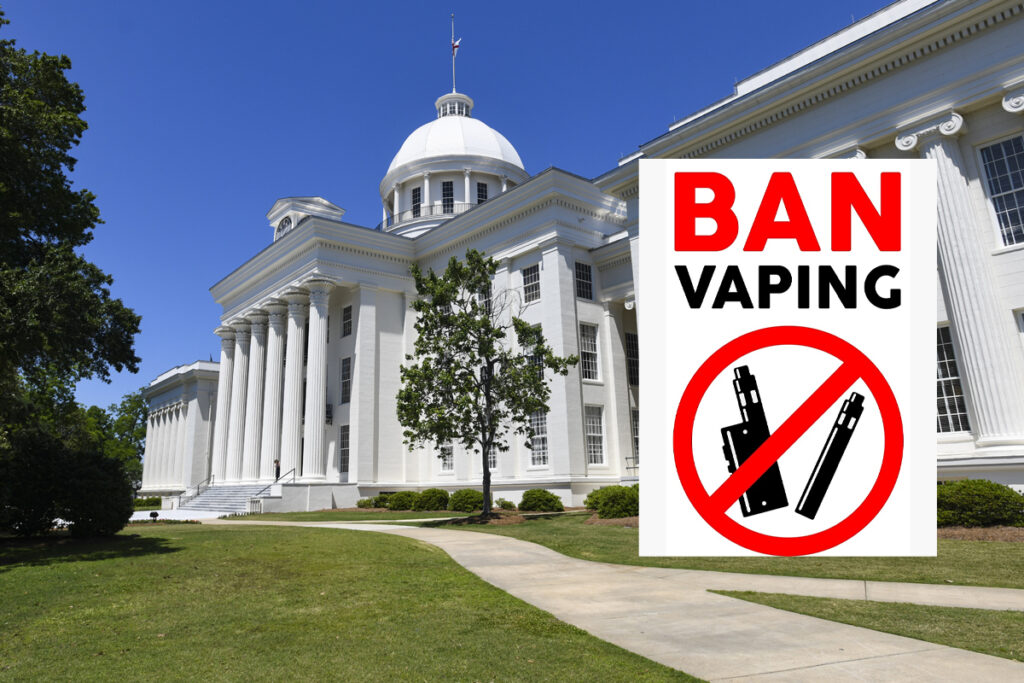
MONTGOMERY, AL – Alabama could soon extend its indoor smoking ban to encompass vaping under controversial new legislation reintroduced by State Senator Gerald Allen (R-Cottondale). If passed, Senate Bill _[Bill Number TBD – Verification Pending] would subject the use of e-cigarettes and other vaping devices in enclosed public spaces to the same restrictions and $25 fines as combustible cigarettes.
The Proposed Legislation: “Treating Vaping Like Smoking”
- Core Change: Sen. Allen’s bill explicitly adds “the use of an electronic nicotine delivery system” to the definition of “smoking” within the existing Alabama Clean Indoor Air Act of 2003. (Confirmed Text Source: Alabama Legislature)
- Scope: This would prohibit vaping in any of the numerous locations already smoke-free, including:
- Retail stores
- Restaurants and bars
- Government buildings
- Shopping malls
- Hospitals, nursing homes
- Airports
- Banks & financial institutions
- Penalty: Violators face a $25 fine per infraction, identical to the current penalty for unlawful smoking.
Déjà Vu: Second Attempt, Persistent Debate
This marks Senator Allen’s second push for such a ban; a near-identical bill failed to gain traction during the previous legislative session. Alabama history offers context: the state was among the last to ban public smoking over two decades ago, a move heavily influenced by the EPA’s classification of secondhand smoke as a Group A carcinogen in the 1990s.
The Science Question: Is Secondhand Vape Comparable?
The debate hinges critically on whether secondhand exposure from vaping warrants identical restrictions to traditional smoke. A pivotal study cited by the National Library of Medicine (Read Here: NLM Exposure Study) highlights a key distinction:
- Nicotine Exposure: The study confirms that vaping indoors “may expose nonusers to nicotine.”
- Absence of Combustion Toxins: Crucially, it found that bystanders are NOT exposed to the “toxic combustion products,” such as tar and carbon monoxide, present in traditional secondhand smoke.
- The Caveat & Call for Research: The study concludes that “more research is needed” to determine the potential health consequences of secondhand nicotine exposure, especially for vulnerable populations (children, pregnant women, cardiac patients). The long-term health risks of passive exposure to the aerosols produced by e-liquids remain incompletely characterized compared to the well-documented hazards of tobacco smoke.
Perspective: Industry & Advocacy Reaction (Anticipated)
“This legislation ignores critical scientific distinctions between smoke and vapor,” comments Michael (last name withheld), owner of a Tuscaloosa vape shop. “Treating them identically under the law sends a misleading message to smokers looking for less harmful alternatives and could push some back to cigarettes.” Public health advocates, however, argue for the precautionary principle. “Until we have definitive long-term safety data, protecting the public, especially in enclosed spaces, is paramount,” stated a representative from the Alabama Public Health Association in response to the bill’s filing.
The bill will now progress through committee reviews and legislative hearings. Its fate remains uncertain, echoing Alabama’s historically complex relationship with tobacco regulation. Industry groups like the Alabama Vape Association are expected to mobilize significant opposition, citing the lack of parity in risk assessment and potential negative impacts on harm reduction for adult smokers.
See our analysis of Alabama vape law Act 2025-403 for more context on state regulation.




Follow the wider vape market
Read the latest vape news
Track regulation, launches and industry updates.
Open vape news →Browse product data
Move from market news to device specifications.
Open product data →Check product reviews
Read independent testing and comparison reports.
Read review coverage →