

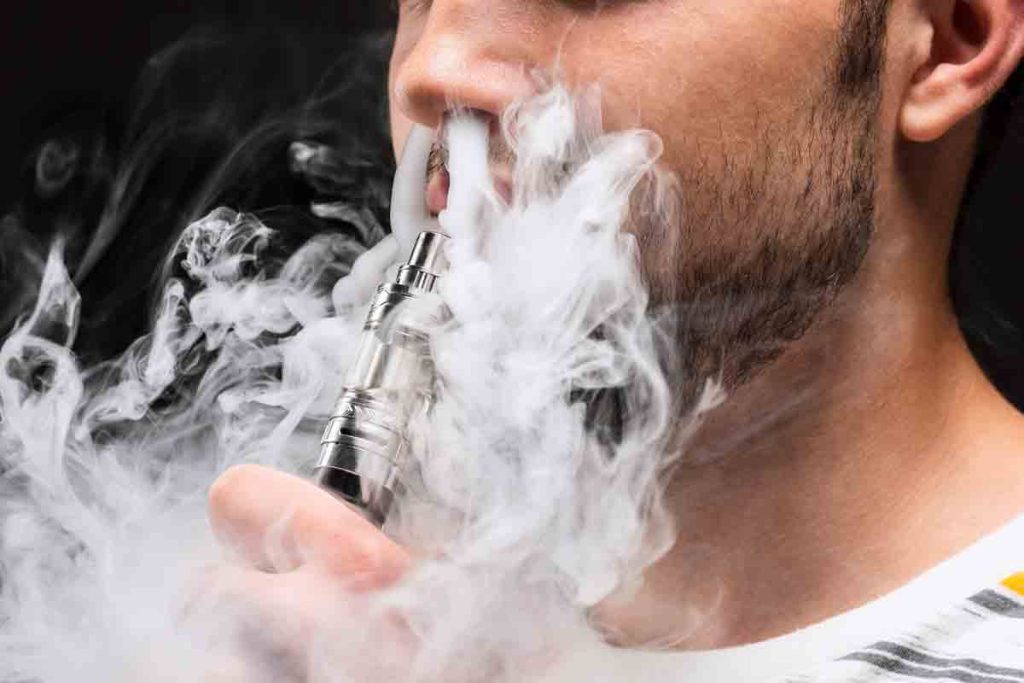
Quick Answer: No Tobacco Leaves, But a Regulatory Twist
Short answer: vapes do not contain tobacco. No tobacco leaves, no combustion, no tar, no ash. But there is a catch that most people miss, and it matters more than you might think.
The nicotine in most e-liquids is extracted from tobacco plants. That means while the physical tobacco leaf never ends up in your vape, the addictive substance it produces does. And since a 2022 federal law change, even vapes made with lab-synthesized nicotine (never touched a tobacco plant at all) are legally classified as “tobacco products” by the FDA. So the answer depends on whether you are asking about what is physically in the device, or how the government categorizes it.
This article breaks down both answers, with the research to back them up.
What Vapes Actually Contain
A vape heats a liquid into an aerosol that you inhale. That liquid typically has four ingredients, and none of them are tobacco:
- Propylene glycol (PG), a synthetic carrier liquid. It is in asthma inhalers, fog machines, and ice cream. Eating it is fine. Inhaling it heated is a different exposure route, and the long-term effects of repeated inhalation are still being studied.
- Vegetable glycerin (VG), a plant-derived thickener that produces visible aerosol. Same story as PG: safe for ingestion, less well characterized for chronic inhalation.
- Flavoring compounds : food-grade flavorings like diacetyl, cinnamaldehyde, and vanillin. Safe to eat. Not proven safe to heat to 200 degrees Celsius and breathe. Diacetyl, for example, is linked to bronchiolitis obliterans when inhaled occupationally.
- Nicotine (optional), either extracted from tobacco plants or synthesized in a lab. Concentrations range from 0% (nicotine-free) up to 5% (50 mg/mL in most disposables).
Notice what is not on that list: tobacco leaves, tobacco smoke, tar, carbon monoxide, or the roughly 7,000 chemicals identified in cigarette smoke by the CDC. For a full breakdown of what does show up in vape aerosol, see our chemicals in vapes guide.
Nicotine vs. Tobacco: Why the Distinction Matters
Here is where most of the confusion lives. Nicotine is a chemical compound. Tobacco is a plant. They are related but not the same thing.
Tobacco plants produce nicotine naturally as an alkaloid. When manufacturers make e-liquid, they extract that nicotine from tobacco leaves, purify it, and dissolve it in PG/VG. The final product contains nicotine molecules. It does not contain tobacco leaves, stems, or any other plant matter. Think of it this way: caffeine is extracted from coffee beans, but a caffeine pill is not a cup of coffee. The source and the product are different things.
This distinction has real health implications. Cigarette smoke contains at least 70 known carcinogens, including tobacco-specific nitrosamines (TSNAs) like NNK and NNN, which are formed during the curing and combustion of tobacco. A 2025 study in Frontiers in Oncology compared TSNA exposure between e-cigarette users and cigarette smokers and found lower levels in vapers. That is not because nicotine is harmless. It is because the dangerous compounds in cigarettes come from burning tobacco, not from nicotine itself.
Synthetic Nicotine: No Tobacco Plant Involved at All
Starting around 2020, some manufacturers began using synthetic nicotine, which is produced entirely in a laboratory through chemical synthesis. No tobacco plant is involved at any step. The nicotine molecule is chemically identical to the one extracted from tobacco, but its origin is different.
For a while, this created a regulatory loophole. If a vape contained synthetic nicotine rather than tobacco-derived nicotine, was it still a “tobacco product”? Manufacturers argued it was not. Congress disagreed.
On April 14, 2022, a federal law took effect that granted the FDA authority to regulate any product containing nicotine from any source, including synthetic nicotine. The FDA’s own statement was clear: products that are “similar except for the source of nicotine will be regulated as tobacco products.” So even if your vape has never been within a thousand miles of a tobacco farm, it is still legally a tobacco product in the United States.
For more on how nicotine content varies across devices, see our disposable vape nicotine guide.
What Vaping Removes (and What It Does Not)
What you avoid by not burning tobacco
| Compound | In Cigarette Smoke | In Vape Aerosol |
|---|---|---|
| Tar | Present (combustion byproduct) | Absent (no combustion) |
| Carbon monoxide | High levels | Negligible or absent |
| TSNAs (NNK, NNN) | Present (from tobacco curing) | Much lower levels |
| Heavy metals (lead, nickel) | Present (from tobacco + paper) | Possible (from heating coil) |
| Volatile organic compounds | High levels | Lower but present |
| Nicotine | Present | Present (unless 0%) |
The Office for Health Improvement and Disparities (formerly PHE) has consistently stated that vaping is less harmful than smoking, based on the absence of combustion and the resulting reduction in toxicant exposure. But “less harmful” and “safe” are not synonyms. Vaping still exposes your lungs to PG, VG, flavoring compounds, and potentially heavy metals from the heating coil. For the full picture, see our health risks guide.
What you still get
Even without tobacco combustion, vaping still delivers:
- Nicotine addiction, if the e-liquid contains nicotine (most do). A 5% disposable delivers roughly 50 mg/mL, which is a high dose. See our nicotine strength guide for context.
- Respiratory exposure to aerosolized chemicals, PG and VG are not inert when heated and inhaled. A 2024 Nature Scientific Reports study found that even PG/VG aerosol without nicotine or flavorings caused measurable inflammation and oxidative stress in lung cells.
- Flavoring compound risks, diacetyl, cinnamaldehyde, and other food-safe flavorings have not been proven safe for long-term inhalation. Eating vanilla extract is not the same as vaporizing it and breathing it.
The Regulatory Paradox: Tobacco-Free but Legally “Tobacco”
This is the part that confuses people the most, so it is worth spelling out clearly.
In 2016, the FDA’s “deeming rule” extended its authority to cover e-cigarettes, classifying them as tobacco products. At the time, most e-liquids used tobacco-derived nicotine, so the classification made logical sense: the nicotine came from tobacco, so the product was “tobacco-derived.”
Then synthetic nicotine came along. For a brief window, some manufacturers argued that their products, containing lab-made nicotine with zero connection to the tobacco plant, fell outside the FDA’s jurisdiction. Congress closed that loophole in March 2022 with an amendment to the Federal Food, Drug, and Cosmetic Act. The law now defines a tobacco product as any product made or derived from tobacco, or containing nicotine from any source, that is intended for human consumption. The key phrase: “from any source.”
So here is the paradox in plain language: a vape can be physically tobacco-free, chemically tobacco-free, and legally a “tobacco product” at the same time. The legal definition is about the presence of nicotine and the intended use, not the physical presence of tobacco leaves.
For state-level regulatory details, see our flavor restriction tracker.
FAQ: Do Vapes Have Tobacco?
Do vapes contain actual tobacco leaves?
No. Vapes heat a liquid (PG, VG, flavorings, and optionally nicotine) to produce an aerosol. There are no tobacco leaves in the device or the liquid. The nicotine used in most e-liquids is extracted from tobacco and purified, but the final product does not contain tobacco plant matter.
Is the nicotine in vapes the same as the nicotine in cigarettes?
Chemically, yes. Whether the nicotine was extracted from a tobacco plant or synthesized in a lab, the molecule is the same: C10H14N2. The difference is what comes with it. Cigarette smoke delivers nicotine alongside roughly 7,000 other chemicals, including 70 known carcinogens. Vape aerosol delivers nicotine with far fewer toxicants, though not zero.
What about synthetic nicotine? Is that still “tobacco”?
Physically and chemically, synthetic nicotine has no connection to the tobacco plant. But legally, since April 2022, the FDA regulates products containing nicotine from any source as tobacco products. A vape with synthetic nicotine is legally a “tobacco product” in the US, even though it contains no tobacco-derived ingredients.
Are nicotine-free vapes also classified as tobacco products?
Yes, under the FDA’s current framework. The agency defines e-cigarettes as tobacco products regardless of nicotine content, because the device category itself falls under the deeming rule. A 0% disposable is regulated the same way as a 5% one. For more on this, see our nicotine-free vaping guide.
Why do some people say vaping is 95% safer than smoking?
That figure comes from a 2015 Public Health England report, which estimated that vaping is around 95% less harmful than smoking. The number has been widely cited and widely criticized. The 2022 update from the same office (now OHID) maintained the conclusion that vaping is less harmful than smoking but was more cautious about quantifying the exact percentage, citing gaps in long-term evidence. The core point, that removing combustion removes the biggest source of harm, remains well supported.
Can you vape without any tobacco-derived ingredients at all?
Yes. A vape using synthetic nicotine, PG, VG, and synthetic flavorings contains zero tobacco-derived ingredients. It still carries the same respiratory exposure risks as any other vape (PG/VG aerosol, flavoring compounds, potential heavy metals from the coil). The absence of tobacco-derived ingredients removes combustion byproducts and TSNAs, but it does not make the product risk-free. See our smoke vs. vape comparison for the full breakdown.
Related Articles
- What Chemicals Are in Vapes? (full ingredient breakdown).
- How Much Nicotine Is in a Disposable Vape? (nicotine strength comparison).
- What Bad Things Can Happen When You Vape? (health risk overview).
- Is It Better to Smoke or Vape? (harm comparison).
- Nicotine-Free Vaping Guide, 0% options and their limitations.
- Flavor Restriction Tracker (state-level regulations).


How can vape contain tobacco